










































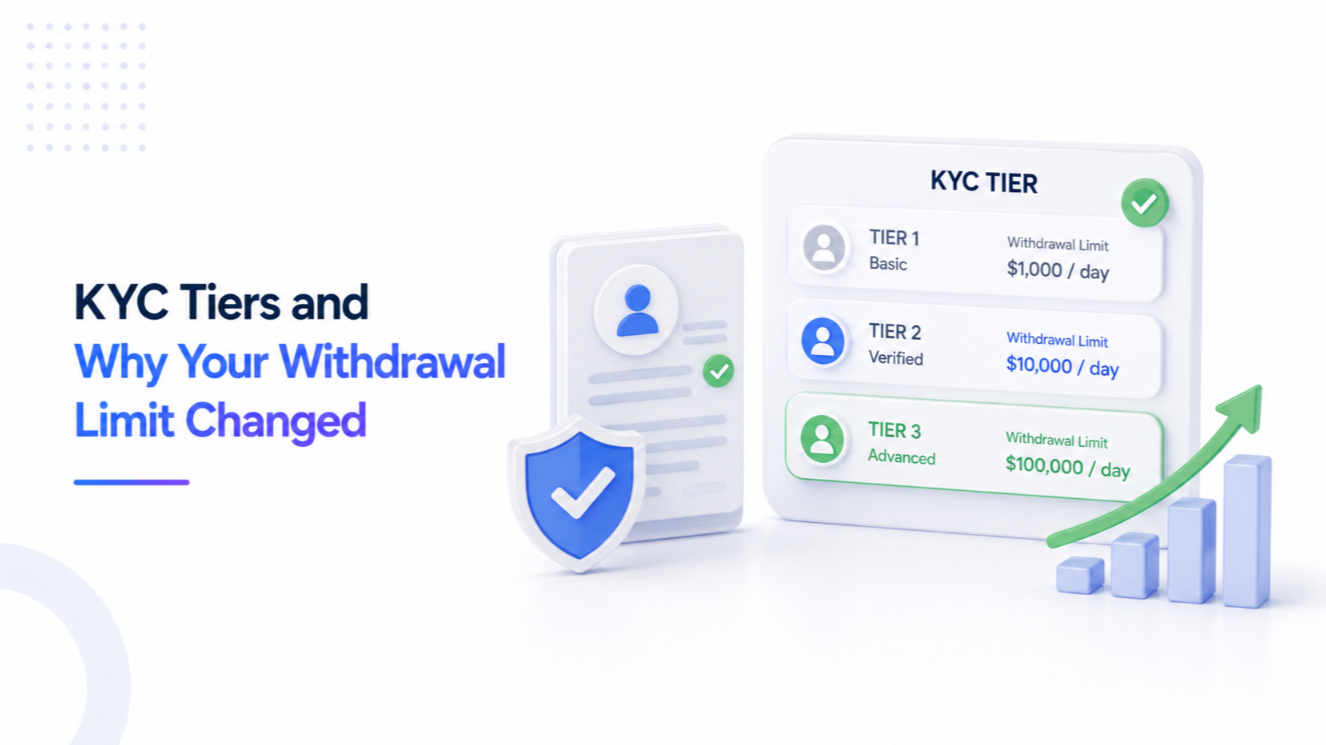
Exchanges apply tiered verification: an unverified or email-only level with minimal access, an identity-verified level covering most retail activity, and enhanced due diligence for higher limits requiring proof of address and source of funds. Limits change when jurisdiction rules shift, when a risk score updates, when documents expire, or when transaction patterns trigger review. Complete verification before you need it and keep documents current.
- 1The typical ladder. **Level zero — registered.** Email and password.
- 2Why a limit changes on an account that did nothing. Five common causes, and none of them generate an explanation.
- 3What verification actually gives the exchange. It is worth being clear about the exchange of value.
- 4Non-custodial and lighter-touch alternatives. Instant exchange services often allow small swaps with limited verification, escalating to full checks above thresholds or when screening flags a…
On this page5 sections
A verification tier is the exchange's answer to a regulatory question: how much do we know about this customer, and how much activity does that knowledge justify. The tiers are not fixed categories so much as a continuously updated risk assessment, which is why limits move without an announcement.
The typical ladder
Level zero — registered. Email and password. Usually enough to deposit crypto and look at the interface, rarely enough to withdraw or to trade meaningfully. Some venues no longer offer any functionality here at all.
Level one — identity verified. Government photo ID, a selfie or liveness check, name, date of birth and address. This is where most retail accounts sit and it unlocks ordinary trading, fiat deposits by bank transfer, and daily withdrawal limits typically in the tens of thousands.
Level two — enhanced. Proof of address, proof of source of funds or wealth, sometimes employment and tax residency. Required for higher limits, larger fiat movements, and in many jurisdictions for corporate accounts. This is where the friction is real: source-of-funds documentation means bank statements, payslips, or sale documents, and reviews take days.
Institutional. A separate process entirely, with corporate documents, beneficial ownership disclosure and named signatories.
Why a limit changes on an account that did nothing
Five common causes, and none of them generate an explanation.
Jurisdiction rules changed. A new licensing regime or a change in the exchange's local authorisation shifts what it may offer to residents of a country. This is also why an exchange can stop serving your country entirely, covered in regional availability.
Documents expired. ID with a lapsed expiry date drops the account a tier until it is replaced. This is the single most common cause and the easiest to prevent.
Risk scoring updated. Exchanges score accounts continuously on transaction patterns, counterparty exposure and screening data. A deposit from an address associated with a sanctioned entity or a mixing service can restrict an account whose owner did nothing wrong.
Pattern triggers. Sudden large volume, rapid deposit-and-withdraw cycles, or transactions inconsistent with a stated profile prompt review. The account is frequently restricted first and reviewed afterwards.
Periodic refresh. Regulated firms must re-verify customers on a cycle. Ignoring the request results in restriction on a schedule you cannot see.
What verification actually gives the exchange
It is worth being clear about the exchange of value. You provide identity documents, a biometric capture, address evidence and often source-of-funds records. In return you get access, higher limits and, in a regulated venue, whatever consumer protections the jurisdiction provides.
That data then sits with the exchange, is shared with its verification vendor, is reported to tax authorities under information-exchange frameworks, and persists after the account closes because retention periods are mandated. The Ledger breach demonstrated what a leaked customer list is worth to attackers; exchange KYC databases are larger and more sensitive.
This is a real cost, not a reason to avoid verification — it is a reason to prefer venues with a security record and a regulator, and to use a dedicated email address so a future breach is at least identifiable.
Non-custodial and lighter-touch alternatives
Instant exchange services often allow small swaps with limited verification, escalating to full checks above thresholds or when screening flags a transaction. The trade-off is worse rates, less recourse, and the possibility of funds being held mid-swap pending verification you did not expect to complete — which is the specific failure mode to understand before using one, and why the instant exchanger ratings weight the published verification policy heavily.
Decentralised exchanges do not verify identity because there is no account, but they also cannot convert to bank money, which is where verification requirements bind.
Practical handling
Complete the highest tier you might plausibly need before you need it. Verification takes days when queues are long and always seems to be required at the worst moment.
Keep documents current and update the address on file when you move. Use an email address you control permanently and secure it with a hardware key or passkey — the 2FA guide covers why SMS is not adequate here.
Expect that deposits from certain sources will trigger review, and think about where funds have been before sending them to a regulated venue. And keep your own transaction records rather than relying on the platform's, because an account under review is an account you cannot export from — a problem the exchange ratings treat as part of custody risk rather than a support issue.
Next step
Understood the mechanics? Keep going, or compare the services.
FAQ
Why did my exchange withdrawal limit drop?
What are the KYC levels on a crypto exchange?
Can I use an exchange without KYC?
What happens to my documents after I close an account?
Related guides
All guides →- Exchange Withdrawal Freezes: Why They Happen and What to DoFour different things get called a frozen withdrawal, and they need four different responses. The first job is working out which one you are in.Beginner8 min
- How to Revoke Token Approvals Before They Drain YouMost wallet losses are not stolen keys. They are approvals granted months ago to a contract that later turned hostile — and revoking them takes about a minute.Beginner7 min
- Exchange Insurance Funds vs Real InsuranceTwo completely different things share the word insurance, and neither means what customers assume when an exchange fails.Beginner7 min
- Perpetual Futures Explained: How Crypto Derivatives WorkPerpetual futures now trade several multiples of spot crypto volume most days. Understanding how perps and funding rates actually work is the difference between using leverage deliberately and being liquidated by it.Intermediate12 min