What Is MEV? How Bots Extract Value from Blockchain Transactions
An inside look at maximal extractable value: how searchers, builders and validators profit from transaction ordering, and who ultimately pays for it.
Selin AydinSecurity Editor · Crypto security, custody, exploits and smart-contract riskUpdated 29 June 2026
The short answer
MEV is the profit available from choosing which transactions enter a block and in what order, on top of the block reward. It is not a bug but a consequence of public transaction ordering. Arbitrage and liquidations are largely benign; sandwiching a pending swap is a direct transfer away from the trader, and ordinary users pay for it through worse fill prices.
MEV, short for maximal extractable value, is the profit that can be earned by choosing which transactions get included in a block and in what order, on top of the standard block reward. It's not a bug in Ethereum or any other smart contract chain, it's a direct consequence of transactions being public before they're final, and every major chain with a public mempool has some version of it. Estimates put MEV extraction on Ethereum alone at hundreds of millions of dollars a year, most of it invisible to the retail traders paying for it.
What Is MEV, Really?
The term dates back to a 2019 paper on "miner extractable value," describing the fact that whoever produces a block has enormous discretion over transaction ordering, and that discretion has a price. After Ethereum's move to proof-of-stake, the "miner" in MEV became "maximal," reflecting that validators, not just miners, are the ones with this power now, alongside a whole industry of specialized actors competing to capture it before a validator ever sees the block.
The Mempool: Where MEV Begins
Before a transaction is confirmed, it sits in the mempool, a public waiting room visible to anyone running a node. This is the hunting ground for MEV. Bots, known as searchers, continuously scan pending transactions looking for ones that will move a price, trigger a liquidation, or otherwise create an exploitable opportunity the instant they land on-chain. Because the mempool is public, a searcher can see a profitable trade coming before it happens and construct their own transaction to profit from it, provided they can get it ordered correctly relative to the original.
Common MEV Strategies
Arbitrage
The most benign form of MEV is cross-exchange arbitrage: if ETH trades at a slightly different price on two decentralized exchanges in the same block, a searcher bot buys low on one and sells high on the other, pocketing the spread and, in the process, actually pushing prices back into alignment. This kind of MEV is generally considered value-neutral or even value-positive for the market, since it improves price efficiency across venues that would otherwise drift apart.
Liquidations
On lending protocols, MEV searchers race to be the first to liquidate undercollateralized positions the moment they become eligible, capturing the liquidation discount described in most lending protocol designs. This is also broadly considered a healthy form of MEV: someone needs to do this job, and competition among bots keeps the fee for doing it close to the minimum necessary to make it worthwhile.
Sandwiching
The extractive end of the spectrum is sandwiching, where a bot spots a large pending swap, places a buy order immediately ahead of it to push the price up, lets the victim's trade execute at the worse price, then sells immediately after to capture the difference. Unlike arbitrage or liquidations, sandwiching creates no efficiency benefit for anyone; it's a direct transfer from an ordinary trader's pocket into a bot's, and it's common enough on unprotected swaps that it deserves its own detailed breakdown separately.
Who Actually Captures MEV
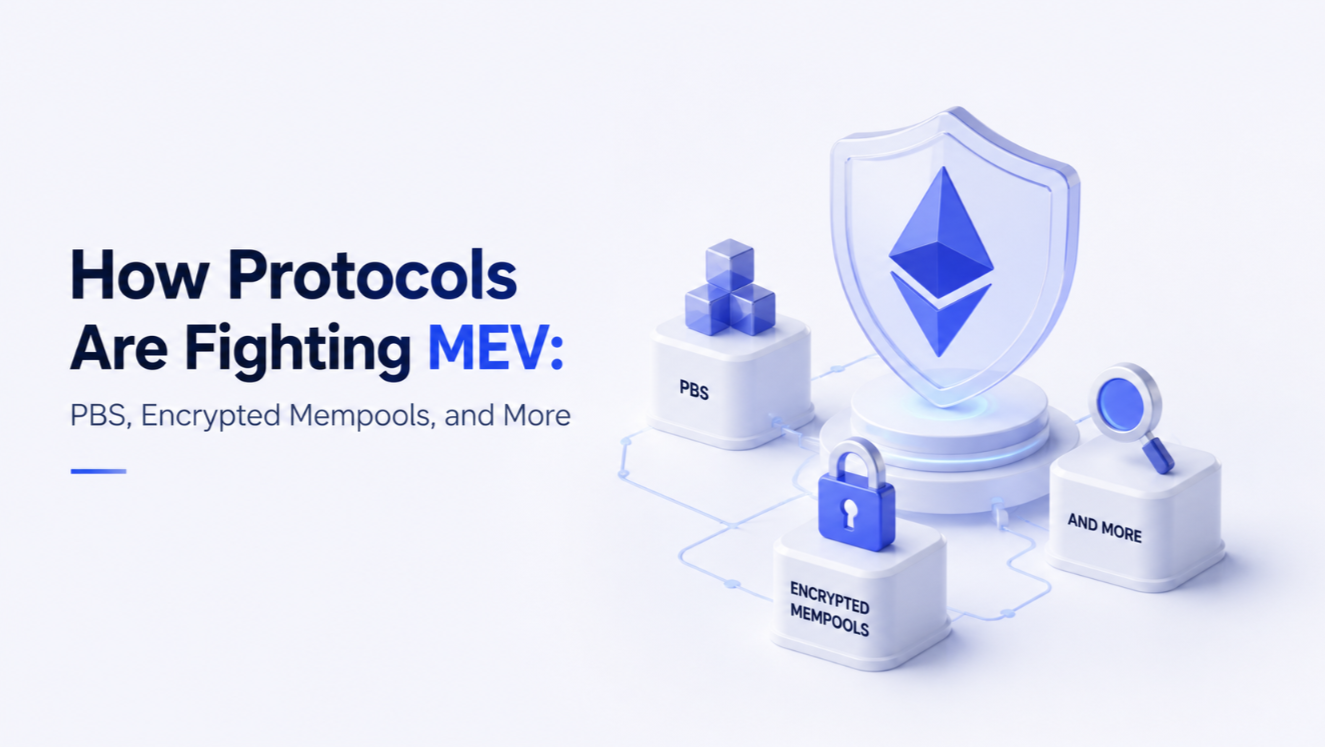
In today's Ethereum, MEV doesn't flow to validators directly in most cases. It flows through a layered market: searchers bundle their profitable transactions and bid for inclusion, builders assemble full blocks from these bundles to maximize total value, and validators simply auction off the right to propose the next block to whichever builder offers the highest payment. This is proposer-builder separation, and it means the validator earning the MEV payment often has no idea what strategies produced it, they're just selling blockspace to the highest bidder.
MEV-Boost, PBS and the Auction for Blockspace
MEV-Boost, the software most Ethereum validators run, plugs them into this builder marketplace and is now used by the overwhelming majority of validators because it reliably pays more than building blocks themselves. It's efficient, but it's also created real centralization pressure: a handful of sophisticated builders dominate block construction because scale gives them better bundle flow and pricing, which concentrates influence over transaction ordering in fewer hands than the protocol's original design intended.
Is MEV a Problem, or Just a Tax?
The honest answer is both, depending on which flavour you're looking at. Arbitrage and liquidation MEV are closer to a market-clearing service that happens to be profitable. Sandwiching and other purely extractive forms are closer to a tax on anyone who trades without protection, quietly deducted from execution price rather than shown on a receipt. The direction of travel, through private order flow, encrypted mempools and MEV-aware routing in wallets and aggregators, is toward shrinking the extractive share while leaving the efficiency-improving share largely intact, but that shift is nowhere near complete, and until it is, assume every unprotected on-chain swap is being watched by something faster than you.
FAQ
What is MEV?+
Maximal extractable value: profit available from including, excluding or reordering transactions in a block, beyond the ordinary block reward and fees.
What is the mempool?+
The public waiting area for transactions that have been broadcast but not yet included in a block. It is where searchers see pending trades and decide what to act on.
What are the main MEV strategies?+
Arbitrage between venues, liquidating undercollateralised loans, and sandwiching a pending swap by buying ahead of it and selling into the resulting move.
Who ultimately pays for MEV?+
Ordinary users, mostly through worse fill prices on swaps. Arbitrage and liquidation MEV are largely benign; sandwiching is a direct transfer away from the trader.
 Selin AydinSecurity Editor · Crypto security, custody, exploits and smart-contract risk