What Is Restaking? How EigenLayer and Shared Security Work
Restaking lets the same staked ETH secure a dozen other systems at once, turning idle collateral into rented security. Here's the actual mechanics behind EigenLayer and the shared-security model it popularised.
Selin AydinSecurity Editor · Crypto security, custody, exploits and smart-contract riskUpdated 16 June 2026
The short answer
Restaking lets already-staked ETH secure additional services, so the same capital earns from more than one source. Operators opt into actively validated services, each defining its own conditions for penalising them. The extra yield is payment for accepting slashing rules written by newer teams, and a large share of it has been paid in points or protocol tokens rather than realised revenue.
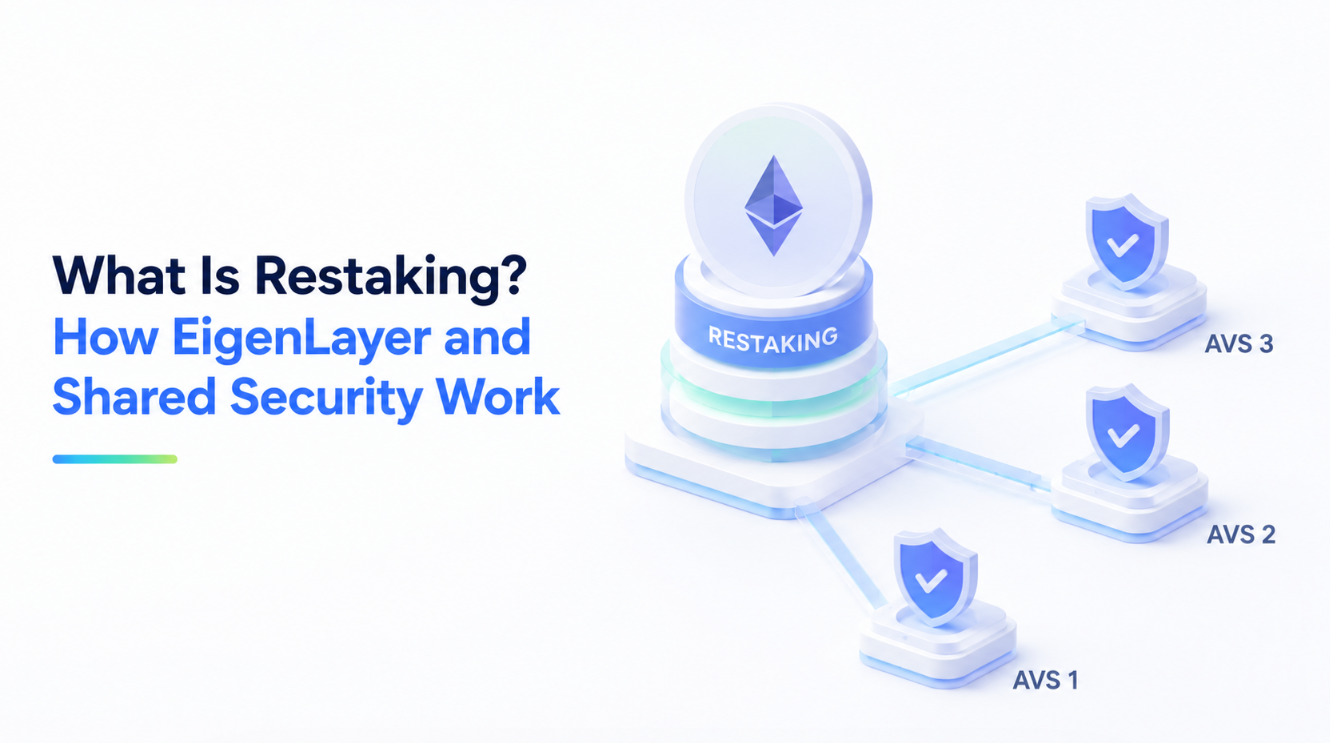
Restaking starts from a simple observation about Ethereum's security budget: the ETH locked up to secure the base chain is doing exactly one job, and doing it with room to spare. A validator's stake is collateral against misbehaviour — the network can slash it if the validator equivocates or goes offline for long stretches — but that same economic guarantee, the threat of losing real money for acting dishonestly, is a thing plenty of other systems would happily pay to borrow. Restaking is the mechanism that lets them. It takes ETH that's already staked, or a liquid token that represents it, and extends the same slashing-backed commitment to secure additional infrastructure, without unstaking the original position. EigenLayer built the protocol that made this a mainstream primitive rather than a theoretical idea, and understanding how it actually works means separating three things that get blurred together in most explainers: what's being restaked, who's providing the service being secured, and what happens when something goes wrong.
The problem restaking is solving
Ethereum's validator set secures the base chain and nothing else by design — that narrow scope is deliberate, because bolting extra responsibilities onto core consensus would bloat the protocol and introduce new failure modes into something that has to stay boring and reliable. But the ecosystem around Ethereum is full of systems that need their own security guarantees and don't have Ethereum's decade of battle-testing to lean on: oracle networks, bridges, data availability layers, and new virtual machines all need someone to bond capital and get punished for cheating. Historically, each of these launched its own token, ran its own validator set, and asked a fresh group of stakers to bootstrap trust from zero — a slow, capital-intensive, and often thin process, since a young network's security is only as strong as the market cap of a token nobody has priced yet. Restaking reframes the question: instead of bootstrapping new security from nothing, why not rent security that already has tens of billions of dollars and years of proven economic weight behind it?
How EigenLayer actually works, mechanically
EigenLayer is a set of smart contracts on Ethereum that let stakers opt in to extending their slashing conditions to additional services, which EigenLayer calls Actively Validated Services, or AVSs. There are two entry points. Native restaking lets an existing Ethereum validator point its withdrawal credentials at EigenLayer's contracts, effectively telling the protocol it's willing to accept extra slashing conditions on top of the ones it already carries for Ethereum consensus. Liquid restaking, the more common route for anyone who isn't already running validator infrastructure, involves depositing a liquid staking token — stETH, rETH, and similar — into EigenLayer's contracts, which then issues a liquid restaked token representing that deposit. From there, node operators — not necessarily the depositors themselves — opt in to run the software for specific AVSs, and the restaked capital backing those operators becomes the economic security for whatever that AVS does. If an operator misbehaves according to an AVS's rules, a portion of the restaked capital behind that operator can be slashed, on top of whatever Ethereum-level slashing already applies.
What AVSs actually are
An AVS is any service that needs a decentralised set of operators doing something verifiable, backed by economic stake, without wanting to bootstrap its own token and validator set to get there. In practice this has meant oracle networks that need operators to report data honestly, bridges that need attestors to sign off on cross-chain messages correctly, and data availability layers that need someone to actually store and serve the data they claim to be making available. EigenDA, EigenLayer's own data availability product, was the flagship example at launch, but the broader pitch was always that any team building this kind of infrastructure could plug into restaked Ethereum security rather than spend a year and a fortune convincing a fresh set of stakers that a brand-new token is worth bonding against.
It's worth being precise about who is making which decision, because restaking involves at least two separate parties with separate incentives. The staker who deposits capital is typically delegating to a node operator and, depending on the design, may or may not choose which specific AVSs that operator secures — some liquid restaking protocols bundle a basket of AVSs and let the staker opt in passively, while others expose more granular choice. The node operator is the one actually running the software, deciding which AVSs to support, and bearing the operational burden of not getting slashed across all of them simultaneously. This division matters because a staker chasing restaking yield is, in effect, trusting an operator's judgement about which AVSs are worth the added slashing surface, and that judgement varies enormously between operators.
The yield, and why it isn't free
The appeal for stakers is additive yield: on top of ordinary Ethereum staking rewards, restaked capital earns whatever fees or token incentives the AVSs it secures choose to pay for that security. Early AVSs leaned heavily on token incentives to attract restaked capital fast, which produced eye-catching headline yields that were, in substance, subsidised by token emissions rather than organic fee revenue — a pattern anyone who lived through DeFi's liquidity-mining era will recognise immediately. That's not a criticism unique to restaking; it's how most new crypto infrastructure bootstraps usage. But it does mean the sustainable, long-run yield from restaking is whatever AVSs are actually willing to pay out of real revenue once the incentive programmes taper off, and that number is still being discovered rather than settled.
Liquid restaking tokens and the layer this creates
Liquid restaking tokens exist for the same reason liquid staking tokens do: locking capital away for an uncertain duration is a real cost, and a tradeable receipt token lets that capital keep working elsewhere in DeFi — as collateral, as a trading pair, as a building block in other yield strategies — while the underlying stake keeps earning restaking rewards. This is convenient and also where a meaningful amount of restaking's structural risk actually accumulates, because it stacks a second layer of smart-contract and market risk — the liquid restaking protocol's own contracts, plus whatever the token gets used as collateral for elsewhere — directly on top of the restaking mechanism itself. A liquid restaked token trading at a discount to its underlying value during stress isn't a hypothetical; it's the exact pattern liquid staking tokens have already shown during periods of network congestion or validator uncertainty.
It's worth placing restaking in context rather than treating it as something unprecedented. Cosmos's interchain security, which lets the Cosmos Hub's validator set secure additional consumer chains, is solving essentially the same problem — reusing an established validator set's economic weight rather than bootstrapping a new one — through a different mechanism native to that ecosystem. Polkadot's shared security model, where parachains lease security from the Relay Chain, is another variant of the same underlying idea. What EigenLayer did differently was build shared security as a permissionless, opt-in layer on top of Ethereum specifically, using smart contracts rather than a purpose-built base-layer protocol, which is part of why it was able to move quickly and attract capital fast — and also part of why its risk profile is shaped more by smart-contract design than by protocol-level consensus rules.
What restaking changes about Ethereum's role
The bigger structural shift is what restaking implies about Ethereum's position in the wider ecosystem. Rather than Ethereum simply being a settlement layer that other chains bridge to, restaking positions it as something closer to a security wholesaler — a base of economic trust that other infrastructure can rent by the AVS, denominated in the same asset and backed by the same slashing logic that secures the base chain itself. Whether that's a durable improvement in how crypto infrastructure gets bootstrapped, or a clever repackaging of existing risk into new products, is genuinely still an open question — and one that depends heavily on how the risks covered separately below play out as restaking scales into the tens of billions of dollars it's already approaching.
FAQ
What is restaking?+
Committing already-staked ETH to secure additional services, so the same capital earns from more than one source and answers to more than one set of rules.
What is an AVS?+
An actively validated service — a protocol that buys security from restakers instead of bootstrapping its own validator set, and defines its own conditions for penalising them.
Where does restaking yield come from?+
Fees paid by services for security, plus in practice a large share paid in points or protocol tokens rather than realised revenue. The composition matters more than the headline rate.
What is a liquid restaking token?+
A transferable token representing a restaked position, which adds a further contract layer, an operator selection you did not make, and a market price that can trade below the underlying.
 Selin AydinSecurity Editor · Crypto security, custody, exploits and smart-contract risk