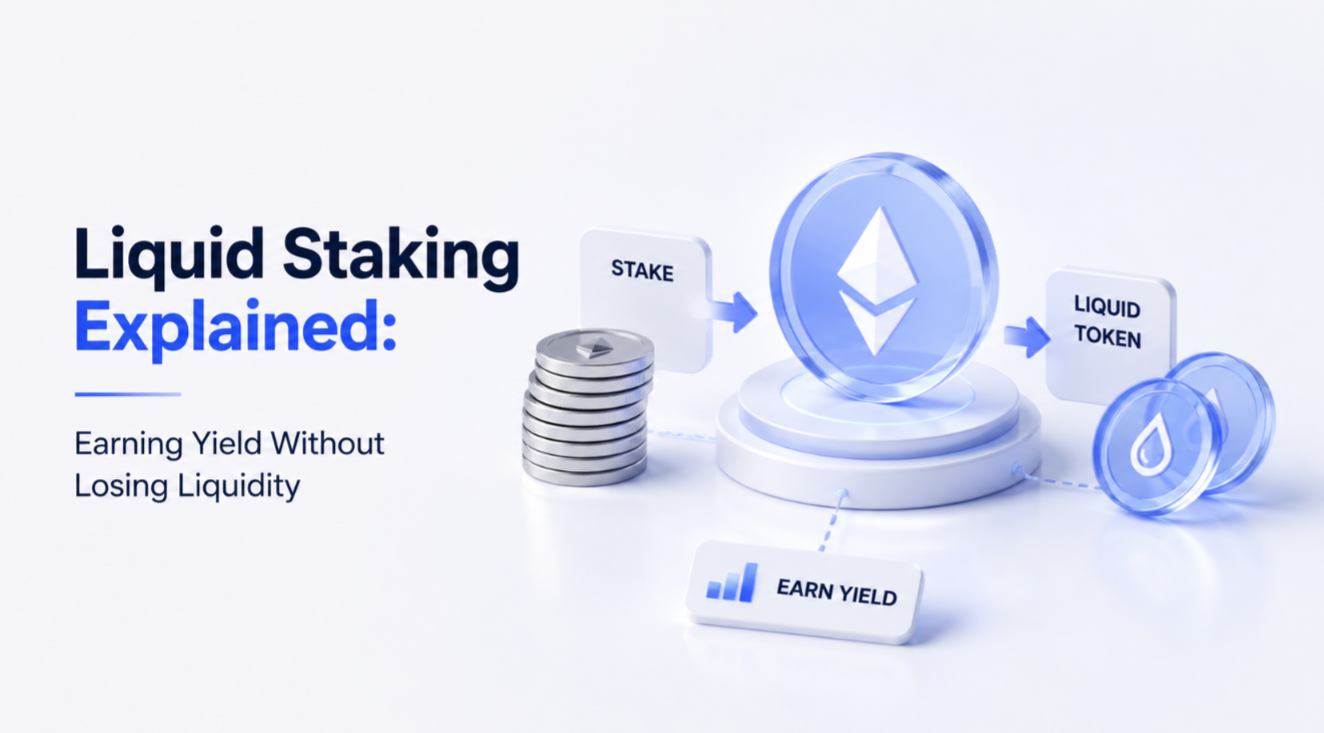
Liquid Staking Explained: Earning Yield Without Losing Liquidity
How liquid staking tokens let holders earn network rewards while keeping their capital free to lend, trade, or post as collateral.
Dario FennDeFi & Markets Lead · DeFi protocols, yield, market structure and on-chain dataUpdated 4 July 2026
The short answer
Liquid staking issues a transferable token representing your staked position plus accrued rewards, so the capital keeps earning while remaining usable elsewhere. The token's exchange rate is set by the protocol from the underlying balance, but its market price depends on liquidity and how quickly redemption is possible — which is why it can trade below the underlying when exit queues lengthen.
Liquid staking solves a problem that used to force stakers into an uncomfortable trade-off: earn network rewards by locking up your assets, or keep your assets liquid and earn nothing from staking at all. Since Ethereum's move to proof of stake, liquid staking has grown into one of the largest categories in the entire on-chain economy, and understanding how the mechanism actually works matters whether you're a validator, a depositor, or simply trying to understand why a token like stETH trades at a small but persistent discount to ETH.
The Problem Liquid Staking Solves
Native staking on a proof-of-stake network requires locking your tokens with a validator, who performs the work of proposing and attesting to blocks in exchange for freshly issued rewards. That's straightforward in principle, but it comes with real costs: a minimum deposit that's often out of reach for individual holders (32 ETH, in Ethereum's case, to run a solo validator), technical overhead in keeping a validator client online and correctly configured, and an exit queue that can take days or weeks during periods of high withdrawal demand. Locked capital also can't be used anywhere else. It can't be posted as collateral for a loan, supplied to a lending market, or paired in a liquidity pool. Staking yield and DeFi yield used to be mutually exclusive.
How the Mechanism Works
Liquid staking protocols break that trade-off by pooling deposits from many users, running the validator infrastructure on their behalf, and issuing a liquid staking token (LST) that represents a claim on the underlying staked position plus accrued rewards. Deposit 1 ETH with a liquid staking provider and you receive a receipt token in return, spendable, tradeable, and usable as collateral, while the underlying ETH is staked and earning consensus-layer rewards in the background. The protocol handles validator selection, key management, and slashing insurance so individual depositors don't need 32 ETH or any technical setup at all.
Rebasing vs Wrapped Tokens
LSTs generally take one of two forms. Rebasing tokens, the model Lido's stETH popularised, increase the holder's token balance directly as rewards accrue, so 1 stETH slowly becomes 1.0004 stETH and so on. Wrapped, non-rebasing tokens instead keep the token count fixed while the exchange rate against the underlying asset rises, so 1 wstETH stays 1 wstETH but is redeemable for an increasing amount of ETH over time. The non-rebasing format tends to integrate more cleanly with DeFi protocols, since many smart contracts assume balances don't change outside of explicit transfers, which is why wrapped variants have become the default building block for lending markets and structured products.
Where the Yield Actually Comes From
The base layer of return is consensus rewards, paid by the protocol for validating the chain honestly, plus a share of priority fees and MEV captured by the validator set. This is the same yield a solo validator would earn, typically in the mid-single-digit percentage range on Ethereum, minus a protocol fee (commonly around 10%) taken by the liquid staking provider for running the infrastructure. On top of that base layer, LST holders can stack additional yield by deploying their token into DeFi: supplying it to a lending market to earn interest, pairing it in a liquidity pool to earn trading fees, or using it as collateral to borrow against and redeploy elsewhere. This layering is what makes liquid staking meaningfully more capital-efficient than native staking, and it's also what makes it riskier, since each additional layer introduces a new smart contract that can fail.
The Peg Question
LSTs are designed to be redeemable 1:1 (adjusted for the exchange rate) for the underlying staked asset, but that redemption typically runs through a withdrawal queue rather than instantly, which means the secondary market price of an LST can and does deviate from its underlying value. During periods of stress, such as a large single holder needing to exit quickly, LSTs have traded at discounts of several percentage points to the underlying asset on the open market, even though the redemption mechanism itself remained fully solvent. That discount is a liquidity premium, not a solvency signal, but it catches out holders who assume the peg is as tight as a fully-backed stablecoin.
Concentration Risk Is a Real Concern
Because liquid staking protocols pool deposits and delegate to validator sets, market share concentration has become a genuine systemic question for networks like Ethereum. When one provider controls a large share of all staked capital, it also controls a large share of block proposal rights, raising questions about censorship resistance and single points of failure that go beyond any individual depositor's risk. Several major protocols have responded by diversifying their validator sets across many independent node operators, but the underlying concentration in market share, as opposed to node operator diversity, remains a live discussion in governance forums.
Practical Risks to Weigh
Smart contract risk sits at the top of the list: an LST is only as safe as the code minting and redeeming it, and audits reduce but don't eliminate this risk. Slashing risk is passed through to depositors in most designs, meaning a validator penalty for downtime or misbehaviour reduces the value backing every LST holder's claim proportionally, even though individual depositors have no control over validator operations. Depeg risk during stress events can matter a great deal if you need to exit through the open market rather than the native redemption queue. And regulatory risk is not hypothetical: staking-as-a-service has already drawn scrutiny from securities regulators in multiple jurisdictions, and the legal treatment of LSTs is still being worked out market by market.
Getting Started Sensibly
If you're evaluating a liquid staking provider, check three things before depositing: how validator operators are selected and how many independent operators are running the pooled stake, what the protocol fee is and how it compares to peers, and how deep the secondary market liquidity is for the LST on the chains you intend to use it on. A large, liquid LST with a diversified validator set and transparent fee structure is a fundamentally different risk profile from a small, single-operator staking pool offering a marginally higher headline yield.
The Bigger Picture
Liquid staking has effectively become the base collateral layer of on-chain finance on proof-of-stake networks, the way government bonds function as collateral in traditional finance. That's a meaningful evolution: it turns staking from an isolated yield product into productive collateral that underpins lending markets, stablecoins, and structured yield products across the ecosystem. It also means that problems in liquid staking, whether a depeg, a slashing event, or a smart contract exploit, no longer stay contained to stakers. They ripple through everything built on top.
FAQ
What is liquid staking?+
Staking through a protocol that issues a transferable token representing your staked position plus accrued rewards, so the capital stays usable while it earns.
Is a liquid staking token pegged to the underlying asset?+
No. Its exchange rate is set by the protocol from the staked balance, while its market price depends on liquidity and how quickly redemption is possible.
Why would a liquid staking token trade below the asset?+
Because the arbitrage that closes the gap takes as long as the exit queue takes. Heavy exit demand lengthens the queue and widens the discount.
What are the risks of liquid staking?+
Contract risk in the staking protocol, validator slashing reducing the underlying balance, operator concentration, and the market discount if you need to exit before redemption completes.
 Dario FennDeFi & Markets Lead · DeFi protocols, yield, market structure and on-chain data