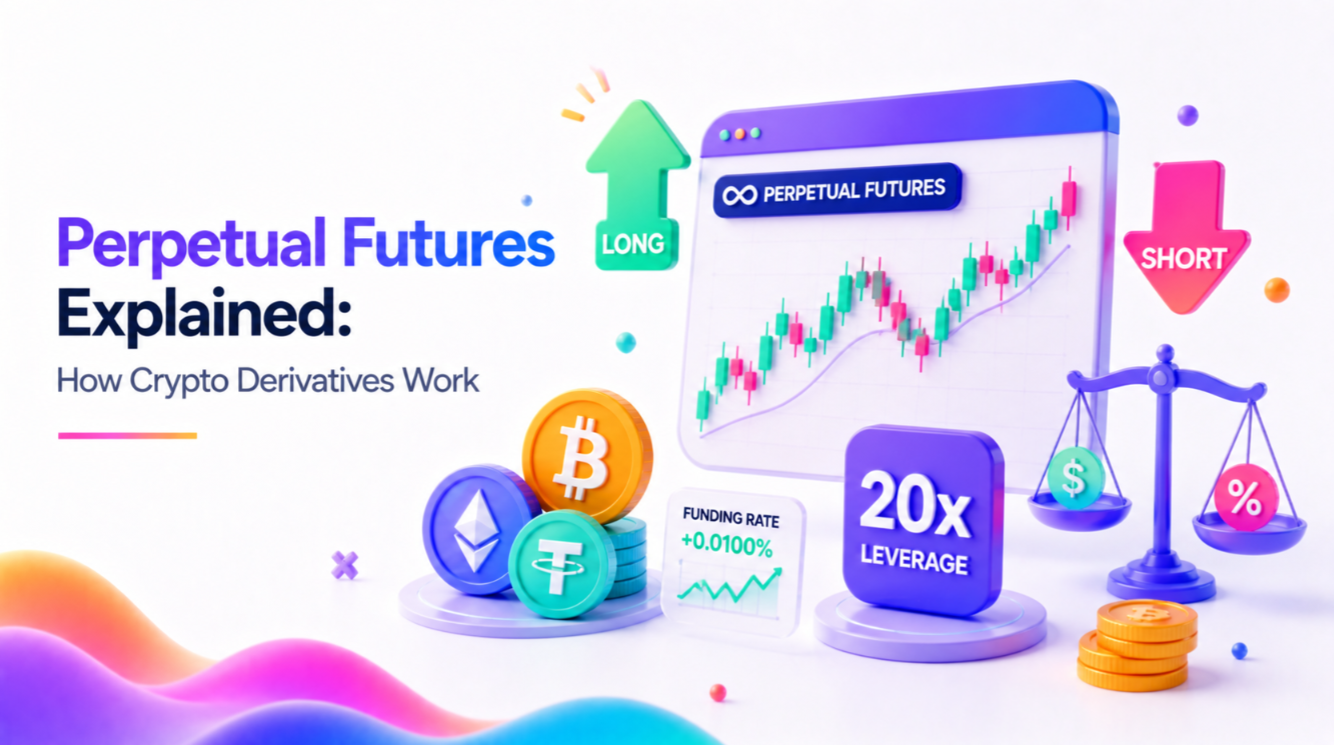
Perpetual Futures Explained: How Crypto Derivatives Work
Perpetual futures now trade several multiples of spot crypto volume most days. Understanding how perps and funding rates actually work is the difference between using leverage deliberately and being liquidated by it.
Dario FennDeFi & Markets Lead · DeFi protocols, yield, market structure and on-chain dataUpdated 8 August 2026
The short answer
A perpetual future tracks an asset's price with no expiry date. Because nothing forces convergence, exchanges use a funding payment between longs and shorts to keep the contract near spot: when it trades above the index longs pay shorts, and below it the reverse. Leverage sets how far price must move before the position is closed by the exchange rather than by you.
Traditional futures contracts expire. You agree today on a price for delivering an asset next month, the contract settles on a fixed date, and then it's gone. Crypto derivatives found this inconvenient almost immediately, because crypto trades continuously and traders wanted continuous exposure without having to roll a position from one expiring contract into the next every few weeks. The solution, first popularised by BitMEX in 2016 and now the dominant instrument in the entire crypto market by volume, was the perpetual future — a futures contract with no expiry date at all. Perpetual futures explained simply: it's a bet on price that never has to be closed, held together by a mechanism most spot traders never bother to learn until it costs them money.
The problem a perpetual has to solve
A contract with no expiry date has an obvious design flaw: what stops its price from drifting away from the actual spot price of the underlying asset indefinitely? A normal futures contract is tethered to reality by its expiry — however far the futures price wanders from spot, the two are guaranteed to converge on settlement day, because at that point the contract simply becomes the asset. A perpetual never settles, so it needs a different tether. That tether is the funding rate, and it's the single most important mechanical detail anyone trading perps needs to understand before opening a position, because it's the mechanism that will quietly cost — or pay — you money for every hour a leveraged position stays open.
How funding rates actually work
The funding rate is a periodic payment, typically every one or eight hours depending on the exchange, exchanged directly between traders holding long positions and traders holding short positions — not a fee paid to the exchange. When the perpetual's price trades above the spot price, meaning more traders want to be long than short, longs pay shorts. When it trades below spot, shorts pay longs. The size of the payment scales with how far the perpetual has drifted from spot and how much leverage a position carries. This creates a constant financial pressure pulling the perpetual's price back towards spot: if perps trade at a persistent premium, the cost of staying long eventually gets expensive enough that some longs close out or new shorts open to collect the payment, and the premium compresses. It's an elegant piece of market design, and also the reason a position can lose money on funding alone even while sitting exactly flat on price.
What a positive or negative funding rate actually tells you
Sustained positive funding, where longs are paying shorts, generally signals that the market is aggressively bullish — enough traders want long exposure that they're willing to pay for the privilege, which during strong uptrends can run to double-digit annualised percentages on some venues. Sustained negative funding signals the opposite: the market is leaning bearish enough that shorts are paying to stay short. Extreme readings in either direction are one of the more reliable crowd-positioning signals available in crypto, because they represent real money being paid, not just sentiment surveys — a funding rate stuck at an annualised 50%+ is a market that's leveraged long to an extent that tends to precede sharp, cascading unwinds when the trade gets crowded and a spot pullback triggers a wave of liquidations.
Leverage, margin, and why liquidations happen
Perpetuals let traders control a position far larger than the capital they've posted, using leverage — commonly anywhere from 2x up to 100x or more depending on the exchange and asset, though anything above 10-20x on a volatile asset is a genuinely aggressive stance rather than a routine one. The capital posted is margin, and exchanges track a liquidation price: the level at which losses have eaten through enough of that margin that the position gets forcibly closed to prevent it going negative. At 10x leverage, roughly a 10% adverse move wipes out the position; at 50x, it takes barely 2%. This is why perpetuals amplify not just gains but the ordinary noise of crypto's daily volatility into full account wipeouts, and why liquidation cascades — one large forced sell triggering the next trader's liquidation price, triggering the next — are a recurring feature of sharp crypto sell-offs rather than a rare event.
Isolated versus cross margin, and why the distinction matters
Most exchanges let a trader choose between isolated margin, where only the capital allocated to that specific position is at risk of liquidation, and cross margin, where the entire account balance backs every open position. Isolated margin caps the downside of any one trade to what was explicitly staked on it — lose the position, lose that specific margin, account otherwise untouched. Cross margin can absorb a temporary adverse move using the rest of the account's balance, reducing the odds of getting liquidated by ordinary volatility, but it also means one badly timed position can, in the worst case, drag down capital that was meant to be backing something else entirely. Traders new to perps consistently underestimate how much this single setting changes their actual risk profile.
Reading the basis and using perps sensibly
The gap between a perpetual's price and spot — the basis — combined with the funding rate, gives a genuine read on market positioning that spot charts alone don't show. A trader who wants leveraged directional exposure without predicting an expiry date uses perps for exactly the reason they were invented. A trader running a basis trade might go long spot and short an equivalent perp position, pocketing positive funding payments as close to market-neutral yield, a strategy that quietly underpins a meaningful share of institutional crypto trading activity. Either use case demands understanding funding as a real, recurring cash flow rather than fine print — the traders who treat perpetual futures as simple leveraged spot bets, ignoring the funding rate ticking against them every few hours, are the ones who discover the difference the hard way, usually during the exact market conditions when they can least afford the surprise.
FAQ
What is a perpetual future?+
A derivative that tracks an asset's price with no expiry date, kept near spot by a periodic funding payment between long and short holders instead of by settlement.
How do funding rates work?+
At each interval, whichever side is crowded pays the other. When the perpetual trades above the index longs pay shorts, and when it trades below shorts pay longs, proportional to position size.
What is the difference between isolated and cross margin?+
Isolated margin caps the loss to the margin assigned to that position. Cross margin defends the position with the whole account balance, which is safer for the trade and more dangerous for everything else.
Why was I liquidated?+
Margin fell below the maintenance requirement, so the exchange closed the position. Leverage sets how far the price must move before that happens — at high leverage that distance is inside ordinary noise.
 Dario FennDeFi & Markets Lead · DeFi protocols, yield, market structure and on-chain data