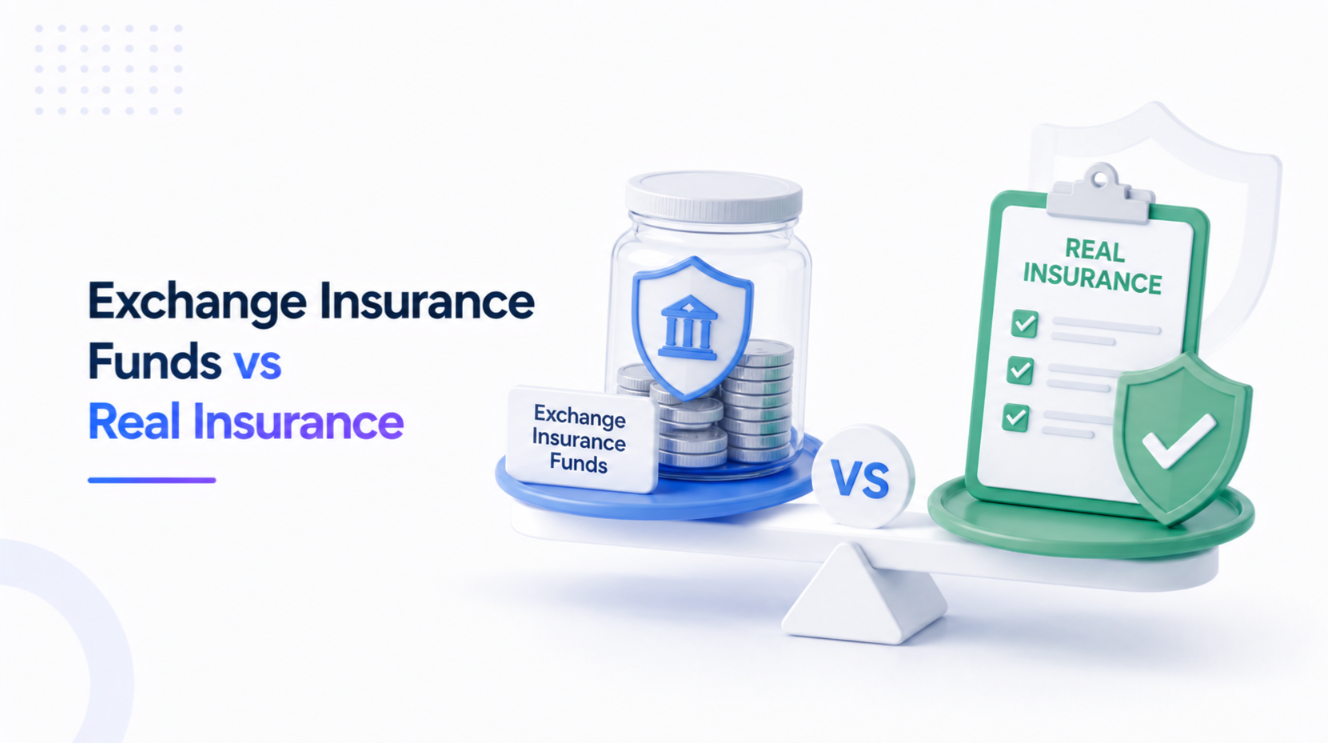
Two completely different things share the word insurance, and neither means what customers assume when an exchange fails.
Nadia OkoroPolicy & Consumer Editor · Regulation, tax, stablecoins and the products retail users holdUpdated 16 October 2026
The short answer
A derivatives insurance fund is a pool of exchange capital that absorbs losses when a liquidation closes below bankruptcy price, preventing profitable traders from being socialised into the loss. It has nothing to do with hacks or insolvency. Separately, some exchanges hold commercial crime or custody policies covering specific perils up to a limit, usually on hot wallet balances only, with the exchange as the insured party rather than you.
Bank deposit insurance is a government guarantee of your specific balance up to a stated limit. Nothing in crypto works like that, and the two things exchanges call insurance both work differently in ways that matter on the day it counts.
The derivatives insurance fund
When a leveraged position is liquidated, the exchange closes it in the market. Ideally it closes above the bankruptcy price — the point where the trader's margin is exactly exhausted — and the remainder is returned. Sometimes the market gaps and the position closes below that price, leaving a shortfall.
Someone has to cover it. The insurance fund does, and it is topped up by the surplus from liquidations that closed better than bankruptcy price. In quiet markets the fund grows; in violent ones it is drawn down.
If the fund is exhausted, the exchange falls back to auto-deleveraging: profitable positions on the opposite side are force-closed at the bankruptcy price to balance the book. That is the mechanism that reaches into a winning trader's account, and it is why the fund's size matters to people who never get liquidated.
So the questions worth asking about a fund are: how large is it relative to open interest, is the balance published in real time, and how often has ADL actually triggered? Venues that publish all three — the practice on Bybit and most major derivatives platforms — are giving you a genuine risk measure. A fund of unknown size on a venue with heavy leverage is not reassurance.
What it is not: protection against a hack, an insolvency, a withdrawal freeze, or a bad trade. It exists solely to keep the liquidation engine solvent.
Custody and crime insurance
Entirely separate. Some exchanges purchase commercial policies covering theft of assets from hot wallets, employee dishonesty, or physical damage to key material.
Four limits apply to every one of these policies. It usually covers hot wallet balances only, which are a small fraction of total holdings. It has an aggregate limit — a fixed maximum across all claims, not per customer. It covers named perils, and the exclusions typically include the things people most fear, such as losses arising from a customer's own compromised credentials. And the insured party is the exchange, not you: a payout goes to the company, which then owes you as a general creditor.
That last point is decisive in an insolvency. Insurance proceeds landing in a bankruptcy estate are distributed by the court under the applicable law, and unsecured customers rank where the terms of service and the jurisdiction put them.
What actually protects a balance
Three things, none of which are called insurance.
**Not keeping it there.** The only complete protection. Exchange balances are for trading and moving; holdings belong in self-custody. Every failure of the last decade has had the same lesson attached and it remains the only one that generalises.
**Legal segregation.** Whether client assets are held on trust or as property of the company, in a jurisdiction that enforces the distinction. This is a terms-of-service and regulatory question, examined in reading an exchange's terms, and it determines whether you are a beneficiary or a creditor.
**Verifiable reserves plus liabilities.** A Merkle-tree proof of reserves with a complete liability commitment tells you the assets exist and are not double-counted, at a point in time. It is a much stronger signal than any insurance claim, and much weaker than segregation with regulatory oversight.
Reading the marketing
"Funds are SAFU" and similar branding describe a company-funded reserve, not a policy and not a guarantee. Such reserves have genuinely paid out — the practice of an exchange covering a hack from its own capital is real and has protected customers more than once — but it is a discretionary commitment by a solvent company, and it is worth exactly what the company is worth on the day it is called.
Regulated venues in some jurisdictions carry actual client-money protections for the fiat leg of a balance, which is real and limited: it covers currency held at a partner bank, not the crypto.
The practical hierarchy is unchanged. Regulatory segregation beats proof of reserves, proof of reserves beats a company reserve fund, and a company reserve fund beats a marketing slogan. All of them lose to holding your own keys — which is why the exchange ratings score custody arrangements and jurisdiction separately from any insurance claim an exchange makes about itself.
FAQ
What does an exchange insurance fund cover?+
On derivatives venues, it covers the shortfall when a liquidation closes below the bankruptcy price, so profitable traders are not force-closed. It does not cover hacks, insolvency or withdrawal freezes.
Is crypto on an exchange insured like a bank deposit?+
No. There is no per-account government guarantee. Commercial policies some exchanges hold cover named perils up to an aggregate limit, usually on hot wallets, with the exchange as the insured party.
What is auto-deleveraging?+
When the insurance fund cannot cover a liquidation shortfall, the exchange force-closes profitable positions on the opposite side at the bankruptcy price. It is the mechanism that makes other traders absorb the loss.
What actually protects funds on an exchange?+
Legal segregation of client assets in a jurisdiction that enforces it, verifiable reserves with a liability commitment, and above all not keeping long-term holdings on an exchange at all.


























 Nadia OkoroPolicy & Consumer Editor · Regulation, tax, stablecoins and the products retail users hold