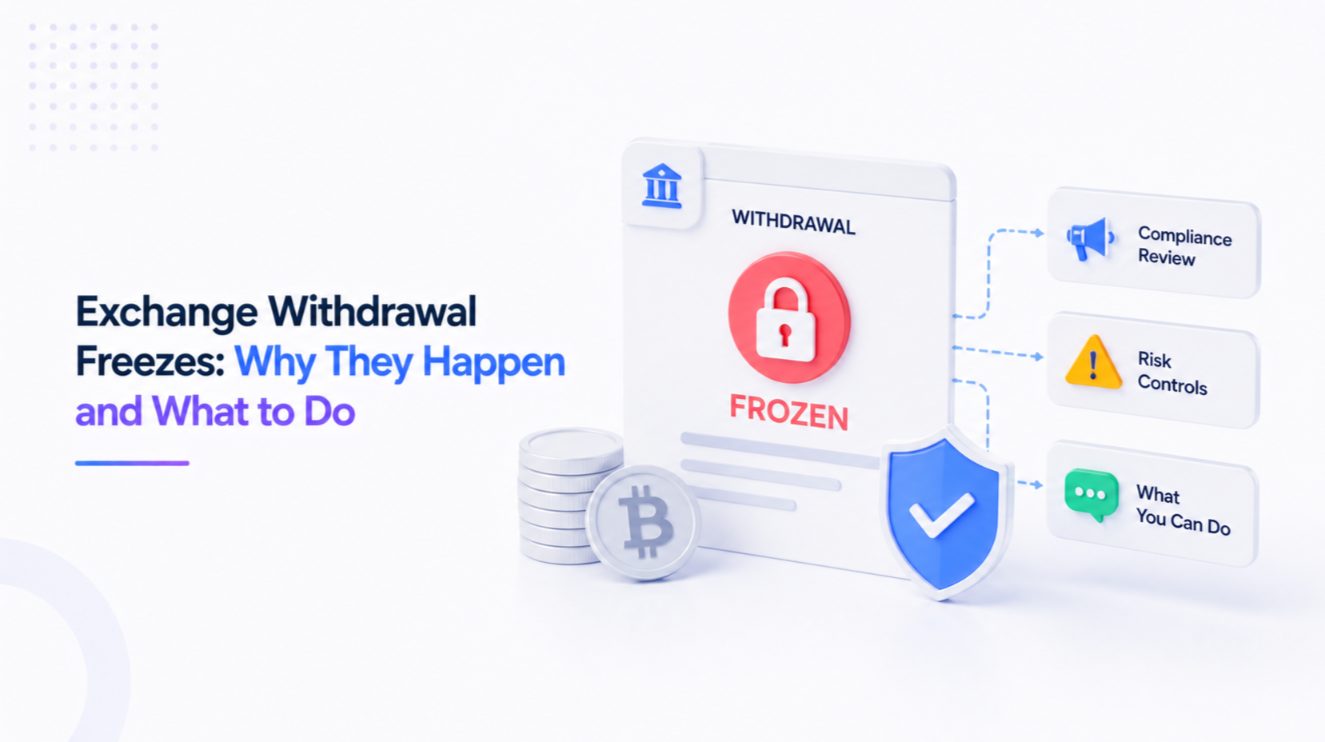
Exchange Withdrawal Freezes: Why They Happen and What to Do
Four different things get called a frozen withdrawal, and they need four different responses. The first job is working out which one you are in.
Dario FennDeFi & Markets Lead · DeFi protocols, yield, market structure and on-chain dataUpdated 23 August 2026
The short answer
Most withdrawal holds are automated compliance or risk flags that clear once you supply the requested documents, and they resolve in days. The dangerous version is an exchange-wide halt affecting everyone at once, which historically precedes insolvency. Distinguish them by checking whether other users can withdraw: if the problem is only yours, it is a case; if it is everybody's, it is an exit.
You click withdraw and nothing happens. The transaction is pending, or a message asks for documents you have already sent, or the asset shows as unavailable for withdrawal. Before doing anything else, work out which of four situations you are in, because the correct response differs completely.
One: an automated compliance flag on your account
The most common cause by far. Exchanges run transaction monitoring that scores deposits and withdrawals against sanctions lists, mixer proximity, and behavioural patterns. A flag pauses the withdrawal and generates a document request — source of funds, identity re-verification, sometimes an explanation of the counterparty.
This is a case, not a crisis. Respond precisely and completely: bank statements showing the fiat that bought the crypto, the exchange or transaction history showing where deposited coins came from, and a short factual explanation. Vague or partial answers restart the clock. Most of these resolve inside a week; the venues where they do not are the ones with the thinnest support, which is why support quality is a scored criterion in our exchange ratings.
Two: a risk hold on the specific transaction
Some holds attach to the transaction rather than the account: a first withdrawal to a new address, a large amount relative to your history, a login from a new device, or a password change in the last 24 hours. These usually clear automatically within the stated window — often 24 to 48 hours — and support cannot accelerate them.
The right move is patience plus verification: confirm through the official app that the withdrawal is queued rather than cancelled, and never respond to anyone who contacts you offering to speed it up. Support impersonation follows account issues closely, and the people who reach out first are never the exchange.
Three: a network or asset-level pause
The exchange has suspended withdrawals for one asset or one chain: a node is out of sync, a chain upgrade is in progress, or a deposit contract is being migrated. This affects everyone, is usually announced on a status page, and resolves in hours.
The tell is scope. If BTC withdrawals work and one token does not, the problem is operational. Withdrawing the same value in a different asset is often possible and is the fastest route out if you want out.
Four: the exchange-wide halt
Everyone is affected, across assets and chains, and the explanation is vague or absent. This is the version that matters. Every large exchange failure of the last decade — Mt. Gox, QuadrigaCX, Celsius, FTX — ran the same sequence: withdrawals slow, then partial, then paused, with a technical explanation, then a legal filing.
That does not mean every halt ends in insolvency; Bybit kept withdrawals open through a $1.5bn theft in February 2025 precisely to avoid the signal. But when a general halt lasts more than a few hours without a specific technical cause, treat it as an exit event and stop adding funds.
What actually moves a stuck case
Use one channel, in writing, through the app or the verified support address, and keep the ticket number. Escalate through the official complaints process rather than opening parallel tickets, which resets queues. Where the venue is regulated, name the regulator in your escalation — an exchange with a MiCA authorisation or a state licence has a supervisory body and a complaints obligation, which is a large part of what the regulatory-standing score in our rubric is measuring.
Send documents in the format requested, once. Do not post account details publicly. Record dates, amounts and responses, because if this becomes a formal complaint that record is your case.
The habit that prevents most of this
An exchange is a venue, not a vault. Keep working capital there and sweep the rest to self-custody, where no compliance queue exists between you and your coins. Withdraw in normal conditions rather than during a panic, and test a small withdrawal to a new address before you need a large one.
Deposits also matter: coins that arrive from a mixer, a sanctioned counterparty or a chain-hopping route are what trigger source-of-funds reviews later. Where you got the coins determines how easily you can leave with them.
FAQ
How long can an exchange legally hold my withdrawal?+
There is no universal limit. Regulated venues must handle complaints within a stated period — often 15 to 35 business days in the EU and UK — but compliance reviews themselves can run longer if the exchange requests documents.
Should I panic if my withdrawal is pending?+
Not if the hold is specific to your account or one asset. The situation that warrants urgency is an exchange-wide halt affecting all users and all assets with no specific technical explanation.
Can support speed up a risk hold?+
Rarely. Automated time-based holds — after a password change or a new withdrawal address — expire on their own. Document-based compliance reviews move only when you supply exactly what was asked for.
What triggers a source-of-funds review?+
Deposits with mixer proximity or sanctioned-address exposure, unusually large withdrawals relative to your history, rapid deposit-and-withdraw patterns, and jurisdiction changes. The source of the coins matters as much as the size.
 Dario FennDeFi & Markets Lead · DeFi protocols, yield, market structure and on-chain data