How Crypto Staking Works: Earning Rewards by Securing a Network
A plain-English walkthrough of proof-of-stake staking — what you're actually doing, how rewards are calculated, and the risks worth knowing before you lock up a single coin.
Dario FennDeFi & Markets Lead · DeFi protocols, yield, market structure and on-chain dataUpdated 11 July 2026
The short answer
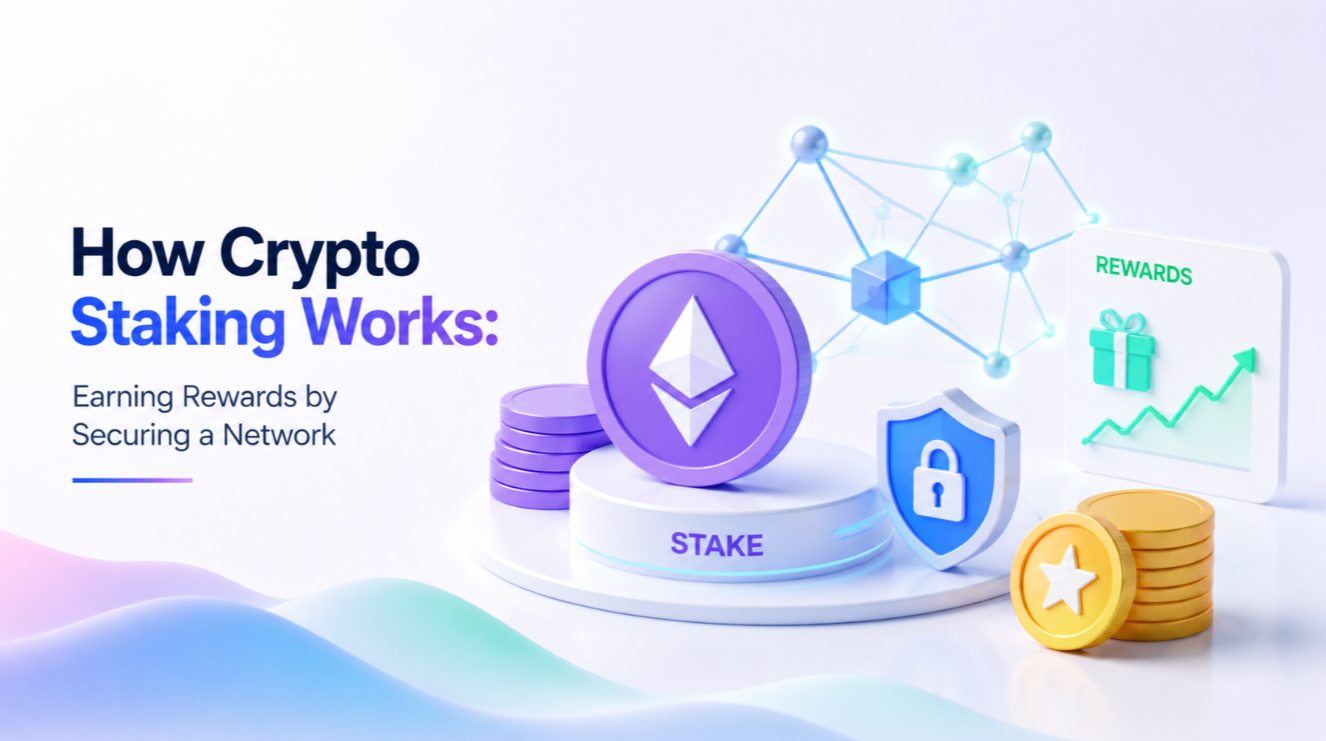
Staking commits tokens to help secure a proof-of-stake network, with validators selected in proportion to stake and rewards paid from issuance plus transaction fees. It is partly dilution rather than pure income: you gain a larger share of a supply that is growing. The real risks are slashing for provable faults, downtime costing missed rewards, and an exit queue that means the position is not liquid on demand.
Crypto staking is the closest thing this industry has to a savings account — except instead of a bank, you're putting your tokens to work securing a blockchain, and instead of an interest rate set by a committee, your return is set by code. If you've ever wondered how people earn yield on assets like ETH, SOL or ADA without doing anything as dramatic as trading, staking is almost certainly the answer. It's not free money, though, and understanding the mechanics before you commit a single token is what separates a sensible allocation from an expensive lesson.
What Staking Actually Is
Proof-of-stake blockchains need someone to propose new blocks and vote on which version of the chain is correct. Rather than burning electricity to win that right, as Bitcoin's proof-of-work miners do, validators on a proof-of-stake network put up collateral — their own coins — as a bond. Get it right, and you're paid a slice of new issuance plus transaction fees. Try to cheat, and that bond gets partially destroyed. Staking, then, is simply the act of locking coins into that system, either by running the validator yourself or by delegating your tokens to someone who does.
Ethereum's shift from proof-of-work to proof-of-stake — the event known as The Merge, completed in September 2022 — is worth understanding as context, because it's the single clearest demonstration of what staking replaces. Pre-Merge, Ethereum's security budget went to miners burning enormous amounts of electricity; post-Merge, that same budget goes to validators locking up capital instead, cutting the network's energy consumption by something in the region of 99.9% overnight. That transition is also why staking discourse exploded in the past few years: an asset that previously had no native yield mechanism suddenly did, and a huge share of the market had to learn what that meant from scratch.
How Validators Get Chosen
Each network has its own selection logic, but the common thread is that stake weight equals influence. Ethereum uses a randomised committee system where validators are chosen to propose and attest to blocks roughly in proportion to how much ETH is bonded across the network. Solana and Cardano use variations on the same idea: more stake behind you, more often you're picked to produce a block, more rewards you collect. This is why staking pools exist — a solo validator with 32 ETH gets picked far less often than a pool commanding hundreds of thousands, even though the annualised percentage return works out similarly over time.
Two distinct jobs get rewarded separately on most networks: proposing a block, which happens rarely for any single validator and pays the largest single reward, and attesting to blocks other validators propose, which happens far more frequently and pays smaller amounts consistently. This is why staking returns smooth out over time even though any individual validator's day-to-day rewards look lumpy — the steady stream of attestation rewards dominates the total, with proposal rewards adding occasional spikes on top.
Delegation vs running your own validator
You've got two real options as a newcomer. Delegated staking means handing your tokens' voting weight to an existing validator — you keep custody (on chains like Cosmos or Cardano) or you deposit into a pool (on Ethereum), and you receive a cut of what that validator earns, minus their commission. Running your own validator means putting up the full stake yourself — 32 ETH on Ethereum, for instance — and operating the hardware and software, which earns you the full reward but exposes you to the full slashing risk if you misconfigure something. For almost everyone starting out, delegation is the sensible entry point. It costs you a percentage in fees, typically 5-15%, but removes the operational risk entirely.
Where the Rewards Come From
It's worth being precise about this because plenty of marketing blurs it. Staking rewards come from two sources: newly issued coins (inflation, essentially — the protocol is paying you to secure it) and transaction fees paid by users of the network. On Ethereum, a small slice of priority fees and MEV (maximal extractable value) also flows to validators, which is why realised yields there tend to run a bit above the base issuance rate. The advertised APY you see on an exchange is rarely the whole picture — always check whether it includes the platform's own cut, and whether it's paid in the staked asset or in some wrapped derivative that trades at a discount.
Real-world numbers help ground this. Ethereum staking has typically yielded somewhere in the 3-4% range annually in ETH terms, though it moves inversely with total stake — more ETH bonded network-wide dilutes everyone's share of the fixed issuance pool. Solana's higher nominal yields, often quoted north of 6-7%, reflect its higher inflation schedule rather than a fundamentally more generous protocol. Cardano and Polkadot sit at their own points on that spectrum. None of these figures are guarantees; they shift as network participation changes, and comparing headline APYs across chains without adjusting for each network's inflation rate is comparing apples to a fairly different type of fruit.
Slashing and Other Risks
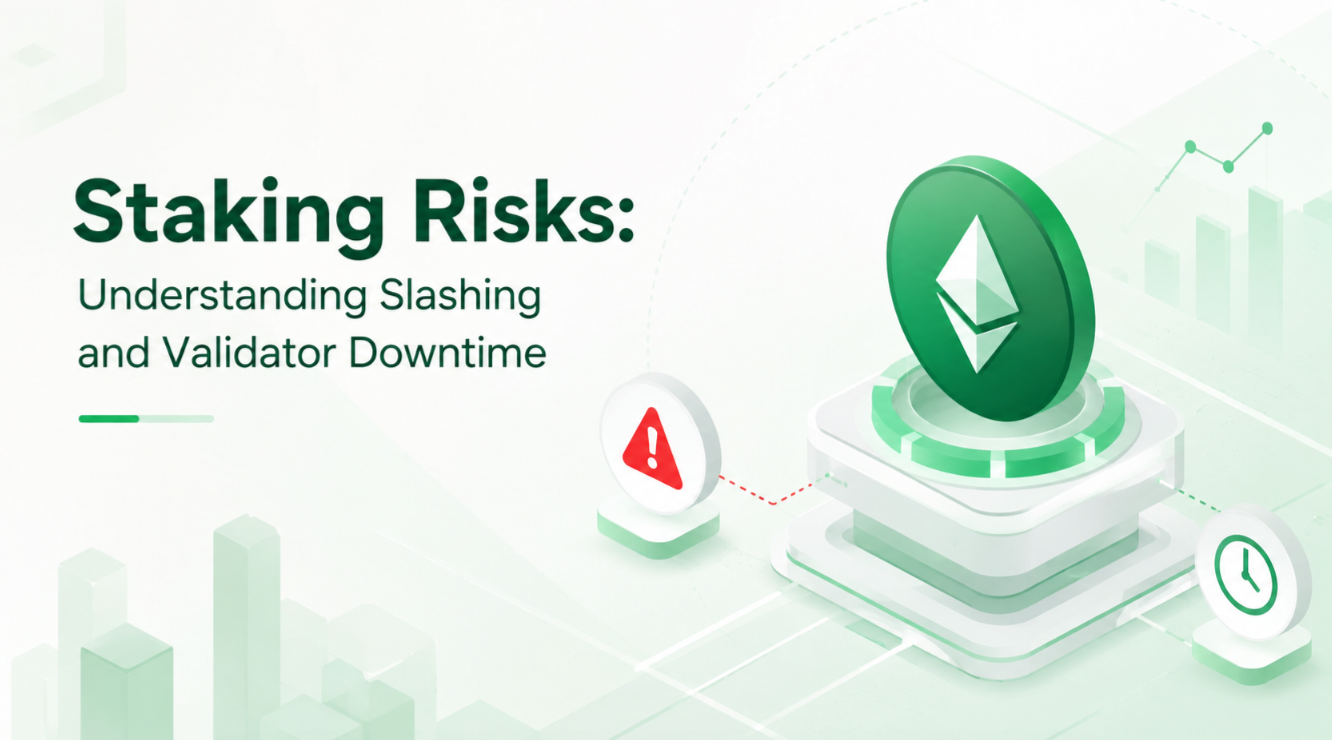
Slashing is the mechanism that keeps validators honest, and it's the risk most beginners underweight. If a validator double-signs a block, or goes offline for extended periods, the protocol confiscates a portion of the staked amount. On Ethereum this is capped and rare, generally reserved for provable misbehaviour rather than simple downtime, which is penalised more gently through 'inactivity leaks.' On some other chains the penalties are steeper. The practical takeaway: your choice of validator or pool matters. A well-run, well-monitored operator with a long uptime record is worth more than an extra half-percent of headline yield. Beyond slashing, there's also lock-up risk — many chains impose an unbonding period, sometimes days, sometimes weeks, during which your tokens are illiquid and still exposed to price moves.
Liquid Staking: Having Your Cake and Eating It
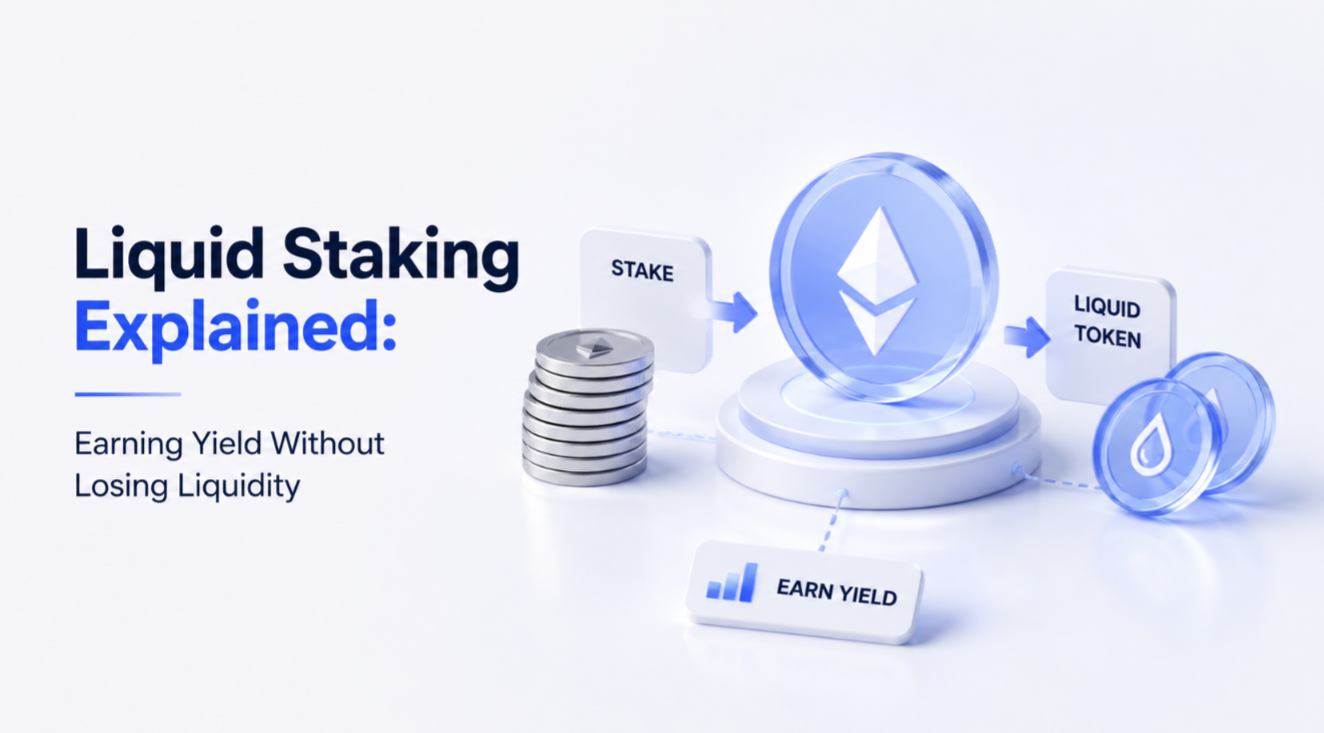
Liquid staking protocols such as Lido or Rocket Pool solve the illiquidity problem by issuing you a receipt token — stETH, rETH, and so on — that represents your staked position and accrues rewards, while remaining tradeable and usable as collateral elsewhere in DeFi. It's a genuinely useful innovation, but it isn't free of trade-offs. You're now trusting the smart contract and the operator set behind the liquid staking token, and in periods of stress these tokens can trade at a discount to the underlying asset if there's a rush for exits and unbonding queues back up. Concentration is a live concern too — a handful of liquid staking providers now control a meaningful share of validated Ethereum, which is worth watching from a network-health perspective even if it doesn't affect your personal return.
Picking a Place to Stake
A few practical filters go a long way. Check the validator's historical uptime and slashing record if the chain's explorer makes that visible. Compare commission rates, but don't chase the cheapest option blindly — a 0% commission validator with patchy infrastructure is a false economy. Understand the unbonding period before you commit, and size your position so that locked-up capital doesn't leave you unable to respond to a market move. If you're using an exchange's staking product for convenience, read the terms on custody — some let you withdraw instantly by pooling liquidity, others mirror the underlying chain's unbonding queue exactly.
Diversifying across two or three validators, rather than piling everything behind one, is also cheap insurance against a single operator's mistake taking a bite out of your stack.
One more practical point worth flagging early: in most jurisdictions, staking rewards are treated as income at the moment you receive them, valued at their market price on that date, which means they generate a tax obligation independent of whether you ever sell the underlying tokens. Keeping a simple log of reward dates and values as you go is far less painful than reconstructing a year of daily reward drips from a block explorer later.
Staking isn't a trade and it isn't a guaranteed win — token prices move far more than staking yields do, so a coin down 30% with a 5% staking return is still down 25% in dollar terms. What it is, done properly, is a reasonably low-effort way to put idle holdings to work securing infrastructure you already believe in, while collecting a return that's set by transparent, on-chain rules rather than a bank's discretion. Understand the mechanics, pick your validator with the same care you'd pick a broker, and it earns its place in a long-term holder's toolkit.
FAQ
What is crypto staking?+
Committing tokens to help secure a proof-of-stake network. Validators are selected in proportion to stake, and rewards come from issuance plus transaction fees.
Where do staking rewards come from?+
New issuance set by the protocol, plus priority fees and, on some networks, MEV. It is partly dilution — the reward is real against the asset, less so against total supply.
Can I lose money staking?+
Yes. Slashing penalises provable faults such as double-signing, and downtime costs missed rewards. Exit queues also mean the position is not liquid on demand.
What is liquid staking?+
Staking through a protocol that issues a transferable token representing the staked position, so the capital can be used elsewhere while it earns. It adds contract risk and a market price that can trade below the underlying.
 Dario FennDeFi & Markets Lead · DeFi protocols, yield, market structure and on-chain data