
















































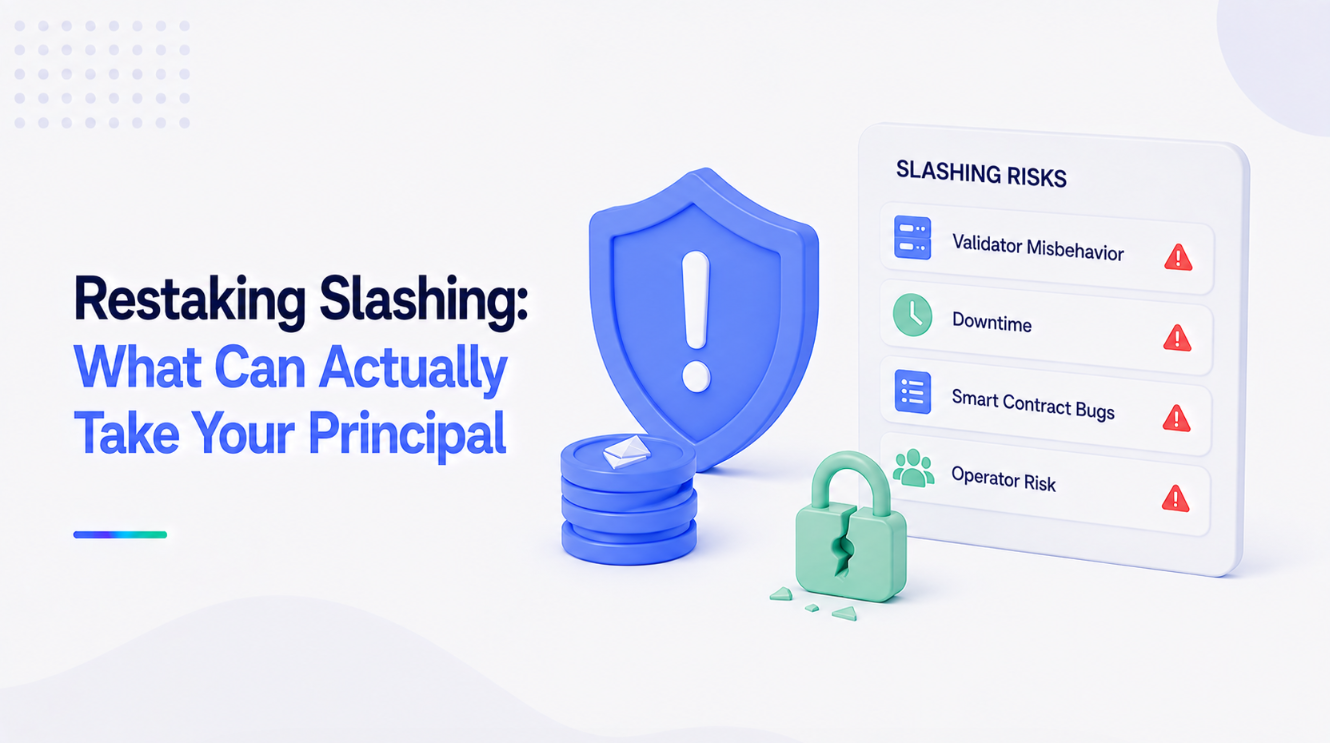
Restaking lets staked ETH secure additional services, each of which defines its own slashing conditions. Your principal is exposed to every condition your operator has opted into, written by teams whose code you have not reviewed. Risks compound through operator concentration, correlated slashing across services, liquid restaking token discounts during exits, and the fact that the extra yield is often paid in points or tokens rather than realised revenue.
- 1How the exposure actually works. Restaked ETH is delegated to an operator, who opts into securing services — actively validated services in…
- 2Correlation is the real problem. Individual slashing events are survivable.
- 3The liquidity layer on top. Most restaking exposure is held through a liquid restaking token rather than directly.
- 4What you are actually paid. Be precise about the yield, because it is often not yield.
On this page6 sections
Staking ETH exposes you to one set of rules: Ethereum's, which are conservative, well understood, and have penalised a tiny fraction of validators in the network's history. Restaking takes the same capital and makes it answerable to additional rule sets, each written by a different team for a different purpose.
That is the entire proposition and the entire risk. The yield is payment for accepting slashing conditions you did not write.
How the exposure actually works
Restaked ETH is delegated to an operator, who opts into securing services — actively validated services in EigenLayer's terminology. Each service defines the behaviour it punishes and the size of the penalty, and enforces it against the stake backing it.
So your exposure is the union of every service your operator has opted into. You did not choose those services, you are unlikely to have read their slashing logic, and the operator's incentive is to maximise yield by opting into more of them.
Two properties make this harder to reason about than ordinary staking. Slashing conditions in a new service are new code, and new code has bugs — a faulty condition can slash honest operators. And the conditions are frequently subjective or oracle-dependent rather than cryptographically provable, meaning a dispute mechanism, not a proof, decides whether you lose principal.
Correlation is the real problem
Individual slashing events are survivable. The scenario that matters is many operators being slashed at once.
Three routes to it. A single service used by most large operators has a bug, and everyone securing it is penalised simultaneously. Operators run similar infrastructure and client software, so an outage or a consensus fault propagates. Or a market event causes mass exits, and the exit queue combined with slashing produces losses that cascade into positions using restaking tokens as collateral.
The last is the one that reaches people who never restaked anything, because liquid restaking tokens are widely used as collateral in lending markets. A discount on the token — from a slashing event, an exit queue, or simply fear — triggers liquidations in positions that had nothing to do with the underlying service.
The liquidity layer on top
Most restaking exposure is held through a liquid restaking token rather than directly. That adds several things to the risk stack: the token contract itself, the protocol's operator selection, the exit mechanics, and secondary market depth.
The exit path deserves specific attention. Redeeming a restaking token means undelegating, waiting the protocol's escrow period, then waiting Ethereum's own withdrawal queue. During that window the only exit is the secondary market, and market prices in stress are set by forced sellers — the exact dynamic that produced the stETH discount in 2022, with more layers.
Protocols like ether.fi publish their operator sets, service opt-ins and exit mechanics, which is the minimum standard for evaluating any of this. A restaking token whose service exposure you cannot enumerate is a position you cannot size.
What you are actually paid
Be precise about the yield, because it is often not yield. A large share of restaking return has been paid in points redeemable for a future token distribution, or in service tokens with limited liquidity, rather than in fees from services actually paying for security.
The honest comparison is: ordinary staking yield in ETH, versus restaking yield in ETH plus a variable amount of something whose value is unknown, in exchange for accepting additional slashing conditions. Whether that is a good trade depends entirely on the size of the something, and it is frequently smaller than the presentation implies. The framework for pricing that kind of speculative reward is in points programmes.
Checks before opting in
Which services is my operator securing, and can I enumerate them? What is the maximum slashing penalty for each, and is it a fixed percentage or unbounded? Are the slashing conditions objective and provable, or subject to a dispute process? Has the service's slashing code been audited specifically, as distinct from the protocol framework? How many operators secure it, and how correlated are they? What is the full exit path and how long does it take? And what fraction of the yield is realised revenue rather than points?
If a restaking product cannot answer the first three, it is not offering a risk you can price.
Sizing it
Treat restaked ETH as a different asset from staked ETH, not as the same asset earning more. Cap the allocation at what you would accept losing to a slashing event in a service you have never heard of, keep a core staking position unrestaked, and avoid borrowing against liquid restaking tokens — that combination converts a slashing event into a liquidation and removes your ability to wait it out. The broader risk framing sits in restaking risks.
Next step
Understood the mechanics? Keep going, or compare the services.
FAQ
What can slashing take in restaking?
Is restaking riskier than staking?
What is correlated slashing?
Can I exit a restaking position quickly?
Related guides
All guides →- What Is Restaking? How EigenLayer and Shared Security WorkRestaking lets the same staked ETH secure a dozen other systems at once, turning idle collateral into rented security. Here's the actual mechanics behind EigenLayer and the shared-security model it popularised.Advanced12 min
- The Risks of Restaking: Slashing Cascades and Systemic ExposureRestaking multiplies yield by putting the same capital to work across several protocols at once — but it multiplies the ways that capital can be slashed, too. A close look at where the compounding risk actually sits.Advanced12 min
- Staking Risks: Understanding Slashing and Validator DowntimeHow delegators can lose principal to slashing and downtime penalties, well before any price volatility comes into the picture.Intermediate10 min
- How Crypto Staking Works: Earning Rewards by Securing a NetworkA plain-English walkthrough of proof-of-stake staking — what you're actually doing, how rewards are calculated, and the risks worth knowing before you lock up a single coin.Beginner9 min