













































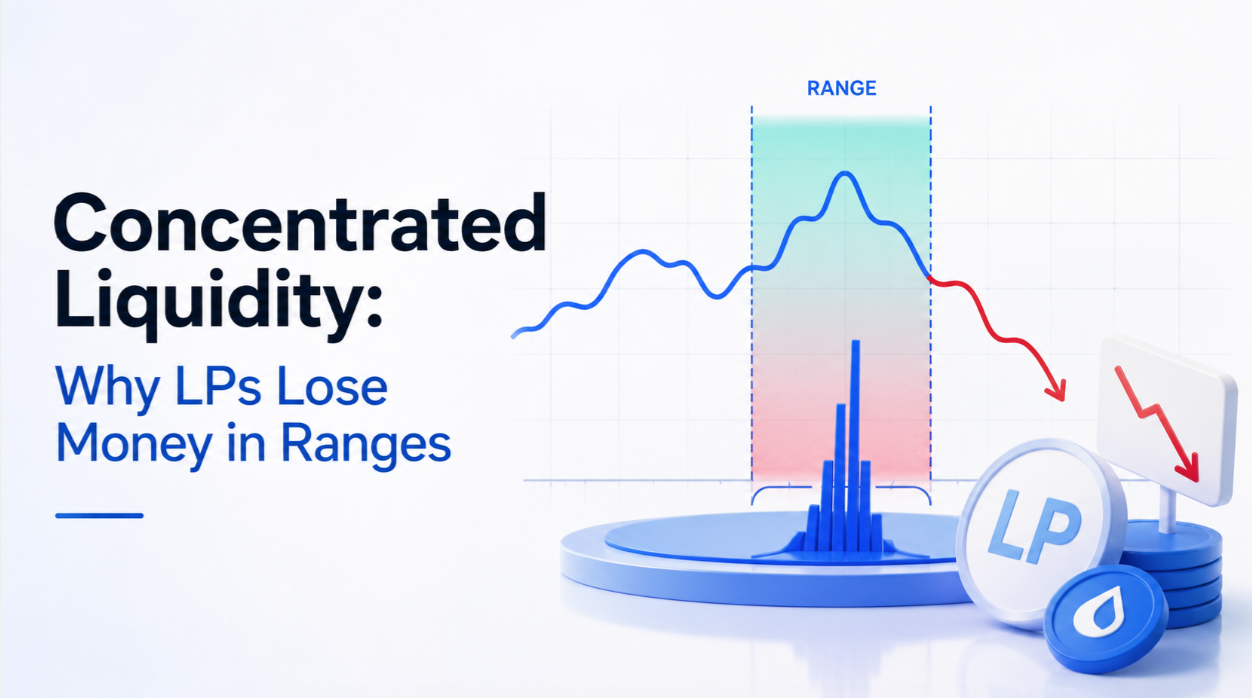
Concentrated liquidity lets a provider allocate capital to a specific price range instead of the whole curve, multiplying capital efficiency and fee income within that range. The same concentration multiplies impermanent loss, and when price leaves the range the position stops earning and sits entirely in the weaker asset. Profitability depends on fees earned while in range exceeding divergence loss plus rebalancing costs, which narrow ranges rarely achieve in volatile pairs.
- 1What a range does mechanically. You choose a lower and upper price.
- 2Why the losses are larger. [Impermanent loss](/learn/impermanent-loss-explained/) is the divergence between holding a pair and providing it as liquidity.
- 3Rebalancing, and why it is not free. When price exits a range, the position must be withdrawn and re-established around the new price to resume earning.
- 4Choosing a range honestly. The decision is a volatility forecast, and it should be treated as one.
On this page5 sections
In the original constant-product design, a liquidity provider's capital is spread across every price from zero to infinity. Almost all of it is never used, because the price never goes there. Concentrated liquidity, introduced with Uniswap v3, lets you place capital only where trading actually happens — and in doing so converts a passive position into an active one.
What a range does mechanically
You choose a lower and upper price. Your capital behaves like a full-range position that exists only between those bounds, which means far more depth per dollar and a proportionally larger share of the fees generated by trades in that band.
The concentration factor is roughly the ratio of the full range to yours. A range covering ±2% around the current price on a pair provides depth comparable to many times the capital in a full-range pool — the source of the efficiency, and the source of everything that follows.
Two boundary behaviours define the position. As price rises through your range you are progressively sold out of the base asset into the quote; as it falls you are bought further into the base. Above the upper bound you hold only the quote asset and earn nothing; below the lower bound you hold only the base asset and earn nothing.
That is worth restating plainly: a range position out of range is not a liquidity position at all. It is a completed limit order sitting idle.
Why the losses are larger
Impermanent loss is the divergence between holding a pair and providing it as liquidity. Concentration multiplies it by the same factor it multiplies fees, because the mechanism is identical: your capital is doing more work per dollar in both directions.
The asymmetry that hurts is what happens at the edges. Inside the range you accumulate fees and divergence loss together. Outside it, the divergence loss is locked in at the boundary and the fee income stops — so the compensation ends exactly when the loss is largest.
Empirical studies of v3 positions have repeatedly found that a majority of liquidity providers in volatile pairs underperformed simply holding the two assets, once fees, gas and rebalancing are counted. The design is not broken; it is a professional market-making tool being used by people who are not being paid to manage it.
Rebalancing, and why it is not free
When price exits a range, the position must be withdrawn and re-established around the new price to resume earning. Each cycle costs gas, realises the divergence loss, and frequently requires a swap to rebalance the asset ratio — which pays price impact and, in taxable jurisdictions, creates disposals.
Rebalancing frequently in a trending market is a mechanical way of selling the winner and buying the loser at every step. This is the single largest source of underperformance and it is invisible in any APR display, because displayed yields count fees and ignore both the divergence and the cost of chasing.
Choosing a range honestly
The decision is a volatility forecast, and it should be treated as one.
Wide ranges earn less per dollar and stay in range through ordinary moves. They approximate a full-range position with modest improvement and modest management. For a volatile pair held passively, this is usually the correct choice.
Narrow ranges earn far more while price is inside and require active management. They suit correlated pairs — stablecoin against stablecoin, a liquid staking token against its underlying — where the exchange rate genuinely does stay within a band, and where the divergence loss is small by construction.
Single-sided ranges placed entirely above or below the current price function as limit orders that collect fees while waiting to fill. This is a legitimate and underused application, and it has nothing to do with market making.
The fee tier interacts with the choice: a higher tier compensates for volatility on exotic pairs, a lower one is appropriate where the pair barely moves. Selecting a 0.05% tier on a volatile pair with a narrow range is the configuration most reliably underperforming.
Doing the arithmetic before depositing
Estimate the pool's fee revenue over a recent period, take your expected share while in range, and multiply by the fraction of time you realistically expect to be in range. That is your income.
Against it, estimate divergence loss for a move of the size your pair typically makes over that horizon, add gas for the expected number of rebalances, add swap costs, and add any tax friction on realised disposals.
If the difference is not clearly positive at a realistic volatility, the position is a bet on calm markets rather than a yield strategy — and the honest comparison is against simply holding, not against zero. The same discipline applies to the automated range managers built on top of these pools: they remove the manual work, not the underlying economics, and their fees come out of the same margin.
The DEX ratings score liquidity provision economics separately from trading execution for this reason. A venue that is excellent to trade on can be a poor place to provide liquidity, and the two facts rarely appear on the same page.
Next step
Understood the mechanics? Keep going, or compare the services.
FAQ
What is concentrated liquidity?
Why do concentrated liquidity providers lose money?
What happens when the price leaves my range?
What range should I choose?
Related guides
All guides →- Impermanent Loss Explained: The Hidden Risk of Providing LiquidityProviding liquidity looks like free yield until you compare it against simply holding the two assets — the gap between those outcomes is impermanent loss, and it's bigger than most LPs realise.Intermediate11 min
- Liquid Staking Explained: Earning Yield Without Losing LiquidityHow liquid staking tokens let holders earn network rewards while keeping their capital free to lend, trade, or post as collateral.Intermediate11 min
- LST Depegs: Why stETH Traded Below ETH and What It MeantThe discount was never a backing failure. It was a liquidity event in an asset that could not be redeemed at the time.Intermediate9 min
- Crypto Tax in Germany: The One-Year Rule ExplainedGermany's treatment is unusually favourable and unusually specific. The whole framework turns on one date and on whether the activity stays private.Intermediate11 min