Optimistic vs. ZK Rollups: How Layer 2 Scaling Actually Works
A side-by-side breakdown of the two dominant rollup architectures, what each trades away to scale Ethereum, and where the gap between them is closing.
Dario FennDeFi & Markets Lead · DeFi protocols, yield, market structure and on-chain dataUpdated 11 June 2026
The short answer
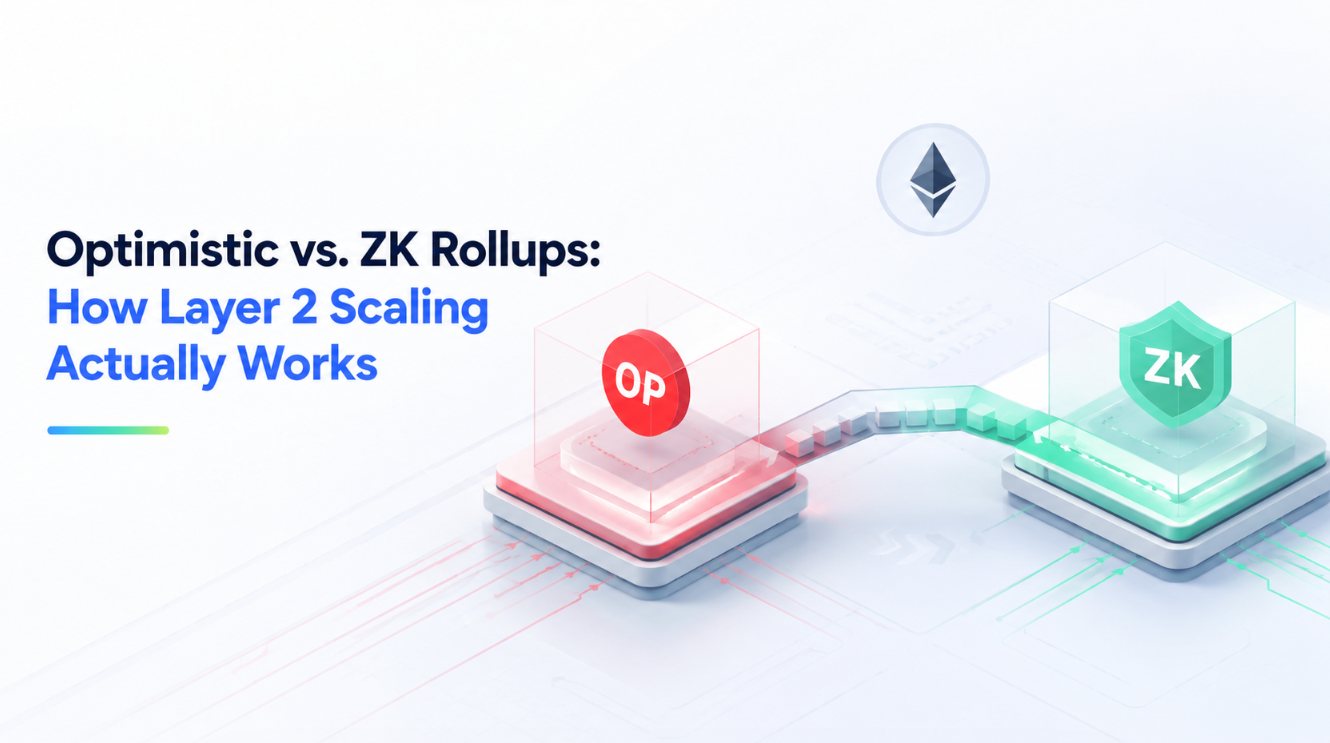
Both rollup types execute transactions off the main chain and post data back to it. An optimistic rollup assumes validity and allows a challenge window for fraud proofs, which is why withdrawals take days. A ZK rollup proves validity cryptographically with every batch, removing the need for an honest challenger at the cost of far more complex proving systems.
Rollups have become the default answer to Ethereum's scaling problem, and almost every layer 2 network you've heard of, from Arbitrum and Optimism to zkSync and Starknet, describes itself with one of two labels: optimistic or ZK. Those two words point to genuinely different architectures with different security assumptions, different cost structures, and different withdrawal experiences, and understanding the distinction matters for anyone deciding where to hold funds or build an application.
The Shared Foundation: What a Rollup Actually Does
Before splitting into the two camps, it's worth being precise about what a rollup is doing at all. Both types execute transactions off the main Ethereum chain, batch large numbers of them together, and post compressed transaction data back to Ethereum (layer 1), which continues to act as the ultimate settlement and data availability layer. This is what makes rollups fundamentally different from earlier scaling attempts like sidechains: a rollup's security is meant to inherit from Ethereum, not to substitute an entirely separate, independently secured chain. The two architectures diverge entirely on one question: how does layer 1 know the batch of transactions submitted was actually executed correctly?
Optimistic Rollups: Assume Honesty, Verify by Exception
Optimistic rollups take their name from their core assumption: batches are presumed valid the moment they're posted, with no immediate proof required. Instead, the system relies on a challenge period, typically seven days on major implementations like Arbitrum and Optimism, during which any observer running a full node can submit a fraud proof if they spot an invalid state transition in the batch. If nobody challenges the batch within that window, it's treated as final. This design is comparatively simple to implement and extremely flexible, since it can support arbitrary, general-purpose smart contract execution with minimal changes to how developers write code, which is a large part of why optimistic rollups reached usable mainnet maturity well before their ZK counterparts.
The Cost of the Challenge Period
The trade-off is withdrawal latency. Because a batch isn't considered final until the challenge window closes, funds moving from an optimistic rollup back to Ethereum layer 1 are subject to that same delay, commonly around seven days, unless a user pays a third-party liquidity provider a fee to front the withdrawal instantly against the eventual on-chain settlement. This doesn't slow down activity within the rollup itself, transactions there confirm quickly, but it does mean optimistic rollups carry an inherent lag between when a transaction happens and when it's genuinely, trustlessly irreversible on Ethereum.
ZK Rollups: Prove It Mathematically, Every Time
Zero-knowledge rollups take the opposite approach: instead of assuming correctness and allowing a challenge window, they generate a cryptographic validity proof, a zk-SNARK or zk-STARK, for every batch before it's accepted on layer 1. This proof mathematically demonstrates that the batch's new state is a correct result of executing the included transactions against the prior state, without needing to reveal or re-execute every transaction on layer 1 itself. Because the proof is verified on-chain at submission time, there's no need for a challenge period at all; once the proof is accepted, the batch is final. Withdrawals back to layer 1 can, in principle, be nearly instant, limited mainly by proof generation time rather than a security-driven waiting period.
The Cost of Generating Proofs
The trade-off here has historically been computational and developer complexity. Generating validity proofs for arbitrary, general-purpose smart contract execution is a genuinely hard engineering problem, which is why early ZK rollups focused on narrower use cases like payments and token transfers before general-purpose zkEVMs (Ethereum Virtual Machine-compatible ZK rollups) became viable. Proof generation is also computationally expensive, requiring specialised hardware and adding latency and cost to the pipeline that optimistic rollups simply don't incur, since optimistic systems only need to run a fraud proof in the rare case someone actually challenges a batch.
Security Assumptions, Compared Directly
Optimistic rollups rely on what's sometimes called a liveness assumption: security holds as long as at least one honest, economically motivated party is watching the chain and willing to submit a fraud proof within the challenge window. If nobody is watching, or if the incentive to challenge is too weak relative to the cost of running a verifying node, an invalid batch could theoretically slip through unchallenged. ZK rollups rely instead on a cryptographic soundness assumption: the validity proof is either mathematically correct or it isn't, and there's no dependency on anyone actively monitoring the chain to catch fraud after the fact. This is a meaningfully stronger security model in the abstract, since it doesn't depend on economic incentives or vigilant third parties behaving correctly.
Where the Gap Is Closing
The historical trade-offs between the two architectures are narrowing on both sides. General-purpose zkEVMs from teams like Polygon, Scroll, and zkSync have made ZK rollups viable for the same broad smart contract use cases optimistic rollups were built for, closing the flexibility gap that used to favour optimistic designs. Meanwhile proof generation hardware and algorithmic improvements have cut proving times and costs substantially, chipping away at ZK's cost disadvantage. On the optimistic side, projects have experimented with shortening challenge periods and building more liquid fast-withdrawal markets to soften the withdrawal delay, though the underlying seven-day security assumption generally remains for trustless exits.
What This Means in Practice
For a typical user moving funds and interacting with applications day-to-day, the difference is often invisible: both architectures offer fast, cheap transactions once you're inside the rollup, and the withdrawal delay on optimistic rollups only bites when you're moving funds back to layer 1 without using a fast-withdrawal service. For developers and larger capital allocators, the distinction matters more directly: ZK rollups offer a cleaner, more self-contained security argument that doesn't lean on external actors, while optimistic rollups have the benefit of a longer production track record and, in several cases, deeper existing liquidity and application ecosystems.
Choosing Between Them
There's no universally correct answer between optimistic and ZK, and the right choice depends on what you're optimising for. If instant, trustless finality on withdrawals matters more than track record, ZK rollups are the stronger architectural fit. If you're prioritising a longer history of battle-tested contracts and the deepest existing liquidity, several optimistic rollups still hold an edge, though that gap is shrinking every quarter as ZK infrastructure matures. Either way, the shared principle, that both inherit their core security from Ethereum rather than standing up an independent trust model, is what actually distinguishes rollups from the sidechains and alt-L1s they're often lumped in with.
FAQ
What is the difference between optimistic and ZK rollups?+
An optimistic rollup assumes transactions are valid and allows a challenge window for fraud proofs. A ZK rollup proves validity cryptographically with every batch.
Why do optimistic rollup withdrawals take days?+
Because the challenge window must elapse before the state is final on the base chain. Third-party liquidity providers offer faster exits by fronting funds and taking that wait themselves.
Which is more secure?+
Both inherit the base chain's security for data availability. ZK proofs remove the need for an honest challenger to be watching, at the cost of far more complex proving systems.
Which rollup should I use?+
In practice, choose on liquidity, application availability and fees. The architectural gap has narrowed while the ecosystem differences have not.
 Dario FennDeFi & Markets Lead · DeFi protocols, yield, market structure and on-chain data