Impermanent Loss Explained: The Hidden Risk of Providing Liquidity
Providing liquidity looks like free yield until you compare it against simply holding the two assets — the gap between those outcomes is impermanent loss, and it's bigger than most LPs realise.
Dario FennDeFi & Markets Lead · DeFi protocols, yield, market structure and on-chain dataUpdated 9 July 2026
The short answer
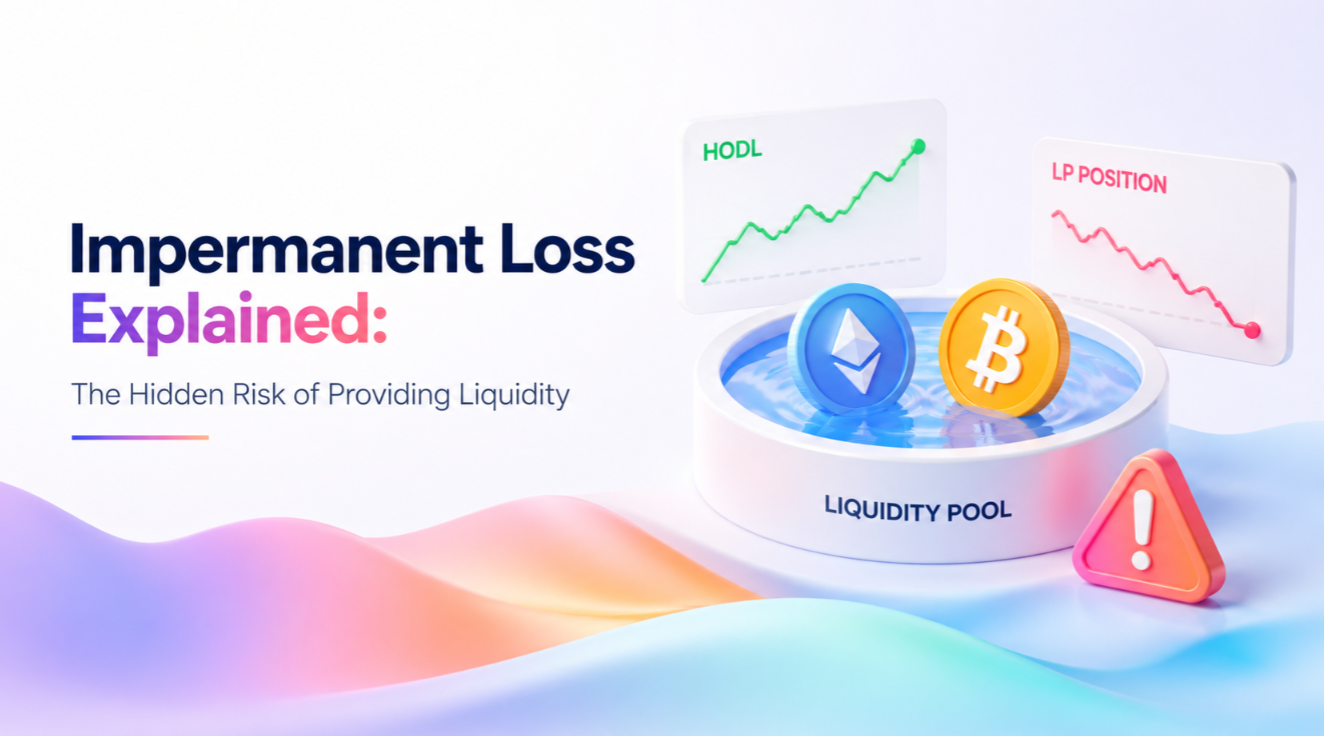
Impermanent loss is the gap between holding two assets and providing them as liquidity. When their relative price diverges, the pool rebalances you into more of the weaker asset, and the loss becomes permanent the moment you withdraw. Trading fees are meant to offset it, which works on high-volume pools of correlated assets and frequently does not on volatile pairs.
Provide liquidity to a pool, and the marketing pitch is simple: earn trading fees on assets you already hold. What that pitch tends to leave out is impermanent loss — the gap between what your liquidity position is worth and what you'd have if you'd simply held the two assets separately. It's not a fee, not a hack, and not something that shows up as a line item anywhere obvious, which is exactly why so many liquidity providers don't notice it until they've withdrawn and done the maths.
What Impermanent Loss Actually Is
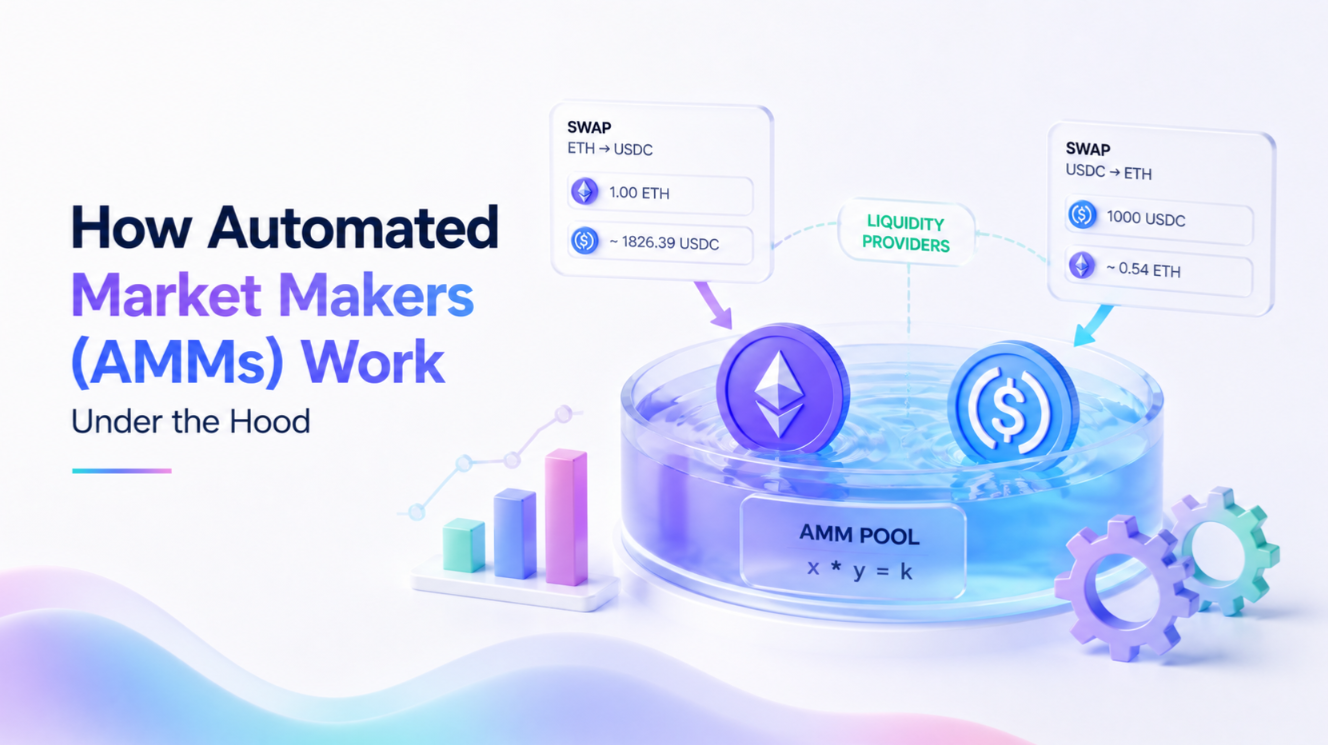
When you deposit two assets into an automated market maker pool — say ETH and USDC — the pool doesn't just hold them passively. It rebalances constantly as traders buy and sell against it, using a formula that keeps the product of the two reserves constant. As the price of one asset moves relative to the other, the pool automatically sells the appreciating asset and buys the depreciating one to maintain that balance. That's what makes the pool function as a market maker, and it's also precisely what causes impermanent loss: you end up holding less of whichever asset went up and more of whichever went down, compared with having just held your original deposit.
A Worked Example With Real Numbers
Say you deposit 1 ETH and 2,000 USDC into a pool when ETH is trading at $2,000 — a total position worth $4,000, split evenly. Now suppose ETH doubles to $4,000. If you'd simply held the two assets in a wallet, you'd have 1 ETH worth $4,000 plus 2,000 USDC, for a total of $6,000. But because the pool has been rebalancing along the way, selling ETH into USDC as the price rose, your actual liquidity position is now worth about $5,657 — roughly 0.707 ETH and 2,828 USDC. That's a shortfall of around $343, or 5.7% less than simply holding. Double the price move again, so ETH rises fourfold from the original entry, and the shortfall widens to roughly 20%. The loss compounds with the size of the price divergence, not linearly but geometrically.
Why It's Called 'Impermanent'
The loss is labelled 'impermanent' because it only becomes a realised, permanent loss the moment you withdraw. If ETH's price later falls back to exactly where it started, the pool rebalances back too, and the paper loss disappears entirely — you'd be back to holding the equivalent of your original deposit, fees aside. The name is accurate but has always struck plenty of liquidity providers as a slightly generous way of describing something that, in practice, very often does become permanent, simply because prices rarely retrace to the exact entry point before an LP decides to exit.
The Formula, in Plain English
For a standard constant-product pool, the impermanent loss relative to holding can be calculated as 2 × √(price ratio) ÷ (1 + price ratio), minus 1, where the price ratio is the new price divided by the entry price. Plug in a price ratio of 1 — no change at all — and the result is zero loss, as you'd expect. Plug in a ratio of 4, meaning one asset has quadrupled against the other, and the loss comes out around 20%. The formula is symmetric, too: it doesn't matter whether the price ratio moves up or down, only how far it moves from 1. A 50% drop and a 100% gain produce the same percentage impermanent loss, because both represent the same underlying divergence between the two assets' relative prices.
How Fees Are Supposed to Offset It
None of this means liquidity provision is a bad trade — it means the fee income earned from the pool has to be weighed against this divergence cost, not treated as free money on top of holding. A pool with high trading volume relative to its total liquidity can generate enough fee revenue to comfortably outrun a modest impermanent loss; a low-volume pool paired with a highly volatile asset often can't. This is why the same ETH/USDC pair can be a perfectly sensible position on a busy exchange during a high-volume period and a quietly losing one on a quieter venue during a trending market, even though the underlying maths of impermanent loss is identical in both cases.
When Impermanent Loss Gets Worse
The size of the loss scales with how uncorrelated and volatile the two pooled assets are. A pool pairing two assets that tend to move together — ETH and a liquid-staked ETH derivative, for instance — sees only minor divergence even in a strong trend, because both sides of the pool are moving in roughly the same direction. Pair a stablecoin against a small-cap token in the middle of a violent rally or crash, on the other hand, and the divergence can run into double-digit percentages within days, because one side of the pool is fixed in price while the other is moving hard in one direction.
Strategies to Manage It
Experienced liquidity providers manage this risk a few ways: sticking to correlated or stable pairs where divergence is structurally limited, choosing concentrated liquidity ranges on platforms like Uniswap v3 that let capital be deployed only around the price band actually being traded (which boosts fee capture per pound of capital but also sharpens losses if price exits that range), and simply sizing positions with the understanding that a token in a strong directional trend will produce meaningfully worse outcomes as an LP than as a straightforward holder. None of these eliminate impermanent loss; they manage the trade-off around it.
Impermanent Loss Isn't the Only Cost to Watch
It's worth separating impermanent loss from a couple of related but distinct risks that often get lumped in with it. Smart contract risk — the chance that the pool's underlying code has a bug or gets exploited — exists independently of any price divergence and can wipe out a position entirely regardless of how correlated the pooled assets are. Gas costs on entering and exiting a position, particularly on Ethereum mainnet during busy periods, can also erode returns meaningfully for smaller LPs, to the point where the fees earned on a modest position over a short holding period may not even cover the cost of the two transactions needed to open and close it. A full accounting of whether providing liquidity was worthwhile has to include all three: impermanent loss, contract risk, and the simple cost of transacting on-chain in the first place.
Comparing Two Real Scenarios Side by Side
Consider two LPs who each deposit $10,000 into different pools on the same day. The first puts capital into a USDC/DAI pool, where both assets are stablecoins that rarely move more than a fraction of a percent against each other; even over a volatile month, the impermanent loss on that position is likely to be a rounding error, and fee income from stablecoin trading volume — often high, since arbitrage and cross-platform stablecoin swaps happen constantly — ends up being close to pure profit. The second puts capital into a newly launched token paired against ETH, and within three weeks the new token has fallen 60% against ETH on broad market weakness. The impermanent loss on that position alone could easily run to 15% or more of the deposit, and no realistic level of trading fees on a young, low-volume pool is going to cover that gap. Same mechanism, wildly different outcome, entirely explained by the correlation and volatility of the underlying pair.
The Bottom Line
Impermanent loss isn't a flaw in AMM design, it's the direct mechanical consequence of how these pools maintain liquidity and pricing without an order book. The mistake isn't providing liquidity — it's providing liquidity without running the comparison against simply holding first. Before committing capital to any pool, work out what fee yield you'd need to offset a plausible price move in either direction, and only then decide whether the trade is actually worth making.
FAQ
What is impermanent loss?+
The gap between holding two assets and providing them as liquidity. When their relative price diverges, the pool rebalances you into more of the weaker asset.
Why is it called impermanent?+
Because it reverses if prices return to their original ratio. Once you withdraw, it stops being impermanent and becomes a realised loss.
Do trading fees offset impermanent loss?+
Sometimes. Fees accrue continuously while divergence loss depends on the price move, so a high-volume pool with a stable pair can come out ahead and a volatile pair frequently does not.
How can I reduce impermanent loss?+
Provide liquidity for correlated pairs, where relative prices barely move, and compare realised fee revenue against a simple hold before committing capital.
 Dario FennDeFi & Markets Lead · DeFi protocols, yield, market structure and on-chain data