Liquidation Mechanics: How Lending Positions Actually Die
Liquidation is not a margin call. There is no phone call, no grace period, and the price that matters is the oracle's, not the market's.
Dario FennDeFi & Markets Lead · DeFi protocols, yield, market structure and on-chain dataUpdated 24 September 2026
The short answer
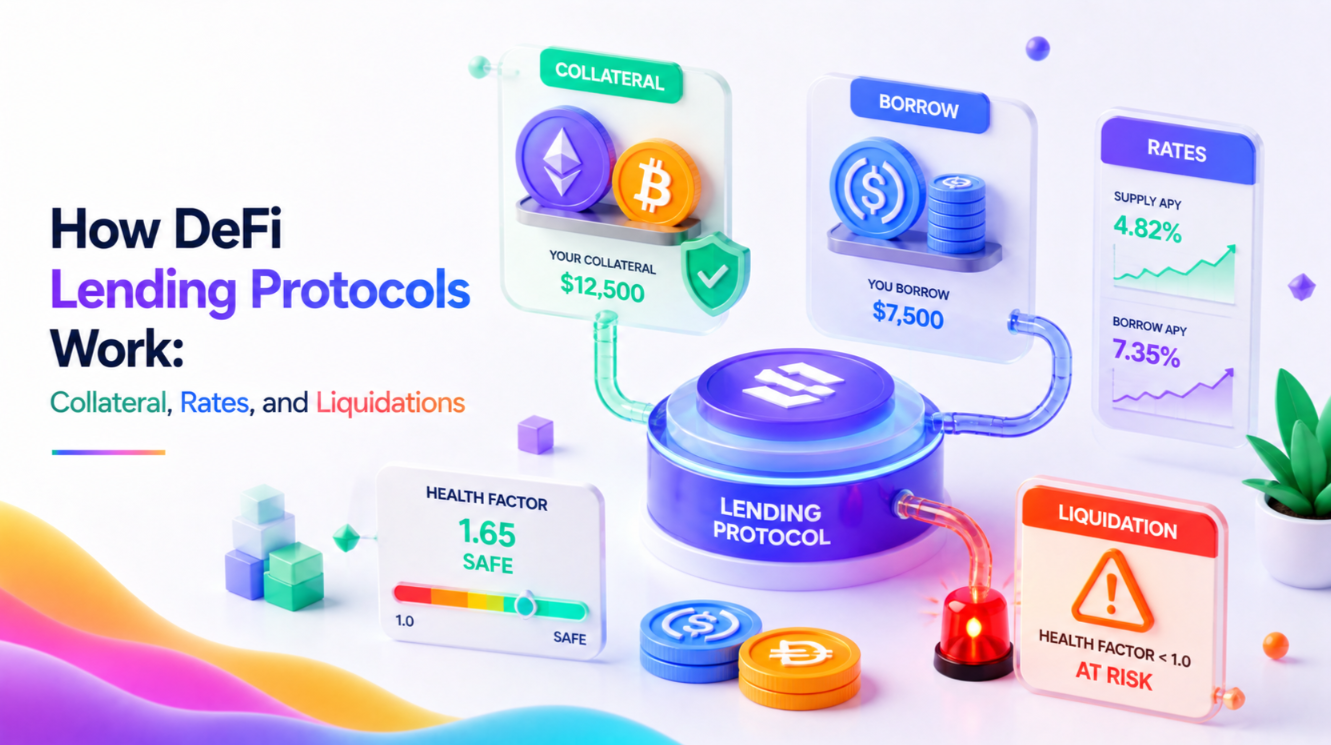
A DeFi loan is liquidated when the value of collateral falls far enough relative to debt that the position crosses a liquidation threshold, measured by a health factor. Anyone can then repay part of the debt and seize collateral at a discount, the liquidation penalty. Liquidations are triggered by oracle price updates, execute in seconds, and are irreversible. Safe borrowing means sizing to a collateral drawdown you can survive, not to the maximum the interface allows.
A lending protocol has no way to chase you for a shortfall. Its only protection is over-collateralisation and the ability to sell your collateral before it is worth less than your debt. Everything about liquidation follows from that constraint.
The health factor
Each collateral asset has a liquidation threshold — the fraction of its value that can support debt. Blue-chip assets sit around 80–85%; volatile or thinly traded ones much lower. Your health factor is the sum of collateral values weighted by their thresholds, divided by total debt. Above 1 you are solvent. At or below 1 you can be liquidated.
Two consequences people miss. The threshold is not the same as the maximum loan-to-value at which you can borrow; there is a deliberate gap between the two so a new borrow does not start on the edge. And the health factor moves on both sides — your debt grows with accrued interest even when prices are flat, so a position opened at a comfortable level drifts downward on its own.
The liquidation itself
When health drops to 1, the position becomes available to anyone. A liquidator repays a portion of the debt — commonly up to half in a single call — and receives collateral worth the repaid amount plus a bonus, typically 5–10% depending on the asset.
That bonus is the penalty you pay, and it is the mechanism that makes liquidation reliable: it must be large enough that bots compete to do it in volatile conditions with high gas. On Aave the parameters are set per asset and published, so the exact penalty on your position is knowable in advance.
It is worth being clear about the economics. Liquidation is not a punishment for its own sake; it is the price of guaranteeing the protocol's solvency without a credit relationship. But it does mean a position that falls 1% below the threshold does not lose 1% — it loses the penalty on the liquidated portion, immediately.
Why the oracle is the real trigger
Positions are not evaluated against exchange prices. They are evaluated against whatever the protocol's oracle reports, and oracles update on a heartbeat or a deviation threshold rather than continuously.
This has three practical effects. A brief wick on one venue may never reach the oracle and never liquidate you. A sustained move triggers liquidation at the moment the oracle updates, which can be seconds after the price passed your threshold — or after it has already recovered. And a manipulated or stale oracle can liquidate a perfectly healthy position, which is precisely how several protocol losses have occurred; the mechanics are covered in how oracles work.
For correlated pairs — staking ETH borrowed against ETH, or a stablecoin against a stablecoin — the oracle design matters even more, because some protocols deliberately price a liquid staking token at its underlying exchange rate rather than its market price, which prevents a temporary LST discount from cascading through borrowers.
Bad debt, and who pays for it
If prices gap far enough that collateral is worth less than debt before liquidators can act, the shortfall becomes bad debt. Someone absorbs it: a safety module, the protocol treasury, or in the worst case the depositors of that market.
This is why market structure matters as much as your own health factor. In a shared pool, bad debt from one collateral asset is socialised across all lenders. In an isolated market, it is contained to the lenders who opted into that pair — the trade-off examined in isolated versus shared lending pools. Lending into a pool that accepts a long-tail asset as collateral means underwriting that asset whether you hold it or not.
Surviving as a borrower
Size to a drawdown, not to a health factor. Ask what percentage fall in your collateral takes you to 1, and whether that move has happened before. For ETH, a 40% drawdown inside a month is entirely ordinary history; a position that dies at 30% is a position that dies.
Then reduce the correlations working against you. Borrowing a volatile asset against volatile collateral means both legs can move the wrong way at once. Borrowing stablecoins against blue-chip collateral leaves you one variable to watch.
Keep the repayment ready. The cheapest liquidation defence is the ability to repay part of the debt in the same minute you notice, which means holding the repayment asset somewhere you can reach without a bridge or a swap.
Set alerts on the health factor, not on the price, and set them well above 1 — by the time an alert at 1.05 fires in a fast market, the position is often already gone. And remember that everyone is liquidated in the same conditions: gas spikes, front ends fail, and RPC endpoints time out precisely when you need to act. A position that requires you to intervene during a crash is not a safe position, it is a plan that assumes calm.
The lending ratings score parameter transparency, oracle design and bad-debt history as distinct criteria, because those three determine what happens to you on the worst day rather than on an average one.
FAQ
What is a health factor in DeFi lending?+
Collateral value weighted by each asset's liquidation threshold, divided by total debt. Above 1 the position is safe; at or below 1 anyone can liquidate it.
How much does liquidation cost?+
A liquidator seizes collateral worth the repaid debt plus a bonus, usually 5–10% depending on the asset. That bonus is your loss, applied immediately to the liquidated portion.
Can I be liquidated by a price wick?+
Only if the oracle records it. Protocols use oracle prices with update heartbeats and deviation thresholds, so a brief move on one venue may never trigger liquidation — and a stale or manipulated oracle can trigger one unfairly.
What is bad debt in a lending protocol?+
The shortfall when collateral becomes worth less than the debt before liquidators can act. It is absorbed by a safety module, the treasury, or ultimately by depositors in that market.
 Dario FennDeFi & Markets Lead · DeFi protocols, yield, market structure and on-chain data