Crypto Options Explained: Greeks, Implied Volatility, and Strategies
Crypto options pricing runs on the same mechanics as equity options, with one crucial difference: the underlying never stops trading. Here's how the Greeks and implied volatility actually work in a 24/7 market.
Dario FennDeFi & Markets Lead · DeFi protocols, yield, market structure and on-chain dataUpdated 10 August 2026
The short answer
An option gives the right, not the obligation, to buy or sell at a fixed strike by an expiry, for a premium paid upfront. Its price moves with the Greeks — delta to the underlying, gamma to the rate of that move, theta to time, vega to implied volatility. Implied volatility is what you are really trading, which is why a correct directional call can still lose money when volatility collapses after an anticipated event.
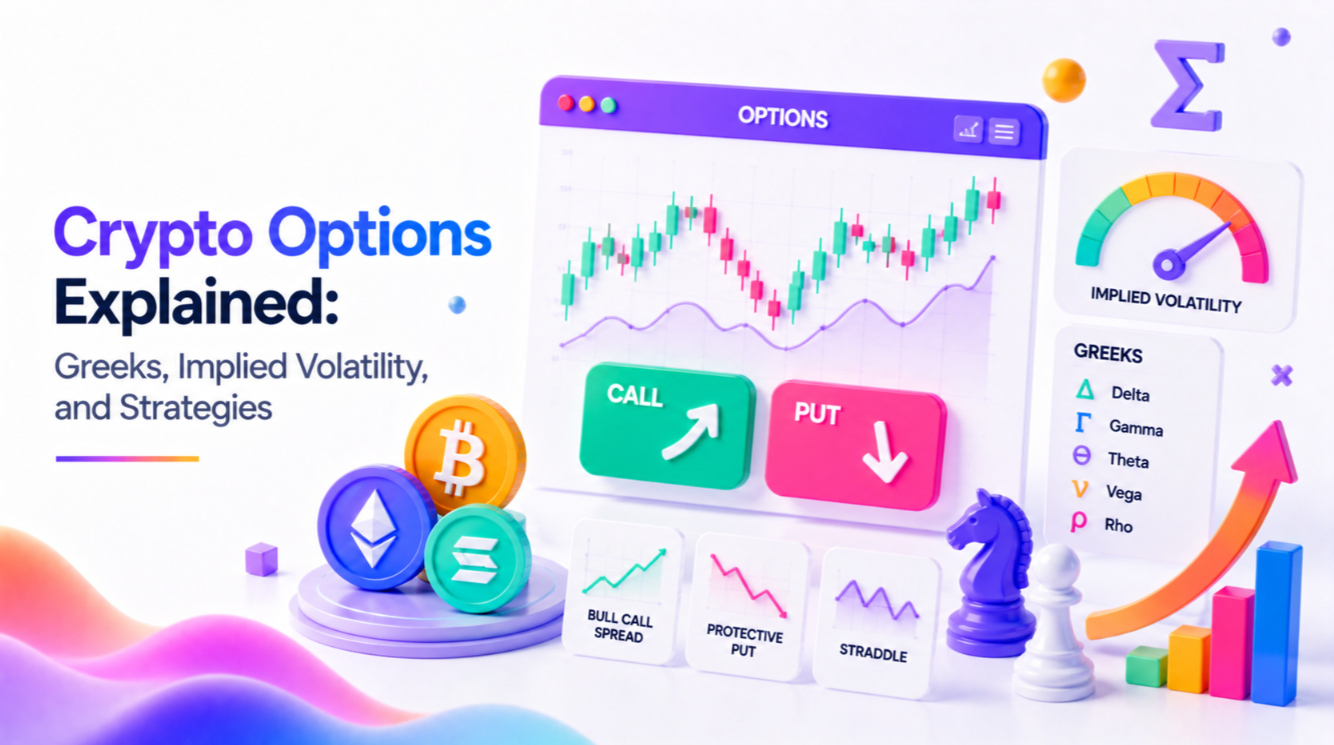
Crypto options give a buyer the right, but not the obligation, to buy (a call) or sell (a put) an asset at a fixed strike price by a set expiry, in exchange for an upfront premium — and while that definition is identical to equity options, the mechanics of trading them in crypto diverge from traditional markets in ways that matter the moment you move past the basics. Deribit still clears the overwhelming majority of global crypto options volume, with Bitcoin and Ether contracts settling in the underlying coin rather than cash, and understanding how that market actually prices risk requires getting comfortable with the Greeks and implied volatility, not just the payoff diagram every introductory guide stops at.
The Greeks: what actually moves an option's price
Delta measures how much an option's price moves for a $1 move in the underlying — a call with 0.50 delta gains roughly $0.50 for every $1 BTC rises, and delta also functions as a rough proxy for the market's implied probability the option finishes in the money. Gamma measures how fast delta itself changes, and it's highest for at-the-money options close to expiry, which is exactly why short-dated ATM options can swing from feeling like a coin flip to feeling like a certainty within hours as gamma accelerates delta's movement. Theta is time decay — the amount of value an option bleeds every day purely from the passage of time, all else equal — and it works against option buyers and in favour of option sellers, which is the single biggest reason naive long-options strategies lose money even when the trader's directional call turns out correct but slow. Vega measures sensitivity to implied volatility itself: an option can gain value even with the underlying dead flat, purely because the market's expectation of future volatility rose. Crypto's Greeks behave the same mathematically as equities', but with far larger absolute swings, because the underlying volatility feeding into every one of these calculations runs several multiples higher than a typical equity index.
Implied volatility: the market's own forecast
Implied volatility, or IV, is the volatility figure that, plugged back into an option pricing model like Black-Scholes, produces the option's current market price — it is not a measure of past price swings but the market's collective, forward-looking bet on how much the underlying will move before expiry. Bitcoin's IV typically ranges from the high 40s to low 60s in percentage terms during calm periods and can spike past 100% around genuine uncertainty, compared with an equity index that might sit in the mid-teens. This gap exists because crypto genuinely does move more, but also because crypto options markets are thinner and less arbitraged than equity options, leaving more room for IV to overshoot realised volatility on both the high and low side — which is precisely the mismatch that volatility traders are trying to exploit rather than a pricing inefficiency retail traders can safely ignore.
Reading the volatility smile and skew
Plot IV against strike price for a given expiry and, rather than a flat line, you get a smile or a skew — out-of-the-money puts and calls typically carry higher implied volatility than at-the-money options, because the market prices in fatter tail risk than a simple lognormal model assumes. In crypto specifically, the skew has historically leaned towards expensive puts relative to calls during risk-off periods — the market paying up for crash protection — and towards expensive calls during strong bull runs, when speculative upside demand outweighs hedging demand. Watching how that skew shifts day to day is a genuine sentiment gauge, arguably a better one than funding rates, because it reflects real premium being paid for asymmetric protection rather than just positioning.
IV crush: the trade that catches beginners every time
Implied volatility tends to spike ahead of known binary events — an FCC or SEC ruling, an ETF approval decision, a Fed rate announcement, a halving — as the market prices in the chance of a large move. The moment the event resolves, whatever the outcome, that uncertainty premium collapses almost immediately, a phenomenon known as IV crush. A trader who buys a straddle purely because they expect volatility around an announced event, without accounting for the fact that IV was already elevated going in, can watch the underlying move sharply in their predicted direction and still lose money, because the collapse in IV after the event wipes out more value than the directional move added. This is the single most common mistake among newer options traders and the clearest argument for checking where current IV sits relative to its own recent range before putting on any volatility-sensitive trade.
Core strategies and what each one is actually for
A covered call — holding the underlying and selling a call against it — generates premium income in exchange for capping upside beyond the strike, and it's the standard strategy for a holder who's bullish-to-neutral and willing to sell into strength anyway. A cash-secured put — selling a put backed by enough stablecoin to buy the underlying if assigned — effectively gets paid to place a limit buy order below the current price, a favourite among traders who want to accumulate on dips rather than chase rallies. A long straddle, buying a call and a put at the same strike, profits from a large move in either direction and is a pure bet on realised volatility exceeding what's implied — the trade to avoid running into a known IV crush. An iron condor, selling a call spread and a put spread simultaneously, profits from the underlying staying within a defined range and is the standard structure for extracting premium in a market that's expected to chop rather than trend. None of these are exotic; they're the same building blocks equity options traders have used for decades, just applied to an underlying that moves considerably more and never closes.
Why crypto options trade differently from equity options
The 24/7 nature of the underlying is the structural difference that changes everything downstream: equity options traders get weekends and overnight sessions where the clock effectively pauses on realised volatility even as theta keeps ticking on the option, whereas Bitcoin can move 8% on a Saturday with full theta decay and full gamma exposure running the entire time — there's no calm period, which is part of why crypto IV runs structurally higher. Deribit's dominance also means crypto options liquidity is far more concentrated in a single venue than equity options are across their fragmented exchange landscape, so wide bid-ask spreads on less liquid strikes and expiries are a genuine cost that needs pricing into any strategy, not a rounding error. And because most crypto options settle in the underlying coin rather than cash, a trader exercising a Bitcoin call needs to actually think about custody and withdrawal logistics that a cash-settled S&P option trader never has to consider.
Sizing and managing the risk properly
Options leverage is often described in terms of premium paid relative to notional exposure controlled, and in crypto that ratio can look extraordinarily favourable on paper — a small premium controlling a large notional position — right up until theta and an IV crush combine to make a directionally correct trade a net loser anyway. The traders who last in this market treat the Greeks as a live risk dashboard, not a one-time calculation at entry: checking delta to know actual directional exposure, watching gamma near expiry because it can flip a position's risk profile within a single session, and tracking vega separately from delta because a well-hedged directional position can still take a real loss purely from a volatility collapse that has nothing to do with which way the underlying moved.
FAQ
What are the option Greeks?+
Sensitivities of an option's price: delta to the underlying's move, gamma to the rate of that change, theta to time passing, and vega to shifts in implied volatility.
What is implied volatility?+
The market's forecast of future movement, backed out of the option's price. It is what you are actually buying or selling, which is why an option can lose value even when the direction is right.
What is IV crush?+
A collapse in implied volatility after an anticipated event, which cuts the option's value regardless of direction. It is the most common way beginners lose money on a correct call.
Why do crypto options differ from equity options?+
The underlying trades continuously, so there are no weekend gaps or closing auctions, and volatility is both higher and more reflexive than in equities.
 Dario FennDeFi & Markets Lead · DeFi protocols, yield, market structure and on-chain data