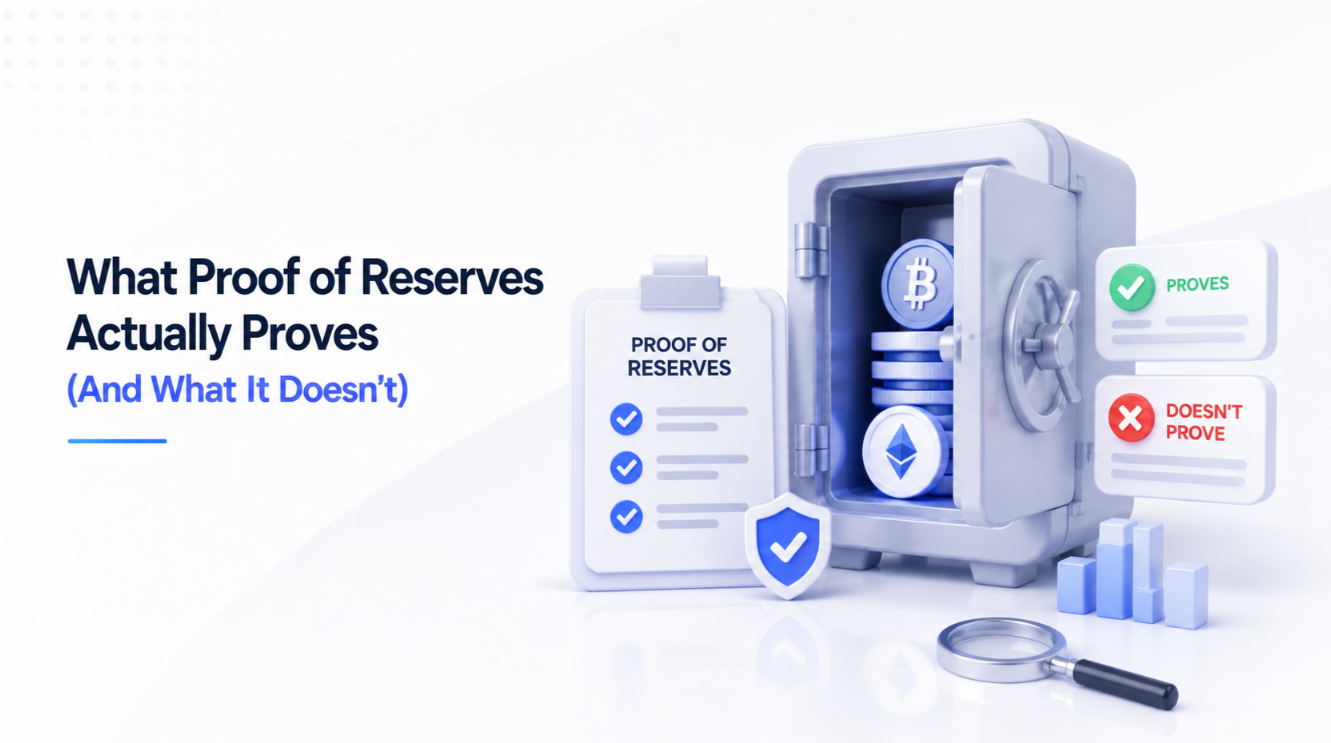
What Proof of Reserves Actually Proves (And What It Doesn't)
A Merkle-tree snapshot is evidence, not a solvency statement. Here is exactly what an exchange proves when it publishes reserves, and the three gaps every programme leaves open.
Nadia OkoroPolicy & Consumer Editor · Regulation, tax, stablecoins and the products retail users holdUpdated 17 August 2026
The short answer
Proof of reserves demonstrates that an exchange controlled a set of wallets at a moment in time. It does not show what the exchange owes, whether the assets were borrowed for the snapshot, or whether they are still there today. A reserve attestation is only a solvency statement when it covers liabilities as well, which most do not.
After FTX collapsed with a hole where customer assets should have been, every large exchange published proof of reserves within about six weeks. The pages look reassuring: a total, a Merkle root, a verification tool, sometimes an accountant's logo. Most of them prove considerably less than readers assume, and the gap between what is proved and what is inferred is where the next failure will live.
What a proof of reserves actually demonstrates
The standard implementation does two things. It publishes a list of wallet addresses and signs a message from each to show the exchange controls the keys. And it builds a Merkle tree of customer balances, publishes the root, and gives each customer a proof they can check to confirm their own balance was included in the total.
Together those establish one narrow fact: at the moment of the snapshot, the exchange controlled wallets holding X, and the customer balances it claimed to owe summed to Y. If X is greater than or equal to Y, the exchange was covered for those specific assets at that specific instant.
That is genuinely useful. Before 2022 the industry offered nothing at all, and an exchange that publishes reserves monthly is measurably more accountable than one that does not. It is also three steps short of a solvency statement.
Gap one: liabilities beyond customer balances
The Merkle tree covers what the exchange owes its customers. It says nothing about what the exchange owes anyone else — loans from lenders, obligations to a sister trading firm, bond issues, unpaid tax, litigation provisions. An exchange can hold every customer coin and still be insolvent because of debts that never appear in the tree.
This is exactly the FTX failure mode. Customer assets moved to Alameda; the shortfall was a liability to customers created by lending their assets to a related party. A reserves-only proof published the week before would not have flagged it, because the wallets and the tree address a different question.
The programmes that close this gap say so explicitly: they cover liabilities alongside assets and are conducted with an independent accounting firm. Kraken is the clearest example among the venues we rate, which is one reason it carries the highest security mark in the exchange ratings.
Gap two: the snapshot is a moment, not a period
A proof covers one block height. Assets present at that height can leave at the next one. Nothing in the mechanism prevents an exchange from borrowing assets shortly before the snapshot, signing, and returning them afterwards — a practice traditional finance calls window dressing and has spent decades writing rules against.
There is a partial defence. If snapshots are frequent, unannounced in advance, and taken at block heights the exchange cannot choose, borrowing for each one becomes expensive and visible on-chain. Monthly publication on a fixed cadence, as OKX has run for several years, is meaningfully harder to game than an annual page refreshed when convenient.
Gap three: the assets you cannot see
Most programmes cover a handful of major assets — bitcoin, ether, a couple of stablecoins — because building the tree for hundreds of long-tail tokens is work with little marketing value. If you hold something outside that set, the proof does not cover your balance, and the exchange's total tells you nothing about whether your specific asset is fully backed.
Check the asset list before you take comfort from the headline number. On several venues, the covered set is well under half of what the exchange lists for trading.
How to read a reserves page in five minutes
Start with the date and cadence. A page updated monthly for two years is a different signal from one published once in 2023. Then look for the word liabilities: if it appears only as a description of the customer-balance tree, the programme covers assets and customer claims, not total obligations.
Check who verified it. An independent accounting firm performing an agreed-upon-procedures engagement is a stronger claim than a self-published tree, and both are weaker than a full financial audit — which almost no exchange provides. Then check which assets are covered, and whether your own balance verifies through the tool rather than assuming it does.
Finally, note what the exchange does not publish. A venue that has never disclosed an ownership structure or filed accounts anywhere is asking you to trust a snapshot as a substitute for everything else it will not show you.
What to do with the answer
Treat reserves as one input among several: incident history, regulatory standing, disclosure quality, and whether the entity you contracted with is the one holding the coins. Our exchange rubric weights security and custody at 25% and regulatory standing at 20% precisely because a reserve page cannot carry that judgement on its own.
The practical conclusion has not changed since 2022: an exchange is a custodian, proof of reserves is partial evidence about a custodian, and the only position that removes custodial risk entirely is self-custody.
FAQ
Does proof of reserves mean an exchange is solvent?+
No. It shows assets held against customer balances at one moment. Solvency also depends on liabilities outside the customer tree — loans, obligations to affiliates, litigation — which standard proofs do not cover.
What is a Merkle tree proof of reserves?+
A cryptographic structure that lets an exchange publish one root hash summarising every customer balance, so each customer can verify their own balance was included in the total without seeing anyone else's.
Can an exchange fake proof of reserves?+
It can borrow assets before a scheduled snapshot and return them afterwards. Frequent, unannounced snapshots at block heights the exchange does not choose make that expensive and visible on-chain.
Which exchanges have the strongest reserve programmes?+
Programmes that cover liabilities as well as assets and involve an independent accounting firm are the strongest. Among the venues we rate, Kraken's liability-inclusive attestation and OKX's unbroken monthly cadence stand out.
 Nadia OkoroPolicy & Consumer Editor · Regulation, tax, stablecoins and the products retail users hold