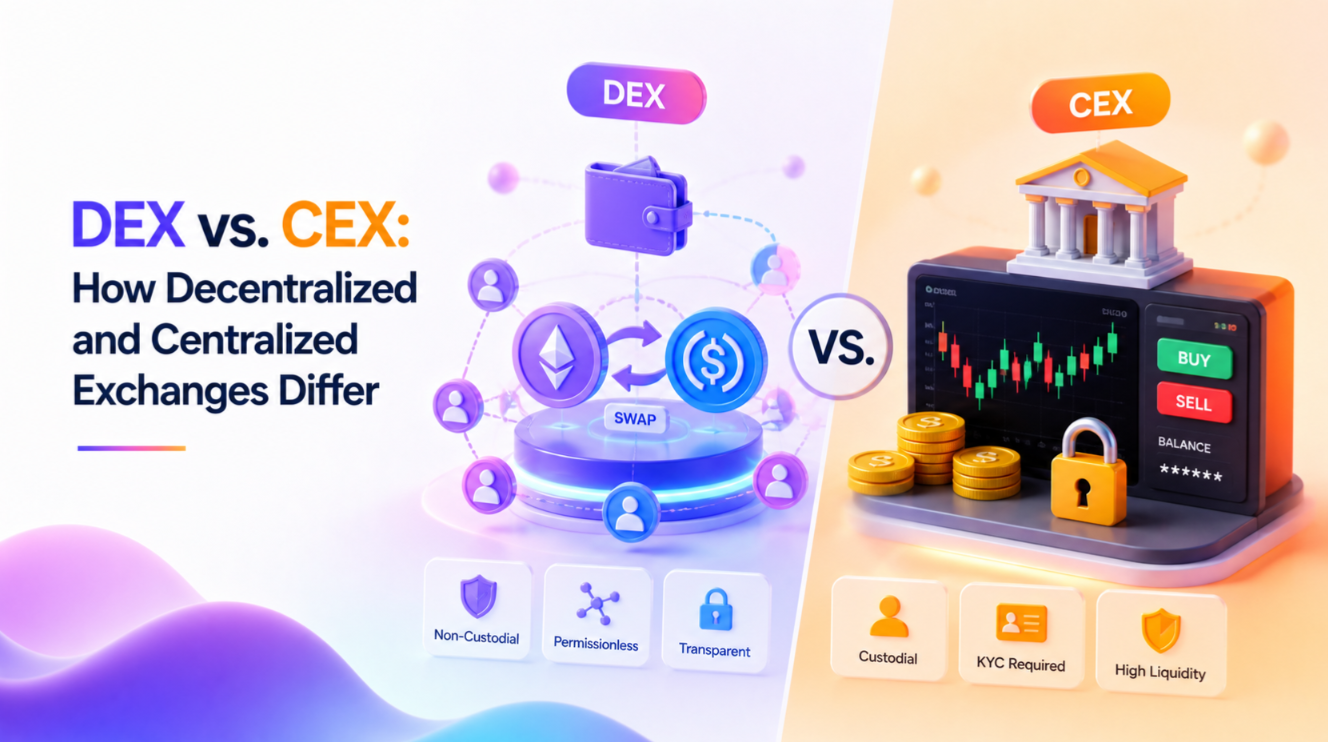
DEX vs. CEX: How Decentralized and Centralized Exchanges Differ
Every crypto trade happens through one of two fundamentally different plumbing systems. Understanding the DEX vs. CEX trade-offs — custody, liquidity, execution, cost — matters more than picking a side.
Dario FennDeFi & Markets Lead · DeFi protocols, yield, market structure and on-chain dataUpdated 24 July 2026
The short answer
The difference is custody. A centralised exchange holds your assets and matches orders on its own books; a decentralised exchange settles on-chain from a wallet you control. Major pairs are usually tighter on a deep centralised book, while many mid-cap tokens fill better on-chain. Only comparing the same trade size on both settles which is cheaper for a given trade.
Ask ten traders whether a DEX or a CEX is the better place to trade and you'll get ten confident, contradictory answers, most of them based on where that particular trader happened to have a bad experience once. The honest answer is that DEX vs. CEX isn't a contest with a winner — it's a set of structural trade-offs that shift depending on what you're trading, how much of it, and how much you value control over convenience. Both models have existed for years, both have had catastrophic failures, and both are still growing. Knowing the mechanics behind each is more useful than picking a tribe.
Who actually holds your coins
The starting point, and the one that matters most when things go wrong, is custody. On a centralised exchange — Binance, Coinbase, Kraken — you deposit assets into wallets the exchange controls, and your account balance is effectively an IOU the exchange owes you, tracked on its own internal database rather than on-chain. That arrangement is what made FTX possible: customer deposits sat in wallets the exchange controlled, and when the exchange chose to use them for something else entirely, depositors had no on-chain claim to fall back on, only a bankruptcy queue. A decentralised exchange never takes custody at all. Trading on Uniswap or a similar protocol means your assets stay in your own wallet until the instant a swap executes via smart contract, and then the new assets land straight back in your wallet. There is no exchange balance to seize, freeze, or lose to mismanagement, because there is no exchange holding anything. The trade-off is that this shifts all custody risk onto you personally — lose your seed phrase and there's no support desk to call.
Where the liquidity actually comes from
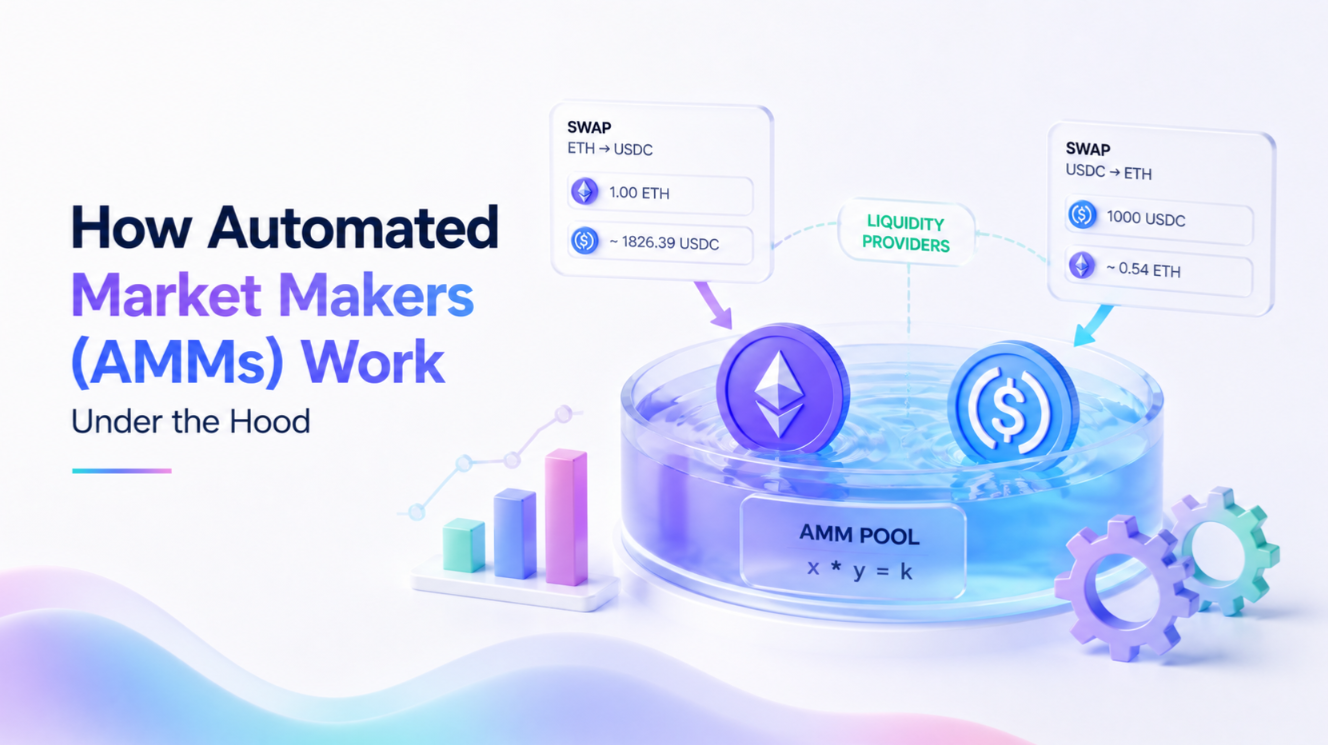
Centralised exchanges run an order book: buyers and sellers post limit orders, a matching engine pairs them, and market makers are paid in maker rebates to keep spreads tight and books deep. This is why a large order on Binance for a top-50 asset barely moves the price — professional market makers are competing to fill it. Most DEXs instead run on automated market makers, pools of two assets supplied by liquidity providers, priced by a formula rather than an order book. A trade against a Uniswap pool doesn't match against another trader's order, it moves along a pricing curve, and the further you push the trade, the worse your price gets — a phenomenon called slippage that barely exists on a deep CEX order book for the same size. For a small trade in a well-funded pool, this difference is invisible. For a large trade in a thin pool, it can mean paying several percent more than the quoted price, which is why serious size on DEXs increasingly routes through aggregators that split orders across multiple pools to minimise the damage.
Execution speed and the MEV problem
A CEX trade executes the instant it's matched, inside a company's own servers, with no public visibility until after the fact. A DEX trade has to be broadcast to a public mempool and included in a block, which means anyone running the right infrastructure can see your trade coming before it settles — and act on it. This is the source of MEV, or maximal extractable value: bots that spot a pending DEX trade, insert their own buy order immediately before it and a sell immediately after, pocketing the difference at the original trader's expense. It's a real cost that has no equivalent on centralised venues, though tools like private transaction relays and MEV-aware routing have made meaningful dents in it over the past couple of years. It's a cost worth knowing about before executing anything sizeable on-chain, not a reason to avoid DEXs altogether.
What you're actually trading, and what it costs
Centralised exchanges list assets after internal review, which means access to genuinely new tokens is often slower and gatekept — but it also means a baseline of due diligence, however imperfect, sits between a scam token and your order book. DEXs list nothing; any wallet can create a trading pair for any token in seconds, which is exactly why new tokens launch on decentralised venues first and why the overwhelming majority of tokens that ever get created on a DEX go to zero. Cost structures differ too: CEX fees are typically a flat percentage, often under 0.1% for makers on high-volume tiers, charged in fiat-equivalent terms with no separate network cost. DEX trades carry a protocol fee, usually 0.05% to 0.3% depending on the pool, plus the blockchain's own gas fee for executing the transaction — which on Ethereum mainnet during busy periods can dwarf the trade itself for small orders, though layer-2 rollups have made this far less punishing than it was a few years ago.
Regulation and who you're actually dealing with
Centralised exchanges are, increasingly, licensed and regulated entities that require identity verification, report to tax authorities in many jurisdictions, and can freeze accounts or block withdrawals on request from a regulator or a court. That's a genuine constraint on freedom of action, but it also means there's a legal entity that can, in principle, be held accountable — which is precisely what happened, however slowly and incompletely, in the aftermath of FTX's collapse. DEXs have no such entity to hold accountable in the same way; the protocol is code, deployed once and often unstoppable by design, which is the entire point for users who value censorship resistance but also means there's genuinely no one to call if a smart contract gets exploited or a frontend gets compromised.
Practical guidance for choosing between them
For most retail-sized trading in established assets, a reputable CEX remains the path of least friction — tighter spreads, no gas costs, fiat on-ramps, and customer support that, while frequently maddening, at least exists. For anything involving newly launched tokens, on-chain-native assets that never get a CEX listing, or situations where custody risk is the dominant concern — after a major exchange collapse, say, or when moving funds you can't afford to have frozen — a DEX is often the only sensible route. The traders who get burned tend to be the ones who apply one tool to every job: running six-figure size through a thin AMM pool without checking slippage, or leaving long-term holdings sitting on a centralised exchange indefinitely because withdrawing felt like an extra step. Match the venue to the trade, not the other way round.
FAQ
What is the main difference between a DEX and a CEX?+
Custody. A centralised exchange holds your assets and matches orders on its own books; a decentralised exchange settles on-chain from a wallet you control.
Which has better prices?+
It depends on the pair. Major pairs are usually tighter on a deep centralised book, while many mid-cap tokens fill better through an on-chain pool or aggregator. Comparing the same trade size on both is the only reliable test.
Do I need to verify my identity on a DEX?+
There is no account to verify, so no. Converting to bank money still requires a regulated venue somewhere, which is where identity checks apply.
What is MEV and does it affect DEX trades?+
Value extracted by reordering transactions, most visibly through sandwich attacks on public swaps. Tight slippage tolerance and an MEV-protected route remove most of the exposure.
 Dario FennDeFi & Markets Lead · DeFi protocols, yield, market structure and on-chain data