














































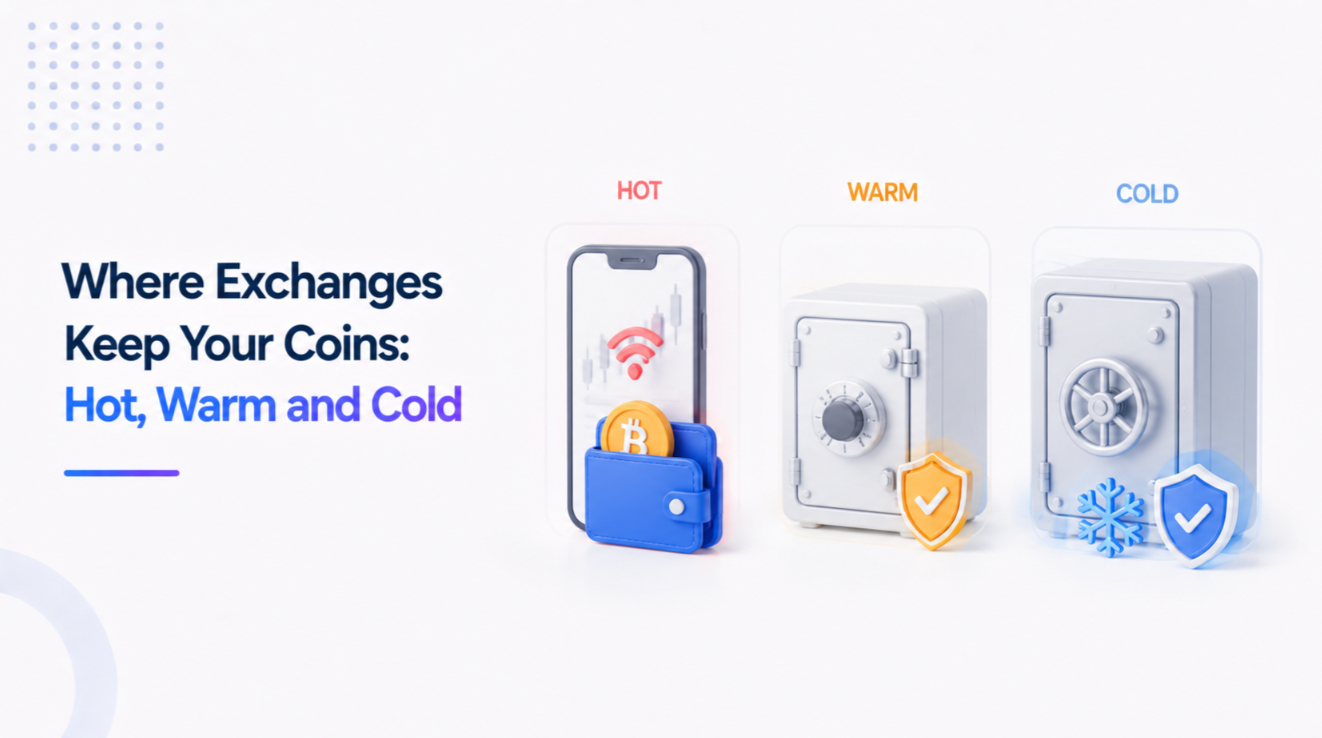
Exchanges tier custody: a small hot wallet connected to the internet processes withdrawals automatically, a warm tier with additional approvals handles larger movements, and cold storage holds the majority offline behind multisig or MPC with geographically distributed key shares. A high cold storage percentage limits the size of a hack but increases withdrawal delays. Neither tier protects against insolvency, and the legal status of client assets matters more than either.
- 1Hot. Keys held on internet-connected systems that sign automatically.
- 2Warm. An intermediate tier requiring human approval or multiple signatures but reachable within minutes.
- 3Cold. Keys generated and held offline, typically in hardware security modules or air-gapped devices, split across multiple signers in different physical…
- 4What to look for. **A stated cold storage percentage,** ideally with an explanation of the tiering.
On this page6 sections
An exchange faces two conflicting requirements. It must process withdrawals instantly, which requires keys that can sign at any moment. And it must protect billions in customer assets, which requires keys that cannot be reached. The resolution is tiering, and the shape of that tiering is one of the more informative things you can learn about a venue.
Hot
Keys held on internet-connected systems that sign automatically. This tier funds routine withdrawals, and it typically holds a small single-digit percentage of total assets — enough for a normal day's outflows.
It is the tier that gets stolen. Every automated exchange theft in the last decade targeted hot infrastructure or the systems controlling it, and the size of the loss was bounded by how much sat there. An exchange keeping 15% hot has a much larger worst case than one keeping 2%.
Defences are operational rather than cryptographic: rate limits, per-address velocity checks, anomaly detection, and automatic suspension when patterns deviate. These work well against gradual theft and poorly against a single large authorised-looking transaction.
Warm
An intermediate tier requiring human approval or multiple signatures but reachable within minutes. It replenishes the hot wallet and handles institutional withdrawals too large for automatic processing.
This is where the human process becomes the control, and it is where the Bybit incident in February 2025 landed: attackers manipulated what signers were shown during an approval, and valid signatures authorised a transfer of roughly $1.5bn. The keys were not stolen and the multisig worked exactly as designed. The failure was in the verification step, which is why multisig custody is only as strong as what each signer independently confirms.
Cold
Keys generated and held offline, typically in hardware security modules or air-gapped devices, split across multiple signers in different physical locations, requiring a deliberate ceremony to move funds. This holds the majority of customer assets, and moving anything from it takes hours or longer by design.
The trade is precisely that latency. A high cold percentage is a security posture that shows up as withdrawal delays during periods of heavy outflow — which is why some delays are a functioning process and others are a warning sign, and telling them apart requires knowing which is normal for that venue.
Most large exchanges now use MPC-based custody for the cold tier rather than traditional multisig, since it produces standard on-chain signatures with no visible contract and works identically across every chain the venue supports.
What to look for
A stated cold storage percentage, ideally with an explanation of the tiering. Coinbase publishes its custody model in some detail as a listed company subject to disclosure obligations; several others describe theirs in security documentation.
Proof of reserves with liabilities. A Merkle-tree commitment lets you verify your balance is included in the total, which is the difference between a reserve claim and a verifiable one — covered in proof of reserves.
Third-party examination. SOC 2 Type II reports, penetration testing, and key ceremony audits are evidence that the described process is the operating process.
Withdrawal address allowlisting on your own account, which is a control you can apply yourself and which defeats most account-takeover scenarios.
The limit of all of it
Custody architecture protects against theft. It does not protect against insolvency, fraud, or the exchange lending out customer assets — the failures that have cost users far more than hacking has.
For that, the questions are legal rather than technical: are client assets segregated and held on trust, in a jurisdiction that enforces the distinction; what do the terms of service say about title to deposited assets, examined in reading an exchange's terms; and who regulates the entity you actually contracted with, which is frequently not the brand on the website.
That is why the exchange ratings treat custody architecture, jurisdiction and asset segregation as three separate criteria. A venue with immaculate cold storage and no legal segregation is a well-secured pool of assets that may not be yours in an insolvency.
What it means for you
The practical conclusion is unchanged by any of this. Exchange balances should be what you are actively trading; holdings belong on a hardware wallet whose keys nobody else tiers. Custody architecture tells you how much you can rely on the exchange in the meantime — it does not change the fact that the safest exchange balance is a small one.
Next step
Understood the mechanics? Keep going, or compare the services.
FAQ
What is exchange cold storage?
What percentage should an exchange keep in cold storage?
Does cold storage mean my funds are safe?
Why do withdrawals sometimes take hours?
Related guides
All guides →- What Is a Crypto Wallet? Hot vs. Cold Storage ExplainedA plain-language breakdown of how crypto wallets actually work, and why the choice between hot and cold storage is the first real security decision every holder makes.Beginner9 min
- DEX vs. CEX: How Decentralized and Centralized Exchanges DifferEvery crypto trade happens through one of two fundamentally different plumbing systems. Understanding the DEX vs. CEX trade-offs — custody, liquidity, execution, cost — matters more than picking a side.Intermediate11 min
- Exchange Insurance Funds vs Real InsuranceTwo completely different things share the word insurance, and neither means what customers assume when an exchange fails.Beginner7 min
- Custodial vs. Non-Custodial Wallets: Who Really Controls Your Crypto?A myth-busting look at the difference between letting an exchange hold your keys and holding them yourself, with the real-world collapses that made the distinction matter.Beginner10 min