
















































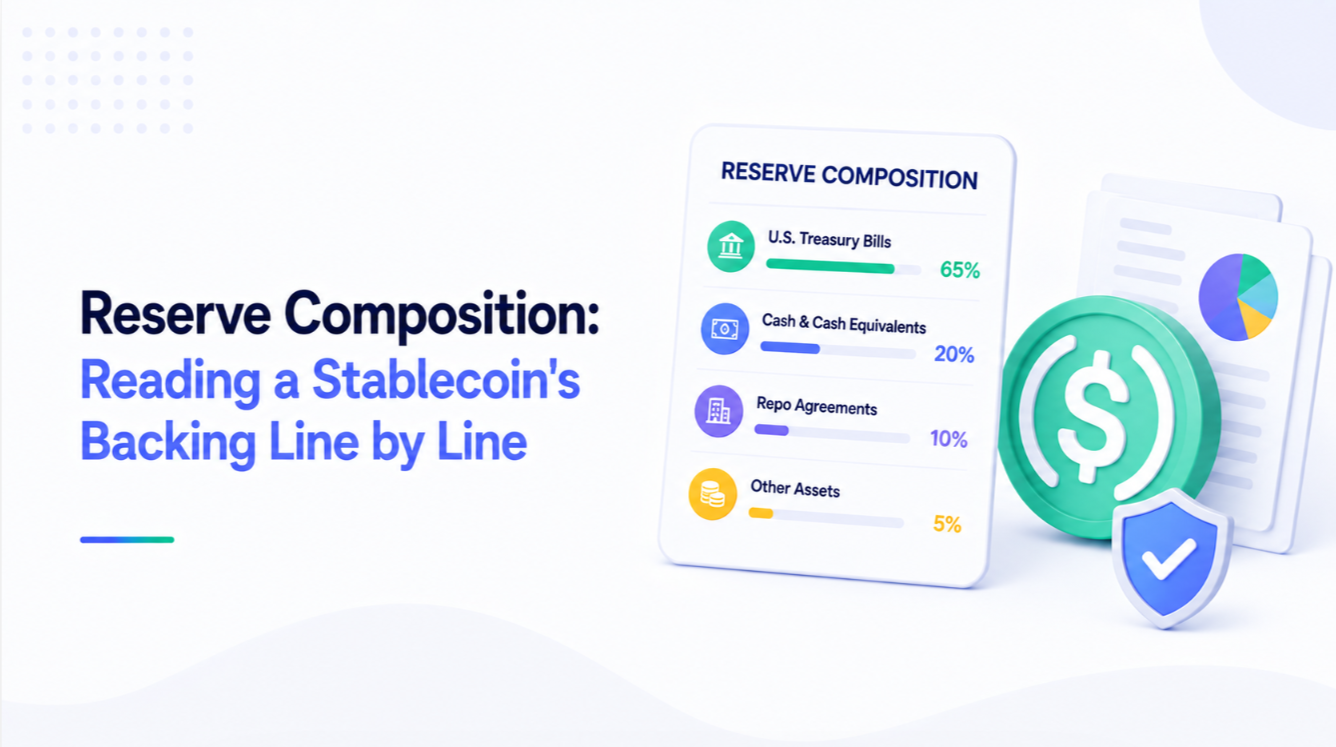
Reserve quality is determined by liquidity under stress and credit exposure, not by the headline backing ratio. Overnight repo and short-dated Treasury bills convert to cash immediately at par. Government money market funds are close behind. Bank deposits are uninsured credit exposure to specific institutions. Commercial paper, secured loans and other digital assets can be illiquid precisely when redemptions arrive. Check composition, maturity and custodians before the ratio.
- 1The ranking, best to worst. **Overnight reverse repurchase agreements.** Cash lent overnight against government collateral.
- 2Maturity, and why it matters more than people think. Duration is the second axis and it is frequently ignored.
- 3Custody and jurisdiction. Where the assets sit determines who can reach them.
- 4Reading the report itself. Work through in order: the as-of date and how recent it is; the preparing firm; whether composition is itemised by instrument type with maturities…
On this page5 sections
A stablecoin holding 102% of its liabilities in assets that cannot be sold on a Monday morning is worse backed than one holding 100% in overnight repo. The ratio is the number everyone quotes; the composition is the number that determines what happens in a run.
The ranking, best to worst
Overnight reverse repurchase agreements. Cash lent overnight against government collateral. One day of duration, effectively no credit risk, converts to cash by definition each morning. The highest-quality reserve asset available and the reason large issuers have shifted heavily toward it.
Treasury bills under three months. Short enough that interest rate moves barely affect value, backed by the government, and traded in the deepest market in the world. Sellable at scale on any business day.
Government money market funds. Treasury exposure with a fund wrapper. Excellent, with one caveat: a fund is a manager and a gate, so redemption is subject to the fund's own terms rather than a direct sale.
Longer-dated Treasuries. Same credit, more duration. If rates rise, the market value falls, and a forced sale during a redemption wave crystallises the loss. Duration is a risk that only appears when you need the money.
Bank deposits. A credit exposure to a specific bank, insured only up to the local limit, which is irrelevant at the scale issuers operate. USDC fell to around $0.87 in March 2023 because roughly $3.3bn of its reserves sat at Silicon Valley Bank as the bank failed. The reserves were real, disclosed and adequate; they were simply somewhere that stopped functioning for a weekend.
Commercial paper and corporate credit. Short-term corporate debt is normally liquid and stops being liquid in exactly the conditions that produce a redemption run. Its retreat from major issuers' reserve reports over the past several years is one of the clearest quality improvements in the category.
Secured loans. Lending to counterparties against collateral. Whether this is sound depends entirely on the counterparties and the collateral, neither of which is usually disclosed in detail. It appears in Tether's breakdown and it is the line that most separates its reserve profile from a pure Treasury portfolio.
Precious metals, bitcoin and other digital assets. Volatile assets backing a fixed liability. Whatever their merits as investments, they can fall at the same moment redemptions rise, which is the opposite of what a reserve is for.
Maturity, and why it matters more than people think
Duration is the second axis and it is frequently ignored. Reserves in overnight and sub-three-month instruments are cash. Reserves in six-month or one-year paper carry mark-to-market exposure — a rate move can put the portfolio underwater on paper even though every instrument will pay at par if held.
That gap between hold-to-maturity value and market value is precisely what destroyed several banks in 2023. Look for the weighted average maturity in the reserve report; the good ones publish it, and the number should be measured in weeks.
Custody and jurisdiction
Where the assets sit determines who can reach them. Read for: named custodians rather than a generic reference to regulated institutions; the jurisdiction of both the issuer and the custodian; whether reserves are held in segregated accounts or as general assets of the company; and whether tokenholders have a direct legal claim on the reserve pool or rank as unsecured creditors.
That last question is not answered by any attestation — it is a matter of corporate structure and law, and it is the difference between a bankruptcy-remote claim and a place in a queue. The distinction between what an attestation covers and what it cannot is set out in attestation versus audit.
Reading the report itself
Work through in order: the as-of date and how recent it is; the preparing firm; whether composition is itemised by instrument type with maturities or summarised into a chart; the weighted average maturity; named custodians; and whether the report reconciles reserves to tokens in circulation rather than to a number the issuer chose.
Then check consistency across months. A composition that shifts materially between reports without explanation is a change in risk that nobody announced, and it is visible only if you read more than one.
Where reserve quality stops being the question
Two exposures sit entirely outside the reserve report. Redemption access — reserves being excellent does not mean you can convert, since most issuers redeem only for verified clients above a minimum, which is the subject of redemption access. And market liquidity, which is what actually determines the price you can get on a bad day.
This is why the stablecoin ratings score reserve quality, disclosure, redemption access, liquidity and regulatory status as separate criteria. A token can hold pristine reserves and still be the wrong thing to hold if you cannot get out of it at par when it matters, and collapsing those into one safety score hides exactly the distinction that decides the outcome.
Next step
Understood the mechanics? Keep going, or compare the services.
FAQ
What are the safest stablecoin reserve assets?
Why are bank deposits risky for stablecoin reserves?
Does 100% backing mean a stablecoin is safe?
What is weighted average maturity and why does it matter?
Related guides
All guides →- Fiat-Backed vs. Crypto-Backed vs. Algorithmic Stablecoins ComparedA side-by-side breakdown of how fiat-backed, crypto-backed and algorithmic stablecoins each maintain their peg, and the specific failure mode that has taken each category down.Intermediate12 min
- How Automated Market Makers (AMMs) Work Under the HoodNo order book, no market makers standing by — just a formula and a pool of reserves. Here's the mechanics behind the constant-product curve that prices most of DeFi.Intermediate10 min
- Yield-Bearing Stablecoins: Where the Yield Comes FromA dollar that pays you something is a dollar taking a risk on your behalf. The only question worth asking is which one.Intermediate10 min
- Why Stablecoins Depeg: The Four MechanismsA stablecoin at $0.94 can be minutes from recovery or days from zero. The difference is which of four mechanisms is doing the breaking.Intermediate9 min