














































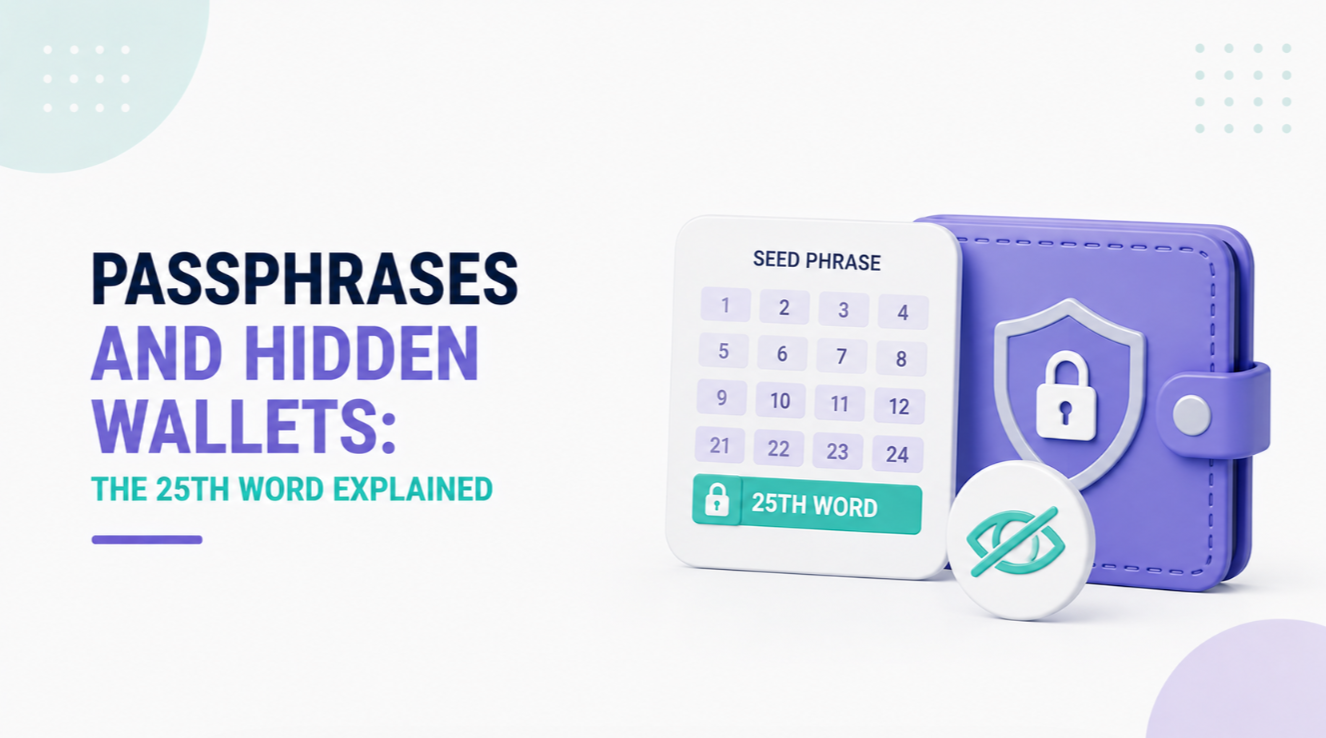
A BIP39 passphrase is an additional secret combined with the seed phrase to derive a different set of accounts. Every possible passphrase produces a valid wallet, so there is no error message for a wrong one — only an empty balance. It protects against a discovered seed backup and enables a plausible decoy wallet, at the cost of an unrecoverable failure if it is lost. Back it up separately from the seed and test the restore before funding.
- 1What it does. Standard derivation takes the twelve or twenty-four words and produces a master key.
- 2What it protects against. **A discovered seed backup.** This is the main case and it is a real one.
- 3What it does not protect against. A malicious transaction you approve.
- 4The failure mode, stated plainly. Lose the passphrase and the funds are gone.
On this page6 sections
The seed phrase is not the wallet. It is an input to a derivation function, and the passphrase is a second input. Change the passphrase and the same seed produces an entirely different, entirely valid set of accounts with no relationship to the first.
This property is what makes it useful and what makes it dangerous, and both follow from the same fact: the wallet does not know which passphrase is correct, because they all are.
What it does
Standard derivation takes the twelve or twenty-four words and produces a master key. With a passphrase, the words and the passphrase are combined first, producing a different master key.
The consequences follow directly. Someone with your seed and no passphrase opens a wallet that is not yours. Someone with your passphrase and no seed has nothing. Both are required, and they can be stored in different places.
There is no such thing as an incorrect passphrase. Type a typo and the device opens the wallet for that typo — a working wallet, with a valid address, containing nothing. It will not tell you anything is wrong, because from the software's perspective nothing is.
What it protects against
A discovered seed backup. This is the main case and it is a real one. A steel plate found in a house, a photograph recovered from a device, a share obtained by someone who should not have it — none of them are enough on their own.
Coercion, with a decoy. Because every passphrase yields a valid wallet, you can maintain one with a small balance and hand it over under pressure while the main wallet remains hidden. Whether this is wise depends entirely on the situation, and it should never be the plan you rely on; the decoy needs a plausible balance and a plausible transaction history or it fails the moment it is examined.
Separating wallets on one device. Several passphrases, several independent wallets, one backup of the seed. This is a legitimate organisational use.
What it does not protect against
A malicious transaction you approve. A compromised computer that captures the passphrase as you type it — which is why entering it on the hardware wallet itself rather than in host software matters. And it does nothing about phishing that asks for both, which is the form the targeted campaigns against wallet owners now take.
The failure mode, stated plainly
Lose the passphrase and the funds are gone. Not recoverable by the vendor, not recoverable by a specialist, not recoverable by brute force unless the passphrase was weak — and if it was weak enough to brute-force, it was not protecting much.
There is no error to alert you, so the loss is often discovered long after the mistake. A trailing space, a different capitalisation, a character you remember differently, an autocorrect on the phone you typed it into once — each produces a silent, empty, valid wallet.
This is why the honest advice is that most people should not use one. A single seed on steel in two locations protects against the failure that actually loses crypto, which is bad backups rather than burglars. A passphrase adds protection against a less common threat and adds a new way to lose everything.
Doing it properly, if you do it
Choose it deliberately. Long enough to resist an attacker who has your seed and knows you use a passphrase — several unrelated words, not a password you use elsewhere, not something derived from public facts about you.
Write it down. In a different place from the seed, in a form that survives you, exactly as typed including case and any spaces. A passphrase that exists only in memory is a plan to lose the money, and a passphrase written on the same plate as the seed is not a passphrase.
Record the derivation details too — which wallet software, which derivation path, whether the passphrase applies at the device level or per-account. Recovery years later into different software is where these details matter.
Test it. Wipe the device, restore from seed plus passphrase, confirm the same addresses appear, before sending anything meaningful. Then test again after any change.
Include it in your succession plan. An heir with the seed and no passphrase inherits an empty wallet and no way to know why. This is the most common way passphrase-protected funds are permanently lost, and it is entirely avoidable — see inheritance planning.
Alternatives worth considering first
If the goal is protecting against a discovered backup, Shamir shares split the secret without introducing a memorised element. If the goal is protecting large holdings, multisig removes the single secret entirely and fails gracefully — losing one key is a rotation rather than a catastrophe. Both are more forgiving than a passphrase, and for most people holding meaningful amounts, more appropriate.
Next step
Understood the mechanics? Keep going, or compare the services.
FAQ
What is a BIP39 passphrase?
What happens if I mistype my passphrase?
Can a passphrase be recovered if forgotten?
Should most people use a passphrase?
Related guides
All guides →- Seed Phrase Backup Beyond Paper: Steel, Shamir and MultisigMore crypto has been lost to bad backups than to attackers. The backup, not the wallet, is where self-custody usually fails.Intermediate9 min
- What Is a Crypto Wallet? Hot vs. Cold Storage ExplainedA plain-language breakdown of how crypto wallets actually work, and why the choice between hot and cold storage is the first real security decision every holder makes.Beginner9 min
- Exchange Insurance Funds vs Real InsuranceTwo completely different things share the word insurance, and neither means what customers assume when an exchange fails.Beginner7 min
- Air-Gapped Signing: What QR Wallets Actually Protect AgainstNo USB, no Bluetooth, no network. The device signs and shows you a QR code, and the only thing crossing the gap is data you can inspect.Intermediate8 min