











































- 1What the SEC staff actually agreed to. The response is three sentences of substance.
- 2How the Project Token is built. Molecule's "Coin-to-Company" model splits each research project into two instruments.
- 3Why the March taxonomy matters here. Molecule's counsel framed the token as a "digital tool" under the Commission's [March 17 interpretive…
- 4Who is affected, and what remains open. Directly, only LabsCo.
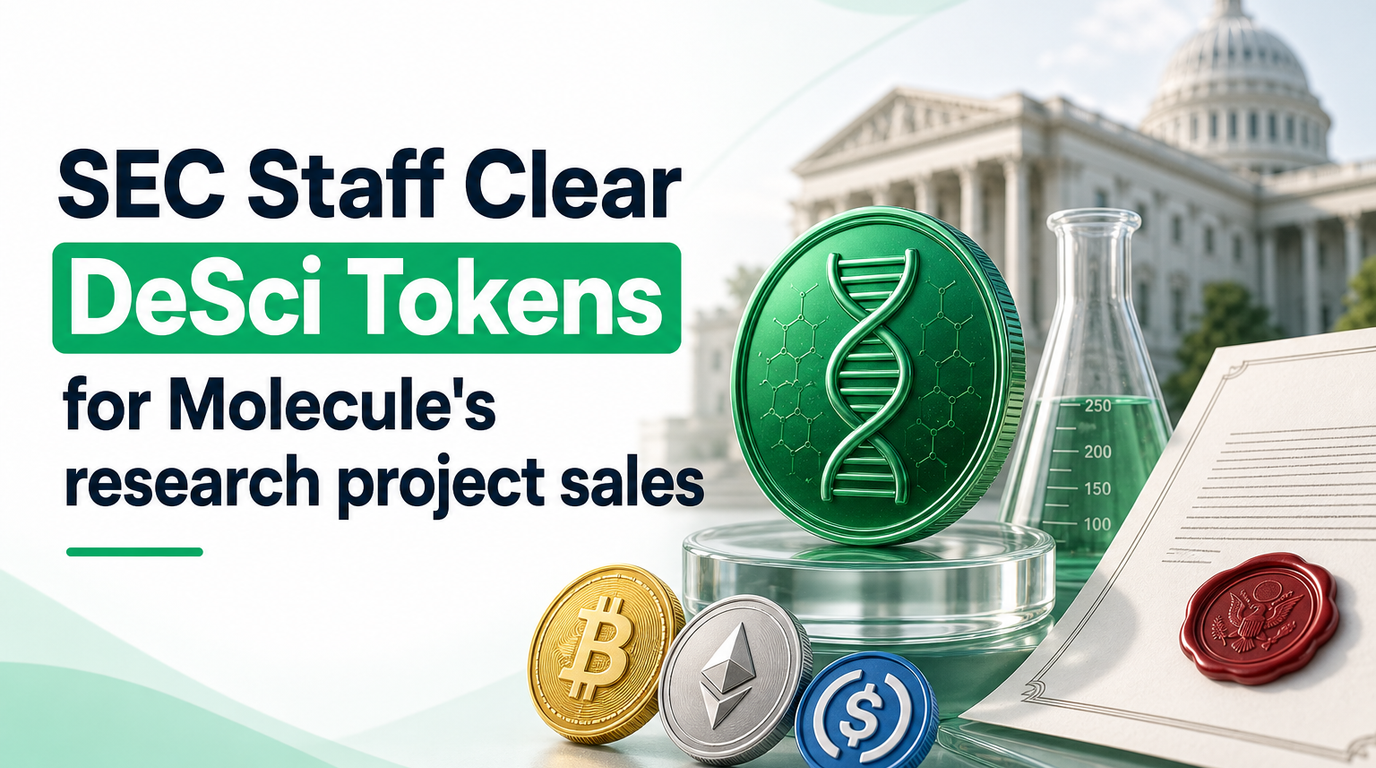
The SEC's Division of Corporation Finance told Molecule AG on November 24, 2026 that it would not recommend enforcement action if the company's US subsidiary sells "Project Tokens" for scientific research without registering them under Section 5 of the Securities Act, and without registering them as a class of equity under Section 12(g) of the Exchange Act. The staff response, signed by Deputy Chief Counsel Jonathan A. Ingram, came five days after Molecule's lawyers at Cahill Gordon & Reindel filed the request on November 19.
It applies the Commission's March 2026 crypto taxonomy to a decentralized science (DeSci) token, and it is the narrowest kind of relief the agency gives: a statement about enforcement, not a ruling on whether the tokens are securities.
What the SEC staff actually agreed to
The response is three sentences of substance. Staff will not recommend enforcement if LabsCo, Molecule's Delaware subsidiary, offers and sells Project Tokens "in the manner and under the circumstances described" in the request. The position rests on Molecule's representations; "any different facts or conditions" could lead to a different conclusion; and the letter "does not express any legal conclusion on the issue presented."
So the record is the incoming 12-page request. Anyone reading the relief as a green light for research tokens in general has to read it against those facts.
How the Project Token is built
Molecule's "Coin-to-Company" model splits each research project into two instruments. LabsCo sells Project Tokens for fiat or crypto, and also hands them out through airdrops and rewards for tasks such as reviewing research proposals or contributing data. Separately, if the research reaches "substantial progress", LabsCo may raise money by selling equity under a registration or an exemption.
The request lists what the token does not carry: no ownership, equity or debt claim on LabsCo, no share of profits or revenue, no enforceable rights beyond its stated utility, and no option or right to buy LabsCo securities. Holding or locking tokens gives no priority in any later equity round, and locking is not a precondition to apply. Molecule also commits that its white paper and other communications will not discuss business plans, milestones tied to token value, price appreciation, or any planned equity offering, and that it will not promise a fixed token supply.
What the token does carry is access: membership in a Wyoming unincorporated nonprofit association of holders, token-gated research data and events, and advisory votes on research direction for holders who lock tokens in LabsCo's smart contract. Those votes are counted one per token and, per the request, are "not binding on LabsCo under any circumstances." Unlocked tokens may trade freely, and LabsCo may keep minting and selling into secondary markets without promising liquidity.
Why the March taxonomy matters here
Molecule's counsel framed the token as a "digital tool" under the Commission's March 17 interpretive release (Release No. 33-11412), which sorts crypto assets into digital commodities, collectibles, tools, stablecoins and digital securities, and states that the first three are not themselves securities. A digital tool is defined by function: a membership, ticket, credential or identity badge. The request then argues the Howey test fails because research success accrues to LabsCo's equity, which token holders cannot reach by holding tokens. For background on how such tokens differ from coins, see our explainer on tokens versus coins.
The letter lands while the Commission's broader Regulation Crypto Assets proposal of August 18 is still pending; that rule would create exemptions for offerings that are investment contracts. Molecule's route is the opposite: argue the token is not an investment contract at all. Our August report on the proposal covers the exemptions.
Who is affected, and what remains open
Directly, only LabsCo. Other DeSci communities, such as the VitaDAO and HairDAO projects the request cites, gain a documented template, not relief of their own. Buyers should note what the design gives up: a token holder funds research but has no claim on what it earns. If a project succeeds, the value goes to equity investors.
Several points are untested. The request says advisory votes and token-gated perks create no financial interest, but secondary-market prices will still move, and the staff did not assess how LabsCo's continued sales into those markets fit the marketing restrictions over time. Molecule also says it expects to form more subsidiaries under the same model; each would sit outside this letter unless its facts match. How governance votes differ when they are binding is covered in our guide to DAO governance tokens.
This story is for information only and is not financial advice. Crypto assets are volatile; do your own research before acting on anything here.
Behind the story
Understand the mechanics, then compare the services it touches.


FAQ
Does the SEC letter mean Molecule's Project Tokens are not securities?
Do Project Token holders get shares in LabsCo?
Sources
- 1staff responsesec.gov
- 2incoming 12-page requestsec.gov
- 3March 17 interpretive releasesec.gov
- 4Regulation Crypto Assets proposalsec.gov
More in Regulation
- Bitcoin and Ether ETFs Bleed Billions as Binance Hack Rattles U.S. InvestorsU.S. spot Bitcoin ETFs lost $643 million in a single session, while Ether funds suffered their worst month since launch. Here is what the exits say about American demand after the Binance breach.
- Binance Hack Shakes Bitcoin Below $77K as US Spot ETFs Still Draw InflowsBinance disclosed a security incident involving about $6.3 billion in assets, pushing Bitcoin below $77,000 and wiping out roughly $1.5 billion in leveraged bets. Yet US spot Bitcoin ETFs extended their inflow streak to three sessions.
- Bitcoin Slips Toward $80,000 After Fed Hold as Ripple Pitches XRP at Swell in New YorkThe Federal Reserve held rates but signaled a hawkish tilt, pushing Bitcoin back toward $80,000. Meanwhile, Ripple used its Swell conference in New York to promote XRP as an institutional payment rail.
- Bitcoin Holds Near $81K as Fed Decision Looms and Google Unveils Crypto Custody SecurityBitcoin is trading around $81,000 as US spot ETFs draw $286 million in two days and markets wait for the Federal Reserve’s rate decision. Meanwhile, Google is previewing a new custody security system for banks handling digital assets.
- Bitcoin ETFs Bleed $65.4M as Hawkish Fed Talk Puts CPI in FocusU.S. spot Bitcoin ETFs logged a $65.4 million outflow on October 12, all from BlackRock’s IBIT, while a hawkish Fed message set the stage for Wednesday’s September CPI report.