












































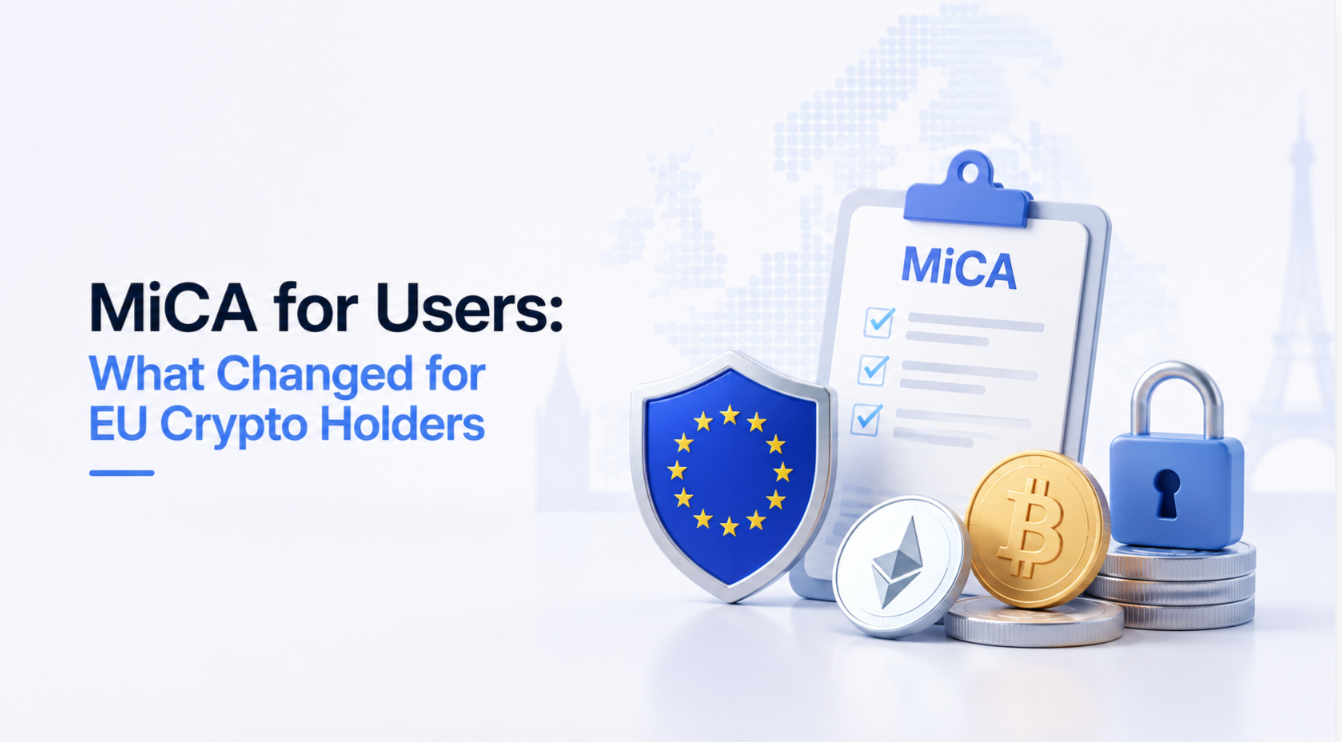
The Markets in Crypto-Assets Regulation created a single EU authorisation regime for crypto-asset service providers, with stablecoin rules applying from June 2024 and service provider rules from December 2024, subject to national transition periods. For users it means licensed platforms passportable across the EU, reserve and redemption requirements for euro and dollar stablecoins, mandatory disclosures, and delistings of tokens whose issuers do not comply.
- 1The structure. Two regimes with different start dates.
- 2The stablecoin rules. MiCA divides stablecoins into e-money tokens, referencing a single official currency, and asset-referenced tokens, referencing anything else.
- 3The service provider rules. Exchanges, brokers, custodians, portfolio managers and advisers all fall within scope as crypto-asset service providers.
- 4Disclosure and marketing. Issuers offering tokens to the public must publish a white paper meeting prescribed content requirements, notified to a regulator, with liability…
On this page6 sections
MiCA is the first comprehensive crypto framework in a major economic bloc. It regulates the firms that issue tokens and provide services, not the technology and not individual holders, and its practical effects on users are indirect but substantial.
This is general information about the framework, not legal advice.
The structure
Two regimes with different start dates. Rules for asset-referenced tokens and e-money tokens — the stablecoin categories — applied from 30 June 2024. Rules for crypto-asset service providers applied from 30 December 2024, with member states permitted to grant existing firms a transition period of up to eighteen months.
Authorisation in one member state passports across the EU, which is the single largest structural change: a licensed firm can serve all member states without twenty-seven separate approvals.
The stablecoin rules
MiCA divides stablecoins into e-money tokens, referencing a single official currency, and asset-referenced tokens, referencing anything else. Both face requirements that changed the European market immediately.
Issuers must be authorised, must hold reserves segregated from their own assets, and must grant holders a right of redemption at par — a genuine consumer right rather than a wholesale arrangement, which is a meaningful departure from the redemption access most global issuers offer. Significant tokens face additional requirements including reserve composition constraints and limits designed to prevent a token becoming a de facto payment currency.
Notably, interest may not be paid to holders of e-money tokens. That is why euro stablecoins issued under MiCA do not pass through yield, and why yield-bearing structures targeting EU users take a different legal form.
The visible effect was delistings. Platforms serving EU users removed tokens whose issuers had not obtained authorisation or did not intend to, and the composition of what a European user can buy changed accordingly. Tokens meeting the requirements — including several euro-denominated issues and compliant dollar tokens — became the default. The stablecoin ratings note regulatory status per token because for EU users it now determines availability, not just risk.
The service provider rules
Exchanges, brokers, custodians, portfolio managers and advisers all fall within scope as crypto-asset service providers. Authorisation brings capital requirements, governance and fit-and-proper standards for management, complaint handling procedures, conflict-of-interest rules, and — importantly for users — an obligation to segregate client assets from the firm's own.
Custody obligations include liability for loss of client crypto-assets in defined circumstances, which is a real consumer protection and one that did not exist before in most member states.
For users choosing a platform, the practical question is whether a firm holds a MiCA authorisation or is operating under a national transition period, and which regulator supervises it. That is disclosed and checkable in national registers, and it is the kind of factor our exchange ratings weight under jurisdiction and custody rather than treating all venues as equivalent.
Disclosure and marketing
Issuers offering tokens to the public must publish a white paper meeting prescribed content requirements, notified to a regulator, with liability for misleading information. Marketing communications must be fair, clear and not misleading, and identifiable as marketing.
This does not make any token a good investment, and MiCA is explicit that authorisation is not endorsement. What it does is create a document with legal consequences attached, which is a higher standard than the marketing white papers that preceded it.
What MiCA does not cover
Several important exclusions. Fully decentralised services without an identifiable provider fall outside the service provider regime, though the boundary is contested and interfaces with identifiable operators may not benefit from it. Non-fungible tokens are excluded unless issued in a fungible series, a distinction that turns on substance rather than labelling.
MiCA also does not address taxation, which remains a national competence — the treatment in Germany and elsewhere is unchanged by it. And it does not create deposit insurance: client asset segregation is not a guarantee of the value of what you hold.
The separate transfer-of-funds rules impose the travel rule on crypto transfers, which is why EU platforms ask who a withdrawal is going to.
What it means practically
Choose authorised firms. The register tells you who is licensed and by whom. An authorised firm has capital, segregation obligations and a complaints route; an unauthorised one serving EU users is operating outside the framework.
Expect availability to differ. Tokens and products available outside the EU may not be available inside it, and yield on euro stablecoins is structurally absent by design.
Read the white paper for tokens you buy. It is now a document with a liable author.
Do not confuse authorisation with safety. MiCA regulates conduct and solvency of firms; it does not make volatile assets less volatile, and it does not protect against your own custody mistakes, which remain the most common way people lose crypto in every jurisdiction.
Next step
Understood the mechanics? Keep going, or compare the services.
FAQ
What is MiCA?
Why were some stablecoins delisted in the EU?
Does MiCA protect my funds on an exchange?
Why do EU euro stablecoins pay no interest?
Related guides
All guides →- Attestation vs Audit: What Stablecoin Reports Really SayEvery major stablecoin publishes reserve reports. Almost none of them are audits, and the difference decides what the document is worth.Intermediate8 min
- Wrapped Assets: Who Holds the Collateral Behind Your TokenWrapped BTC on Ethereum is not Bitcoin. It is an IOU whose value depends entirely on whoever holds the Bitcoin behind it.Intermediate9 min
- LST Depegs: Why stETH Traded Below ETH and What It MeantThe discount was never a backing failure. It was a liquidity event in an asset that could not be redeemed at the time.Intermediate9 min
- Redemption Access: Who Can Actually Cash Out at ParFor almost every retail holder, the peg is not maintained by redemption. It is maintained by other people's ability to redeem.Intermediate8 min