Coins vs. Tokens: What's the Difference in Crypto?
Coin or token? The words get used interchangeably in headlines, but the distinction matters for how an asset is built, secured and valued.
Dario FennDeFi & Markets Lead · DeFi protocols, yield, market structure and on-chain dataUpdated 15 May 2026
The short answer
A coin is the native asset of its own blockchain and pays that network's fees; a token is issued by a contract on an existing chain and relies on that chain's security. The practical test is a contract address on a block explorer — tokens have one, native coins do not. The distinction changes what secures the asset and what drives its value.
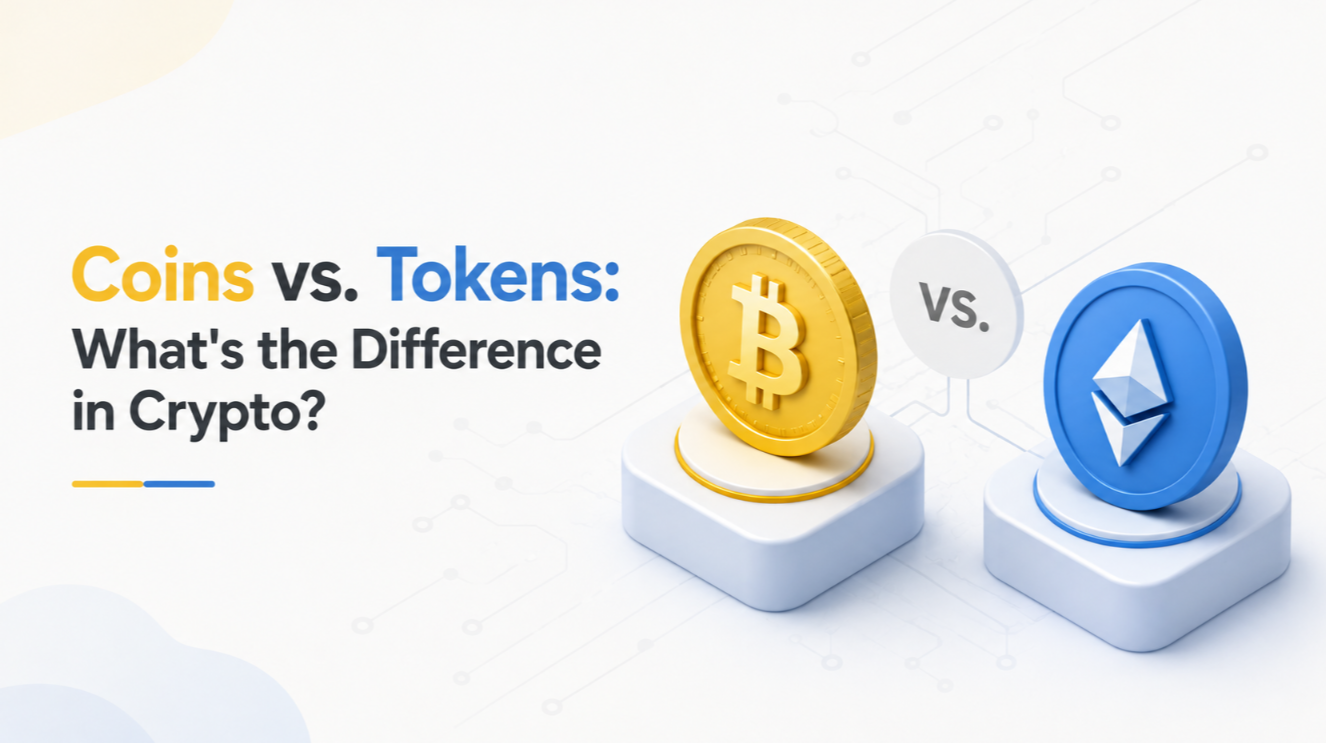
Open any crypto headline and you'll see 'coin' and 'token' used as if they mean the same thing. They don't. The difference between coins and tokens comes down to one question: does the asset have its own blockchain, or does it live on someone else's? Get that straight and half the confusing jargon in this market starts making sense.
What a Coin Actually Is
A coin is native to its own blockchain. Bitcoin is a coin because it runs on the Bitcoin network, secured by its own miners, its own consensus rules and its own ledger. Ether is a coin for the same reason: it's the native asset of Ethereum, used to pay gas fees and reward validators who keep that chain running. Litecoin, Monero, Solana's SOL — all coins, all with dedicated infrastructure built specifically to record and move them.
Coins tend to serve a narrow set of jobs on their home chain: paying transaction fees, rewarding block producers, and acting as the base unit of account that everything else on the network is priced against. Build a new layer-1 blockchain from scratch, give it a genesis block and a native asset, and you've created a coin, whether or not anyone ever uses it.
What a Token Actually Is
A token, by contrast, is built on top of an existing blockchain rather than running its own. It doesn't have its own miners or validators; it borrows the security of the host chain and exists as an entry in a smart contract. Uniswap's UNI, Chainlink's LINK, and the vast majority of assets you'll see on a decentralised exchange are tokens living on Ethereum, or increasingly on Solana, Base, Arbitrum and other chains that support programmable contracts.
ERC-20 and the token standard boom
The reason tokens are so easy to create is standardisation. Ethereum's ERC-20 standard, published in 2015, laid out a common set of functions — balanceOf, transfer, approve — that any token contract could implement. Wallets and exchanges only need to support the standard once, not each individual token, which is why a new ERC-20 asset can list on an exchange within days of being deployed. The same logic gave us ERC-721 for non-fungible tokens and, later, equivalents on other chains. Standards, not blockchains, are what let a single wallet hold thousands of different tokens.
Why the Distinction Gets Blurred
Part of the confusion is historical. In crypto's early years, 'coin' was the only word anyone used, so it stuck around informally even as tokens took over as the dominant asset type by sheer count. Part of it is deliberate marketing: a project launching a token often prefers the word 'coin' because it sounds more established, more like digital cash and less like a speculative IOU issued by a start-up. And part of it is that the underlying technology genuinely does shift over time — a project can start as a token on Ethereum during its fundraising phase, then migrate to its own chain and become a coin once the network is live. BNB did exactly this, launching as an ERC-20 token before Binance Chain went live and BNB became a native coin in its own right.
Practical Ways to Tell Them Apart
If you want a quick test, ask where the asset's transactions get validated. If the answer is 'its own dedicated network of validators or miners,' it's a coin. If the answer is 'a smart contract on Ethereum, Solana, or some other chain,' it's a token. Block explorers make this obvious in seconds: search an asset on Etherscan and if it shows up as a contract address with a token standard listed, you're looking at a token, not a coin native to Ethereum itself.
A second, rougher heuristic: stablecoins, governance assets, and anything tied to a specific DeFi protocol are almost always tokens, because building and securing an entire blockchain just to issue a dollar-pegged asset or a voting right would be enormous overkill. USDT, USDC, DAI — all tokens, despite 'coin' sitting right there in two of those names, which is arguably the single most confusing piece of naming in the whole industry.
Utility Tokens, Security Tokens and Governance Tokens
Within the broad category of tokens, there's a further split worth knowing, because regulators care about it even when traders don't. A utility token grants access to a specific service on a platform — think of it as a prepaid credit for computation or storage. A governance token grants voting rights over a protocol's parameters, treasury or upgrades, which is what UNI, COMP and most major DeFi tokens are primarily used for. A security token, meanwhile, represents an ownership stake, a debt obligation, or a claim on profits in a way that mirrors a traditional financial instrument, and in most jurisdictions that classification triggers securities law regardless of the word 'token' anywhere in its name. None of these sub-categories change whether an asset is a coin or a token in the technical sense described above, but they do change what rules apply to issuing and trading it, which is why regulators spend so much time arguing over which bucket a given asset actually falls into.
Does It Actually Matter for Investors?
Practically, yes, in a few specific ways. Tokens inherit the security and, crucially, the congestion and fee dynamics of their host chain — an ERC-20 transfer can cost more in gas during a busy period than the token itself is worth in some cases. Coins don't have that dependency, but they carry their own risk: a smaller layer-1 with few validators is only as secure as the economic incentives keeping those validators honest, which is a different risk profile from relying on Ethereum's much larger validator set.
It also matters for how an asset can fail. A token can be frozen or blacklisted if its issuer built that function into the contract, as Tether and Circle both can and occasionally do with sanctioned addresses. A genuinely decentralised coin like Bitcoin has no issuer with that kind of override switch, which is precisely the trade-off people are making when they choose custody of a coin over a token tied to a centralised contract administrator.
What About Wrapped Assets?
Wrapped assets sit in an odd middle ground worth flagging separately, because they show the coin/token distinction being deliberately blurred for a practical reason. Wrapped Bitcoin (WBTC) is Bitcoin — a coin native to its own chain — represented as an ERC-20 token on Ethereum, backed one-for-one by real BTC held in custody. It lets a fundamentally coin-based asset participate in Ethereum's token-based DeFi ecosystem, at the cost of introducing a custodian who has to be trusted to actually hold the underlying Bitcoin. Every wrapped asset carries that same trade-off: convenience and interoperability in exchange for a new point of custodial trust that the original coin never had.
Multi-Chain Native Assets Complicate the Picture Further
Some assets now exist natively — not wrapped — on more than one chain simultaneously, thanks to newer cross-chain standards and native issuance by projects like Circle for USDC. In these cases, whether to call the asset a coin or a token depends entirely on which deployment you're looking at: USDC issued directly as a token on Ethereum is a token in the strict technical sense, even though it's also often loosely called a 'coin' by users and headline writers alike, precisely the naming looseness this piece opened with. There's no contradiction here, just an industry that adopted casual language before the technical distinctions had fully settled, and never went back to tidy it up.
The Bottom Line
Coins run their own show; tokens rent space on someone else's. Neither is inherently better — Bitcoin's slow, deliberate coin-based design is a feature for a settlement asset, while Ethereum's token ecosystem is what makes rapid experimentation with new financial products possible in the first place. But when you're reading about a new asset, get in the habit of asking which category it falls into before you ask anything else. It tells you who secures it, what it can cost to move, and who — if anyone — still holds the keys to switch it off.
FAQ
What is the difference between a coin and a token?+
A coin is the native asset of its own blockchain and pays that network's fees. A token is issued by a contract on an existing chain and relies on that chain's security.
Is ETH a coin or a token?+
A coin. It is Ethereum's native asset. Tokens such as USDC or UNI are contracts deployed on Ethereum rather than the network's own asset.
How can I tell whether an asset is a coin or a token?+
A token has a contract address on a block explorer. A native coin does not — it is part of the chain's own accounting.
Does the distinction matter for investors?+
It changes what secures the asset and what drives its value. A coin's value ties to network usage and security budget; a token depends on its contract, its issuer and its own supply mechanics.
 Dario FennDeFi & Markets Lead · DeFi protocols, yield, market structure and on-chain data