How DAO Governance Voting Actually Works (and Its Flaws)
Token-weighted voting was meant to replace corporate boardrooms with open, on-chain democracy. In practice it has produced its own aristocracy — and its own exploits.
Dario FennDeFi & Markets Lead · DeFi protocols, yield, market structure and on-chain dataUpdated 21 July 2026
The short answer
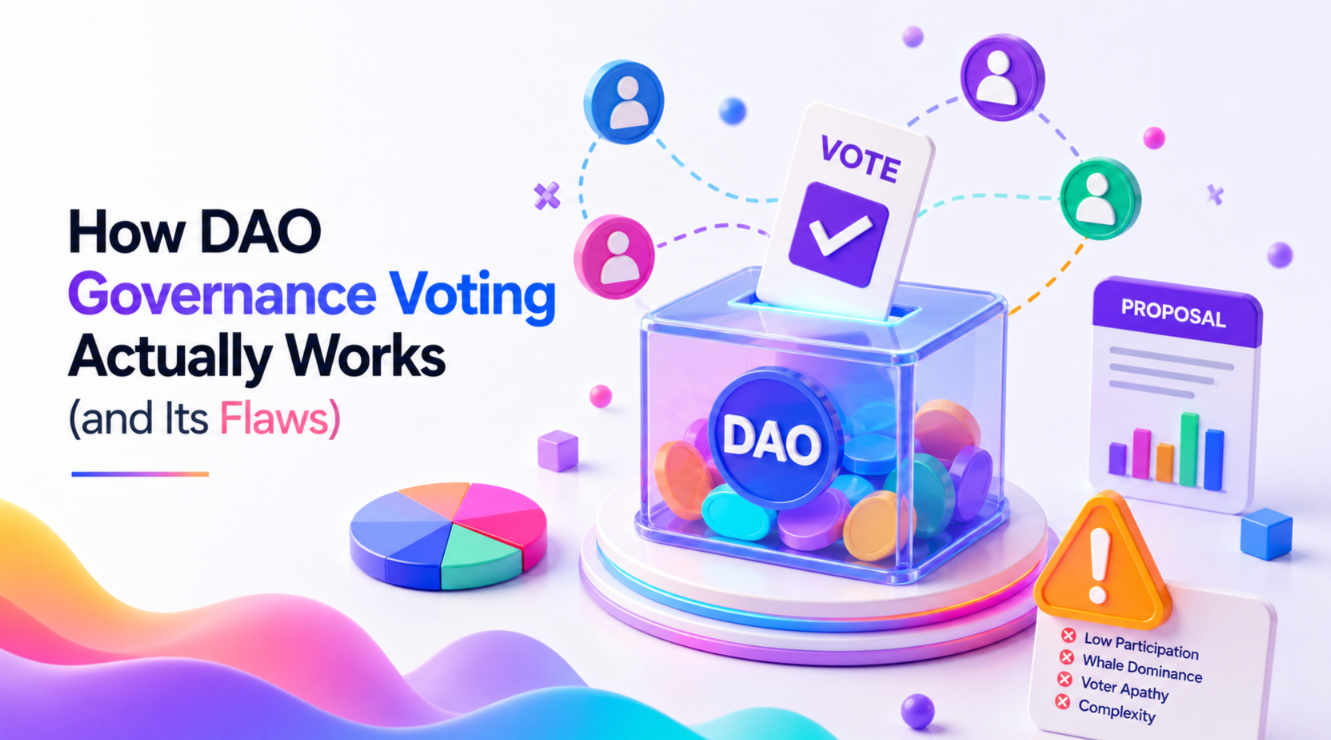
DAO proposals move from discussion to an on-chain vote weighted by tokens held or delegated, executing if they pass quorum and any timelock. In practice turnout is low and delegation concentrates decisions in a handful of delegates, so the effective threshold to control an outcome is a majority of whoever votes rather than of supply. Where voting power can be borrowed, it can also be rented for the length of a vote.
DAO governance voting is the mechanism by which token holders in a decentralised autonomous organisation propose, debate, and enact changes to a protocol — everything from adjusting a lending market's collateral ratios to spending millions from a treasury. It was sold as a genuine alternative to corporate governance: no board, no CEO with a casting vote, just token holders deciding collectively. Ten years into the experiment, the honest assessment is that DAO governance voting works reasonably well as a coordination tool and quite badly as a democracy. Understanding the gap between the two is essential for anyone holding a governance token and assuming their vote carries the weight the marketing implies.
The proposal lifecycle, in practice
Almost every major DAO follows a version of the same pipeline. An idea starts as an informal forum post — on Commonwealth, Discourse, or a protocol's own site — where it gets picked apart by whoever bothers to show up. If it survives, it becomes a formal proposal, usually put to an off-chain 'temperature check' vote on Snapshot, a gasless signalling platform that records wallet signatures rather than on-chain transactions. Snapshot votes cost nothing to cast, which is precisely why they're used for early-stage sentiment rather than binding execution. Only if a proposal clears that bar does it typically move to a binding on-chain vote, executed through governance contracts like Compound's Governor Bravo or OpenZeppelin's Governor framework, and even then, execution is usually delayed by a timelock — 48 hours for many protocols, longer for those handling larger treasuries — specifically so token holders have a window to notice and react to something malicious before it takes effect.
Token-weighted voting and the whale problem
The core design choice underpinning nearly all DAO governance is one-token-one-vote, and it inherits capitalism's core feature rather than democracy's: influence scales with capital, not with participation or stake in the outcome beyond financial exposure. In practice this means a handful of wallets routinely decide outcomes that thousands of smaller holders technically had a vote on. Uniswap's governance has repeatedly seen proposals pass or fail on the strength of a16z's roughly 15 million UNI delegation alone — a single venture fund able to outvote most of the rest of the token holder base combined. This isn't a bug anyone is trying particularly hard to fix, because the obvious alternatives — quadratic voting, one-wallet-one-vote, reputation-weighted systems — all introduce their own attack surface, chiefly Sybil resistance: nothing stops a whale from splitting one large position across a thousand wallets to defeat any scheme that isn't ultimately still counting capital.
Voter apathy is the norm, not the exception
The dirty secret of on-chain governance is that almost nobody votes. Turnout on contested Compound and Uniswap proposals routinely sits in the low single digits of circulating supply, and plenty of proposals that clearly matter — fee switch activations, treasury allocations worth tens of millions of dollars — pass with a smaller number of participating tokens than a mid-sized centralised exchange's daily withdrawal volume. Quorum requirements exist precisely to guard against a tiny, motivated faction pushing through changes nobody else noticed, but low turnout means quorum itself becomes the binding constraint more often than the actual vote count does. Several DAOs have quietly lowered their quorum thresholds over time not because interest grew, but because the original thresholds were becoming impossible to hit, which rather undercuts the premise that this is participatory governance at all.
Delegation, vote markets, and the Curve Wars
Delegation was meant to solve apathy: holders who don't want to research every proposal can delegate their voting power to someone who does. In practice it created a market. Curve Finance's vote-escrowed model, where locking CRV for up to four years grants voting power (veCRV) that directly determines which liquidity pools receive the richest token emissions, spawned an entire secondary economy — Convex, Votium, and a string of imitators — built around renting and bribing that voting power. Protocols that want deep liquidity on Curve don't lobby CRV holders directly; they pay bribes, openly and on-chain, to whoever controls the votes, often through Convex's aggregated stake. The 'Curve Wars' turned governance voting into a functioning derivatives market on influence itself, which is either a clever piece of mechanism design or proof that the veto-holder in a DAO is, functionally, for sale — reasonable people land on both readings.
When governance itself becomes the attack vector
Because governance contracts can, by design, move funds and change protocol parameters, they are themselves a target. The clearest case study is Beanstalk Farms, an algorithmic stablecoin protocol drained of roughly $182 million in April 2022 through a flash-loaned governance attack: the attacker borrowed enough tokens in a single transaction to instantly control the majority of voting power, used that transient majority to pass a malicious proposal donating the protocol's treasury to their own wallet, and executed it before the loan needed repaying — all within one block. Beanstalk had no timelock delay on its governance execution, which is exactly the safeguard that would have stopped it; the attack remains the standard textbook example of why a delay between a vote passing and it taking effect isn't bureaucratic friction, it's a security control.
Optimistic governance and the shift towards challenge periods
A newer pattern, popularised by Optimism's Citizens' House and Arbitrum's Security Council model, flips the default: instead of requiring a vote to pass before anything happens, certain proposals are treated as approved unless a sufficient number of token holders actively object within a challenge window. The bet is that apathy cuts both ways — if nobody objects to a routine change, forcing an active vote just to confirm the obvious is wasted overhead, and the real signal is whether anyone cares enough to raise a flag. It's a genuine attempt to route around the quorum problem rather than pretend it doesn't exist, though it trades one flaw for another: a determined minority now has to actively organise opposition within a fixed window rather than simply outvoting a proposal, which shifts the burden of participation onto whoever disagrees.
MakerDAO's slow drift towards professionalised governance
MakerDAO offers a useful counterpoint to the Beanstalk story: rather than a single catastrophic exploit, its governance has drifted gradually towards something closer to a professional board than a grassroots vote. Its Endgame restructuring split the protocol into semi-autonomous SubDAOs, each with its own token and narrower governance scope, explicitly because coordinating meaningful votes across an increasingly large and technical parameter set — collateral types, stability fees, debt ceilings spanning a treasury worth billions — had become impractical for a diffuse token holder base to meaningfully evaluate proposal by proposal. Delegate compensation, another Maker innovation now copied widely, pays recognised delegates a salary specifically to show up, read every proposal in depth, and vote consistently, which is a tacit admission that relying on volunteer goodwill alone simply doesn't produce reliable governance at scale.
What governance is actually good for
None of this means DAO governance is theatre from top to bottom. It functions reasonably well for slow-moving, low-stakes-per-vote decisions where a motivated, informed minority genuinely represents the interests of the wider holder base — parameter tweaks, grant approvals, incremental protocol upgrades that have already been vetted by delegates who do this professionally, a category that includes research-focused delegate groups like Gauntlet or Blockworks Advisory who publish detailed rationale for every vote. Where it breaks down is high-stakes, contested decisions where whale concentration, low turnout, and financial incentives to vote a particular way all point in the same direction, and the outcome ends up reflecting who had the most capital and patience rather than what the broader token holder base actually wanted.
Reading a DAO's governance before you trust its token
For anyone evaluating a governance token as more than a speculative asset, the useful diligence isn't reading the whitepaper's governance section — it's pulling up the DAO's actual voting history on Tally or Boardroom and checking three things: how concentrated the top ten voting wallets are, what percentage of proposals actually hit quorum without a last-minute whale intervention, and whether a timelock exists between a vote passing and it executing. A protocol that scores badly on all three isn't necessarily broken, but it is not the decentralised democracy its governance token is implicitly being sold as, and that gap between marketing and mechanism is worth pricing in.
FAQ
How does DAO voting work?+
A proposal moves from discussion to a formal on-chain vote weighted by token holdings or delegated voting power, and executes if it passes quorum and any timelock.
What is the whale problem in token voting?+
Voting power is proportional to tokens held, so large holders decide outcomes. Combined with low turnout, a holder with a few per cent of supply can be decisive.
Why is DAO voter turnout so low?+
Voting costs time and often gas, and a small holder's vote rarely changes the result. Delegation concentrates the decision in a handful of active delegates instead.
Can governance be attacked?+
Yes. Where voting power can be borrowed and is measured at vote time, an attacker can rent tokens for the duration of a vote with no economic exposure to the outcome.
 Dario FennDeFi & Markets Lead · DeFi protocols, yield, market structure and on-chain data