














































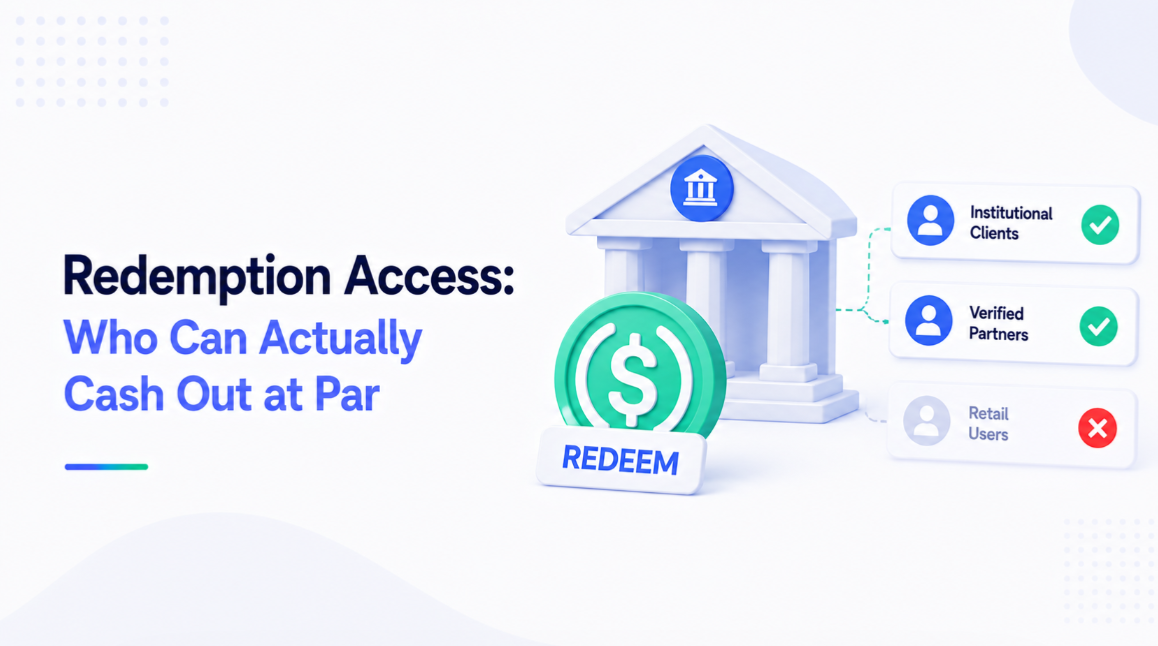
Most stablecoin issuers redeem only for verified institutional clients above a minimum, often $100,000, with fees and a processing window. Retail holders exit through the secondary market at whatever price is available. That indirect arbitrage normally holds the peg, but it depends on redeemers being willing and able to act — which is exactly what fails during a stress event. Check minimums, eligibility, fees and any right to suspend before relying on a token as cash.
- 1The typical terms. Read any major issuer's redemption policy and the same structure appears.
- 2Why it usually works anyway. Because the arbitrageurs are well capitalised and highly motivated.
- 3Where it breaks. Four conditions, and they tend to arrive together.
- 4The questions to ask before treating a token as cash. Who can redeem, and could I qualify?
On this page6 sections
The peg on a fiat-backed stablecoin is an arbitrage, not a promise to you. If the token trades below a dollar, someone buys it cheaply and redeems it for a dollar of reserves; that buying pressure restores the price. The mechanism works only for whoever can perform the redemption, and for most holders that is not them.
The typical terms
Read any major issuer's redemption policy and the same structure appears.
Eligibility. Redemption is available to verified account holders, typically institutions and businesses, following full onboarding. Individual holders generally cannot open a redemption account at all.
Minimum size. Often $100,000 per redemption. Below that, no service.
Fees. Some issuers charge a redemption fee, occasionally a percentage, which sets a floor beneath which arbitrage stops being profitable.
Processing. One to several business days, on banking hours, through banking rails — meaning a weekend stress event has no redemption path until Monday regardless of anyone's eligibility.
Discretion. Terms almost universally reserve the right to suspend redemptions in exceptional circumstances, and to refuse or freeze at the issuer's discretion.
Each of these is commercially reasonable. Together they mean the retail holder's exit is the secondary market, and the peg's stability is a service provided by other people's balance sheets.
Why it usually works anyway
Because the arbitrageurs are well capitalised and highly motivated. A few basis points of discount on a large size is a good trade, and market makers holding redemption accounts will do it continuously. In normal conditions the mechanism is fast enough that retail holders never notice they cannot use it.
It is genuinely effective. The observed peg tightness of the largest fiat-backed tokens is a direct result of deep redemption access at the wholesale level.
Where it breaks
Four conditions, and they tend to arrive together.
Banking hours. USDC's March 2023 depeg opened on a Friday evening and ran through a weekend during which no redemption could settle. The reserves were fine; the rails were closed.
Credit doubt. If arbitrageurs are unsure the redemption will be honoured, buying the discount stops being a low-risk trade and becomes a position. The bid disappears exactly when it is needed.
Suspension. An issuer exercising its right to pause redemptions removes the mechanism entirely, and the token then trades on sentiment.
Capacity. Redemption throughput is finite. A wave larger than the issuer can process creates a queue, and a queue in this market looks like a discount.
The questions to ask before treating a token as cash
Who can redeem, and could I qualify? What is the minimum, the fee and the expected processing time? Can redemptions be suspended, and under what stated conditions? Has redemption been tested at scale — has the issuer processed a large wave and published the outcome? And what is the secondary market depth for the pair I would actually exit through, since that is my real redemption mechanism.
The last one is measurable today. Check the depth on the venues you would use, using the method in order book depth, and know what a large sale would realise.
Decentralised and yield-bearing variants
Over-collateralised stablecoins invert the model: anyone can redeem by repaying debt and reclaiming collateral, permissionlessly and at any hour. That is genuinely open access, with a different dependency — the collateral must be liquid enough to sell and the liquidation machinery must work under stress.
Synthetic and yield-bearing tokens have their own redemption mechanics, often involving a cooldown or an unwinding period on the underlying positions. A cooldown is a queue, and a queue is a discount when everyone wants out at once.
Practical implications
Hold the token you can exit, not merely the token that is well backed. Those are different criteria and both matter, which is why the stablecoin ratings score redemption access and market liquidity separately from reserve quality.
Diversify across issuers for anything meaningful, because the failure modes are issuer-specific — a bank problem at one has no bearing on another.
Keep the operational exit ready: a verified account somewhere that converts to bank money, and knowledge of which pair is deepest. And treat a persistent discount as information rather than an opportunity, unless you have specifically established that redemption is open and functioning. The reserves being real is necessary and it is not the thing that determines what you get on the day.
Next step
Understood the mechanics? Keep going, or compare the services.
FAQ
Can I redeem stablecoins directly with the issuer?
How does the peg hold if I cannot redeem?
Why did USDC depeg in March 2023 if it was fully backed?
Can an issuer suspend redemptions?
Related guides
All guides →- LST Depegs: Why stETH Traded Below ETH and What It MeantThe discount was never a backing failure. It was a liquidity event in an asset that could not be redeemed at the time.Intermediate9 min
- Liquid Staking Explained: Earning Yield Without Losing LiquidityHow liquid staking tokens let holders earn network rewards while keeping their capital free to lend, trade, or post as collateral.Intermediate11 min
- The Risks of Tokenized RWAs: Custody, Legal, and Redemption ExplainedA tokenized bond is only as good as the custodian holding it, the legal entity issuing it, and your ability to actually redeem it. A framework for the risks that live off-chain in every RWA tokenization deal.Advanced12 min
- Reserve Composition: Reading a Stablecoin's Backing Line by LineFully backed is a claim about quantity. What matters in a run is what the reserves are made of and how fast they turn into cash.Intermediate10 min