The Risks of Tokenized RWAs: Custody, Legal, and Redemption Explained
A tokenized bond is only as good as the custodian holding it, the legal entity issuing it, and your ability to actually redeem it. A framework for the risks that live off-chain in every RWA tokenization deal.
Selin AydinSecurity Editor · Crypto security, custody, exploits and smart-contract riskUpdated 9 June 2026
The short answer
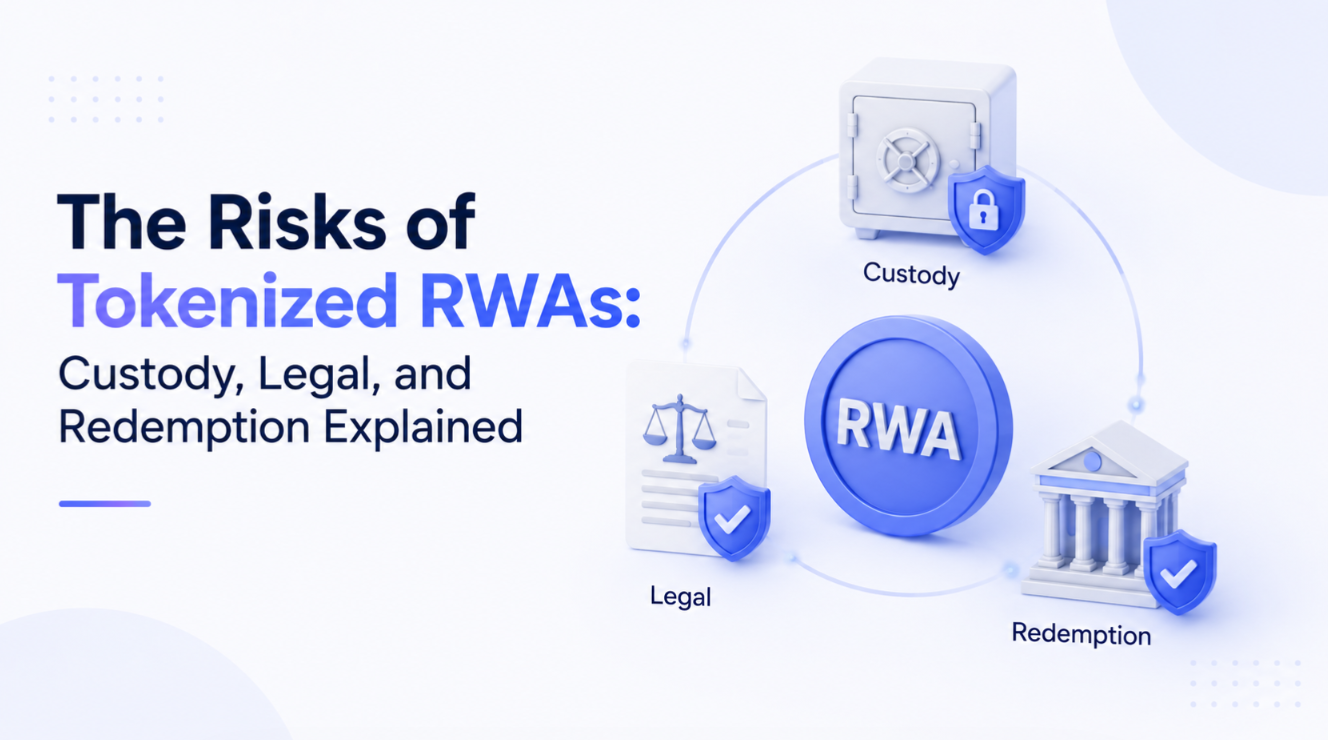
The risk in a tokenized real-world asset is not mainly on-chain. It is the gap between the token and the claim: who custodies the underlying, what the legal structure actually entitles you to, whether redemption is open or restricted, and whether the price reflects a live market or the issuer's own valuation. No smart contract can enforce any of those.
The risks of tokenized RWAs are almost entirely a different category from the risks crypto investors are used to evaluating, and that mismatch is where a lot of avoidable losses come from. A smart-contract bug or a bridge exploit is a risk that lives entirely on-chain, and it's the kind of risk crypto-native diligence is genuinely good at assessing — audits, bug bounties, time-tested code. Tokenized RWAs add a completely different risk surface on top: the legal structure holding the asset, the custodian safeguarding it, and the process by which a token can actually be converted back into the thing it claims to represent. Treating a tokenized Treasury or tokenized private credit pool with the same risk framework as a DeFi token misses precisely the risks most likely to actually bite.
Custody risk: who actually holds the asset
Every tokenized RWA depends on a custodian — a bank, a trust company, a specialised digital asset custodian — actually holding the underlying asset and not, say, lending it out, pledging it as collateral elsewhere, or simply misrepresenting how much of it exists. This isn't a hypothetical concern invented for crypto; it's the exact failure mode behind decades of traditional finance custody scandals, going back to MF Global and well beyond. Tokenization doesn't remove this risk — if anything, it can obscure it, because a token trading smoothly on-chain gives a reassuring impression of backing that has nothing to do with whether the custodian is actually solvent and holding what it claims. The honest question to ask of any tokenized RWA is not whether the blockchain record looks clean, but who the custodian is, what jurisdiction regulates them, and what independent attestation — ideally more rigorous than a self-published PDF — confirms the assets are actually there.
Legal structure risk: what the token actually entitles you to
The token itself typically doesn't grant direct ownership of the underlying asset; it grants a claim against a special purpose vehicle that holds the asset, and the strength of that claim depends entirely on how the SPV is structured and in which jurisdiction. A well-structured SPV is bankruptcy-remote, meaning the underlying assets are legally ring-fenced from the issuer's own creditors if the issuer runs into trouble elsewhere. A poorly structured one isn't, which means token holders could find themselves as unsecured creditors in a bankruptcy proceeding rather than holders of a specific, protected claim — a distinction that matters enormously in a default and is invisible in ordinary market conditions when everything is functioning normally. Reading the actual legal documentation behind a tokenized RWA, rather than relying on marketing language about the token being 'backed' by an asset, is tedious and exactly the diligence that separates a genuinely protected claim from a hopeful one.
Redemption risk: the gap between trading and cashing out
A tokenized asset can trade smoothly on secondary markets while redemption — actually converting the token back into cash or the underlying asset — remains slow, restricted, or gated behind conditions that only become apparent when someone tries to use them. Some tokenized Treasury products restrict redemption to accredited or institutional holders, or process redemptions only during specific windows rather than continuously, which means the 24/7 liquidity often advertised as tokenization's core benefit applies to secondary-market trading, not necessarily to converting the token back into the underlying value at par. This gap matters most exactly when it's most needed — during periods of market stress, when everyone wants to redeem simultaneously and issuers face genuine pressure to slow or restrict the process, which is the same dynamic that has caused runs on money market funds and open-ended property funds in traditional finance for decades.
Valuation risk: what the token price is actually reflecting
For liquid, simple assets like Treasuries, on-chain price and underlying value stay closely aligned because the underlying market is transparent and continuously priced. For less liquid RWA categories — real estate, private credit, fine art — the on-chain token price can drift meaningfully from the actual value of the underlying asset, because that underlying value is only periodically appraised and the appraisal process itself involves judgement calls that a stale or overly generous valuation can quietly distort. A tokenized real estate fund trading at a price based on a year-old appraisal during a period when the local property market has softened considerably is not a hypothetical scenario — it's the default state of affairs for any asset that isn't priced continuously by a deep, liquid market, and it's a risk that's easy to overlook when a token's on-chain price looks perfectly stable.
Regulatory risk: the rules are still being written
Tokenized RWAs sit at an uncomfortable regulatory intersection — securities law, banking and custody regulation, and crypto-specific rules that are still evolving in most jurisdictions, often simultaneously and sometimes inconsistently with each other. A tokenization structure that's compliant today can face new restrictions as regulators catch up with a fast-growing category, and issuers based in different jurisdictions have taken meaningfully different approaches to compliance, ranging from rigorous registration with securities regulators to structures that lean on more permissive offshore jurisdictions. This isn't a reason to avoid the category, but it is a reason to treat regulatory clarity as a genuine risk factor rather than an afterthought — a token issued under a clear, tested regulatory framework carries materially different legal risk than one issued under a novel structure nobody has tested through an actual dispute.
Tokenized RWAs also depend on someone accurately reporting what's happening to the underlying asset — loan repayment rates for private credit, occupancy and rental income for real estate, reserve levels for Treasury-backed tokens — and that reporting is only as trustworthy as the party providing it and the verification process behind it. Self-reported data from an issuer with a direct financial interest in the token maintaining its value is a materially weaker guarantee than independent, third-party attestation, and the gap between the two is exactly where problems tend to surface late rather than early. Investors who wouldn't dream of trusting a DeFi protocol's self-reported TVL figures without independent verification should apply the same scepticism to an RWA issuer's self-reported collateral performance — the incentive to present a rosier picture than reality exists in both cases, and the tooling to independently verify it is considerably less mature for off-chain assets than it is for on-chain ones.
A practical checklist before allocating to a tokenized RWA
Given all of the above, a few concrete questions do most of the useful work before committing capital. Who is the custodian, what jurisdiction regulates them, and is there independent, recent attestation of the underlying assets rather than a self-published claim. What does the actual legal documentation say the token entitles a holder to, and is the SPV structure bankruptcy-remote in the jurisdiction that matters. What are the actual redemption terms — not the marketing description of them — including any gates, minimums, or processing windows that would apply under stress rather than in calm conditions. How is the underlying asset valued, how frequently, and by whom, particularly for anything beyond simple, liquid instruments like Treasuries. And finally, what happens to token holders specifically in an issuer default scenario, because that answer, more than any yield figure on a dashboard, is the one that actually determines whether a tokenized RWA is a genuinely protected claim or a much riskier bet dressed up in the reassuring language of on-chain transparency. None of this diligence is exotic — it's the same due process any careful allocator would apply to an off-chain structured product — but it's routinely skipped for tokenized assets precisely because the on-chain wrapper feels more transparent and more verifiable than it actually is.
FAQ
What is the main risk of tokenized real-world assets?+
The gap between the token and the claim. The token is only worth what the legal structure and the custodian actually deliver, which no on-chain mechanism can enforce.
Who holds the underlying asset?+
A custodian named in the offering documents. Their solvency, jurisdiction and segregation arrangements are the real security model, not the blockchain.
Can I always redeem a tokenized asset?+
Usually only through the issuer, often with eligibility conditions, minimums and a processing window. Trading a token is not the same as cashing out the asset.
How is a tokenized asset priced?+
Frequently by the issuer's own valuation rather than a live market, particularly for real estate and private credit. The token price can reflect a mark rather than a bid.
 Selin AydinSecurity Editor · Crypto security, custody, exploits and smart-contract risk