














































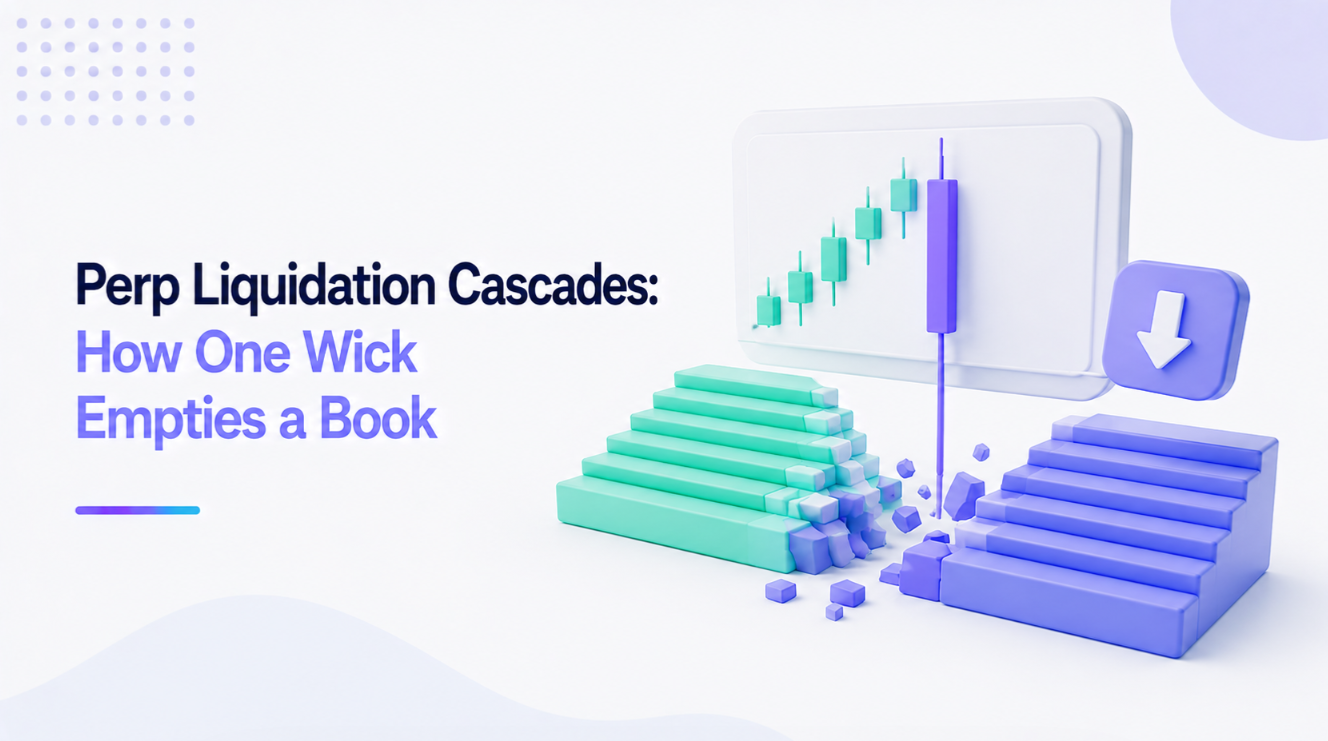
When leveraged positions are liquidated, the exchange closes them with market orders that push price further in the same direction, triggering more liquidations. The loop accelerates on thin books, at low-liquidity hours, and where open interest is concentrated on one side. Circuit breakers, insurance funds, auto-deleveraging and mark-price mechanisms limit it. The practical defences are lower leverage, wider margin buffers, and never using a stop that becomes a market order.
- 1The loop. Leveraged longs accumulate as a market rises.
- 2What makes it worse. **Thin books.** The same liquidation volume moves price much further when depth is low, which is why cascades concentrate in weekend and off-hours…
- 3What limits it. **Mark price, not last price.** Serious venues liquidate against a mark derived from an index of external spot prices rather than the venue's own…
- 4The trader's side. Three defences, in order of effectiveness.
On this page5 sections
A liquidation is not a signal. It is a forced market order sent by a risk engine that must close a position regardless of price. When enough of them fire together, the resulting price movement triggers the next set, and the market briefly stops being a mechanism for discovering value.
The loop
Leveraged longs accumulate as a market rises. Their liquidation prices cluster below, at intervals determined by common leverage settings — the 10x crowd sits together, the 20x crowd sits together beneath them.
A move down reaches the first cluster. The risk engine closes those positions by selling into the book. That selling consumes bids and pushes price lower, into the next cluster. Repeat.
Each iteration is faster than the last, because each one removes bids while adding sells. The move ends when the clusters are exhausted or when new buyers arrive with enough size to absorb the flow — and the price at that moment has no particular relationship to anything except where the leverage stopped.
What makes it worse
Thin books. The same liquidation volume moves price much further when depth is low, which is why cascades concentrate in weekend and off-hours sessions and in assets outside the majors.
One-sided open interest. Funding rates tell you this in advance. Persistently high positive funding means longs are crowded and paying to stay in, which is a map of where the fuel is.
Fragmentation. Open interest split across many venues means each one liquidates into its own book, and the price impact on one propagates to others through index pricing and arbitrage.
High leverage availability. Venues offering very high maximum leverage attract positions whose liquidation prices sit close to the market, so a small move starts the sequence.
What limits it
Mark price, not last price. Serious venues liquidate against a mark derived from an index of external spot prices rather than the venue's own last trade. This prevents a manipulated or thin local book from triggering liquidations that the broader market does not justify — the single most important protection, and the first thing to check on any venue.
Partial liquidation. Closing part of a position to restore margin, rather than all of it, reduces the size hitting the book.
Insurance funds and auto-deleveraging. The fund absorbs shortfalls when a position closes below bankruptcy price; if it is exhausted, ADL force-closes profitable opposing positions instead. The mechanics are in exchange insurance funds, and ADL is why a cascade can reach into an account that was correctly positioned.
Liquidation throttling. Some venues deliberately meter the rate at which forced closes hit the market. Hyperliquid publishes its liquidation and backstop mechanics openly, which is the standard to compare against — a venue whose engine behaviour you cannot read is one whose worst day you cannot model.
The trader's side
Three defences, in order of effectiveness.
Lower leverage. This is the whole answer, and everything else is a refinement. Leverage sets the distance between the current price and the point where your position is closed by someone else. At 20x that distance is a few per cent — well inside ordinary noise in this market.
Margin buffer, monitored. Isolated margin caps the loss to one position; cross margin uses the whole account to defend it, which is safer for the position and more dangerous for everything else. Know which you are using, and maintain a buffer you would not need to top up in a hurry, because gas spikes, interfaces fail and exchanges throttle precisely during cascades.
Stops that are not market orders. A stop-market order in a cascade fills wherever the book is when it triggers, which can be far from the stop price. A stop-limit protects against that and risks not filling at all. Neither is safe; the choice is which failure you prefer, and sizing so that neither is catastrophic is the actual solution.
Cascades as an opportunity, carefully
Because cascades overshoot, resting bids well below the market occasionally fill at prices no discretionary trader would have chosen to offer. This is a legitimate strategy and it is also how people are filled into a genuine collapse rather than a wick.
The distinction is knowable only afterwards, so the discipline is size: a resting bid should be an amount you would be content to hold if the move turns out to be information rather than mechanics. Watching open interest collapse alongside the price — leverage being flushed rather than positions being established — is the closest available real-time signal that the move was structural, and it is visible on the derivatives data pages of most market tools.
The broader point is the one the perp DEX ratings score directly: a venue's liquidation engine, mark price construction and insurance funding are not implementation details. They determine what happens to your account on the one day of the year when it matters.
Next step
Understood the mechanics? Keep going, or compare the services.
FAQ
What is a liquidation cascade?
Why do cascades happen at odd hours?
What is mark price and why does it matter?
How do I avoid being liquidated in a cascade?
Related guides
All guides →- Limit Orders vs. Market Orders: A Beginner's Guide to Crypto TradingThe choice between a limit order and a market order comes down to a simple trade-off: control the price and wait, or take whatever price is available right now.Beginner8 min
- DEX vs. CEX: How Decentralized and Centralized Exchanges DifferEvery crypto trade happens through one of two fundamentally different plumbing systems. Understanding the DEX vs. CEX trade-offs — custody, liquidity, execution, cost — matters more than picking a side.Intermediate11 min
- Concentrated Liquidity: Why LPs Lose Money in RangesChoosing a price range is choosing leverage. The fees rise, the divergence loss rises with them, and most range positions underperform simply holding.Advanced11 min
- LST Depegs: Why stETH Traded Below ETH and What It MeantThe discount was never a backing failure. It was a liquidity event in an asset that could not be redeemed at the time.Intermediate9 min