Limit Orders vs. Market Orders: A Beginner's Guide to Crypto Trading
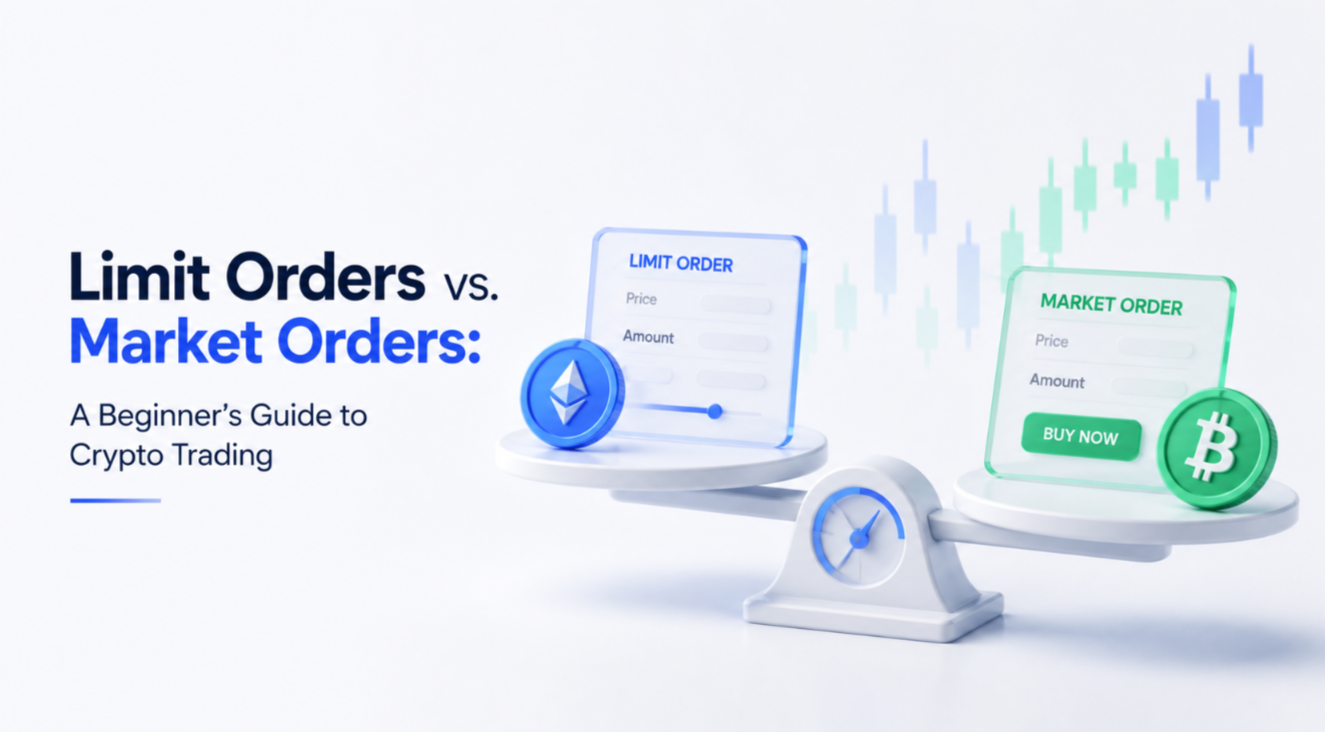
The choice between a limit order and a market order comes down to a simple trade-off: control the price and wait, or take whatever price is available right now.
Dario FennDeFi & Markets Lead · DeFi protocols, yield, market structure and on-chain dataUpdated 6 July 2026
The short answer
A market order fills immediately at whatever price is available; a limit order sets the worst price you will accept and waits, which may mean it never fills. The limit order also usually earns the lower maker fee, since it adds liquidity rather than removing it. Use a market order when execution certainty matters more than a few basis points, and a limit order for everything else.
Every trade on every exchange, from a centralised platform like Coinbase to a decentralised one like Uniswap's order-book-style competitors, ultimately comes down to one of two decisions: take the price the market is offering right now, or name your own price and wait for the market to come to you. Those are market orders and limit orders, and understanding the difference — properly, not just the one-line definition — is the first real skill in trading anything, crypto included.
It sounds simple, and the mechanics are simple. What trips people up is not knowing which one suits a given situation, and losing money to slippage or missed fills as a result.
What a market order actually does
A market order tells the exchange: execute this trade immediately, at whatever the best available price is right now. You're not naming a price — you're prioritising speed and certainty of execution over price precision. If you place a market order to buy 1 ETH, the exchange fills it against the lowest sell orders currently sitting in the order book, working up through price levels until your full order is filled.
This works cleanly in a liquid market with a tight spread — the gap between the best buy and best sell price. On a major pair like BTC/USDT on a large exchange, that spread might be a few cents on a $60,000 asset, so a market order executes at essentially the price you saw on screen. The problem shows up in thinner markets: a small-cap altcoin with a shallow order book might have a spread of several percent, and a large market order can "walk the book," filling against progressively worse prices as it consumes available liquidity at each level. This is called slippage, and it's the single most common way new traders lose money without realising it — the screen showed one price, the fill confirmation shows another, and the gap between them is real money left on the table.
What a limit order actually does
A limit order tells the exchange: only execute this trade at this specific price or better, and wait as long as necessary. If you place a limit buy order for ETH at $3,000 while the current price is $3,050, nothing happens until the market price drops to $3,000 or lower — the order sits in the book, visible to the exchange's matching engine, until it either fills or you cancel it.
The trade-off is the mirror image of a market order: you get exact price control, but you sacrifice the certainty of execution. If the price never reaches your limit, the order simply never fills, and you've spent time waiting for a trade that didn't happen. This is a genuine cost, not a neutral outcome — missing a move because you were waiting for a price that never came is a common frustration for traders who use limit orders reflexively without considering the situation.
Maker versus taker — the fee angle most beginners miss
Beyond execution certainty, there's a fee structure most exchanges use that quietly rewards limit orders. When you place a limit order that doesn't execute immediately, you're adding liquidity to the order book — you're a "maker," because your order sits there for someone else to trade against. When you place a market order, you're removing liquidity by matching against an existing order — you're a "taker."
Most exchanges charge lower fees for maker orders than taker orders, sometimes substantially so. Binance, for instance, has historically charged around 0.1% for both, but tiered structures based on trading volume and fee-token discounts often push maker fees noticeably below taker fees, and this gap widens further at higher volume tiers. For someone trading frequently, that fee differential compounds meaningfully over time, which is one reason more experienced traders default to limit orders even when a market order would fill at essentially the same price.
When a market order is genuinely the right call
There are real situations where paying for certainty makes sense. If you're reacting to breaking news and need a position on immediately, waiting for a limit order to fill risks missing the move entirely. If you're closing a losing position and cutting a loss matters more than shaving a fraction of a percent off the exit price, a market order guarantees you're out. And in highly liquid pairs with tight spreads, the slippage cost of a market order is often negligible enough that the simplicity is worth it.
The situations where market orders hurt most are the ones involving size and thin liquidity together — a large order in a low-volume token, where the price impact of your own trade becomes the dominant factor in your entry price rather than the broader market.
When a limit order is the better tool
Limit orders make sense whenever you have a specific price in mind and no urgent reason to trade immediately. Setting a limit buy below the current market price is effectively placing a standing instruction to buy the dip to a level you've already decided is attractive, without needing to watch the screen. The same logic applies to selling — a limit sell above the current price captures an upside target without requiring you to catch the exact moment it's hit.
Limit orders are also the more disciplined tool almost by construction, because they force you to decide your entry or exit price in advance rather than reacting emotionally to a moving screen. That's a genuinely underrated benefit — a market order placed in a moment of panic or excitement executes at whatever the market happens to be doing at that second, while a limit order set calmly beforehand enforces the plan you made when you weren't under pressure.
A practical way to decide
Ask two questions before placing any order. First: does this trade need to happen right now, or can it wait for the right price? If timing genuinely matters — news, a rapidly moving market, closing a risk position — lean market order. If the price matters more than the timing, lean limit order.
Second: how liquid is this specific pair, right now, at the size I'm trading? A $200 market order on BTC/USDT is a non-event. A $200 market order on an obscure token with a few thousand dollars of order book depth can move the price against you noticeably. Checking the order book depth before trading — most exchange interfaces show this directly next to the trading chart — takes a few seconds and tells you immediately how much slippage risk you're carrying.
A note on stop and other order types
Once these two are comfortable, most exchanges offer variations worth knowing exist even if you don't use them immediately: stop-limit orders, which convert into a limit order once a trigger price is hit, and stop-market orders, which convert into a market order at that trigger. These combine the two core concepts covered here rather than introducing anything fundamentally new, which is exactly why getting comfortable with plain limit and market orders first makes everything that follows easier to understand.
The two order types aren't in competition with each other — they're tools suited to different jobs, and most active traders use both regularly depending on the situation. The goal isn't to pick a favourite; it's to recognise, trade by trade, which trade-off — price control or execution certainty — matters more right now.
FAQ
What is the difference between a limit and a market order?+
A market order fills immediately at whatever price is available. A limit order sets the worst price you will accept and waits, which may mean it never fills.
Which order type should I use?+
A limit order for anything that is not urgent, since it controls price and usually earns the lower maker fee. A market order when execution certainty matters more than a few basis points.
What is the difference between maker and taker fees?+
A resting order adds liquidity and pays the lower maker fee. An order that executes immediately removes liquidity and pays the taker fee, often around double.
What is a stop order?+
An instruction that becomes active once the price reaches a trigger. A stop-market fills at whatever the book offers, which can be far from the trigger in a fast move; a stop-limit protects the price but may not fill at all.
 Dario FennDeFi & Markets Lead · DeFi protocols, yield, market structure and on-chain data