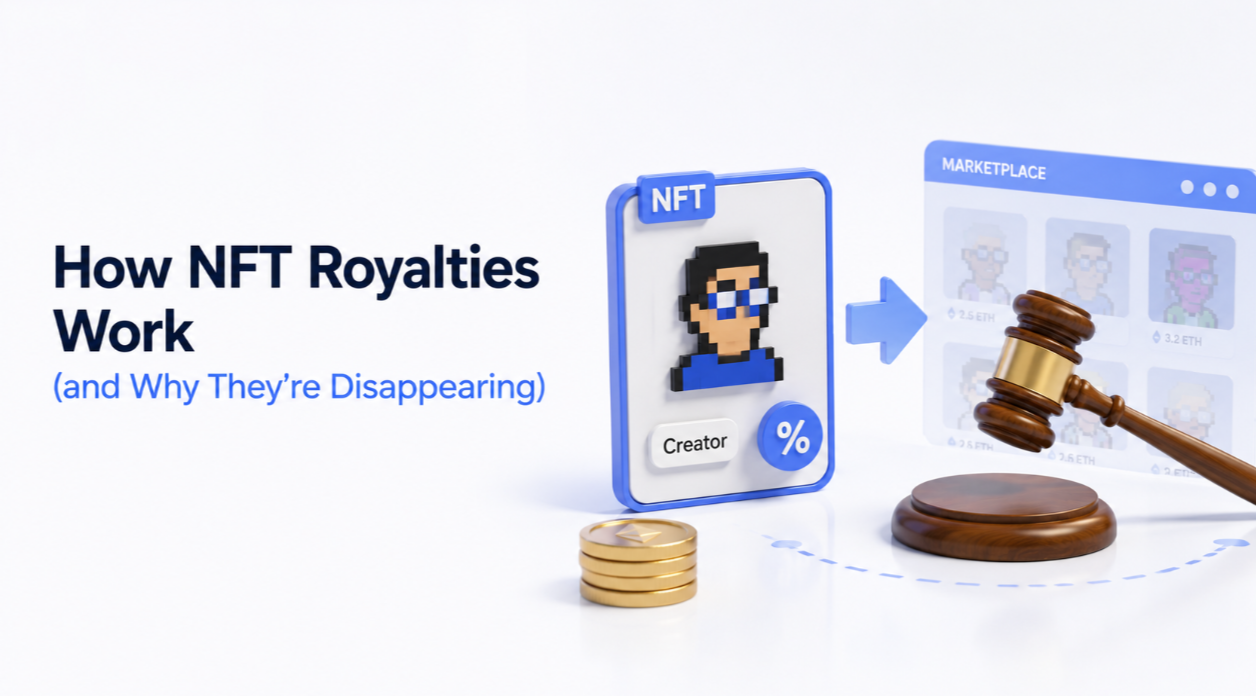
How NFT Royalties Work (and Why They're Disappearing)
Creator royalties were once pitched as NFTs' killer feature over traditional art. A few years and one marketplace price war later, most of that promise has quietly evaporated — here's how NFT royalties actually work and why enforcement collapsed.
Dario FennDeFi & Markets Lead · DeFi protocols, yield, market structure and on-chain dataUpdated 26 June 2026
The short answer
Creator royalties were never enforced by the ERC-721 standard — they were honoured voluntarily by whichever marketplace processed the sale. Once one venue made them optional to win volume, sellers moved there and the rest followed. Today royalties are paid where the collection's contract enforces them or the marketplace chooses to, and a stated royalty rate is a request rather than a rule.
One of the pitches that got a lot of artists genuinely excited about NFTs, back when the technology was still being explained to sceptical newcomers, had nothing to do with speculation. It was royalties: the promise that a creator could bake a small percentage — typically 5% to 10% — into their work's code, so that every time the piece resold on the secondary market, forever, a cut flowed automatically back to them. No gallery to negotiate with, no publisher taking the lion's share, just code enforcing a deal a traditional artist could only dream of. How NFT royalties work in principle is elegant. What happened to that promise in practice is one of the more instructive stories in crypto about the gap between what code can technically do and what a competitive market will actually let it do.
The mechanism, when it worked as designed
NFT royalties were never actually enforced by the blockchain itself — that's the detail that turned out to matter enormously. A token standard like Ethereum's ERC-721 has no built-in concept of a royalty payment; transferring ownership of a token is just transferring ownership, full stop. Royalties were instead a metadata standard, most commonly EIP-2981, that let a creator's contract specify a suggested royalty percentage and recipient address. The crucial word is suggested. Marketplaces like OpenSea voluntarily read that metadata and, at the point of sale, deducted the royalty and routed it to the creator before handing over the rest of the proceeds to the seller. It worked beautifully for years, but it worked because marketplaces chose to enforce it, not because the protocol forced them to — and that voluntary arrangement turned out to be exactly as durable as market incentives allowed it to be.
The price war that broke the model
The unravelling started in 2022, when a newer marketplace, X2Y2, and then more consequentially Blur, began competing for trading volume by making royalties optional at the point of sale rather than mandatory. A seller could simply choose to pay 0% instead of the creator's specified 5% or 10%, pocketing the difference themselves. For traders moving large volumes — and Blur specifically targeted high-frequency professional flippers with token incentives tied to trading volume — that difference was real money, and optional royalties became a genuine competitive edge for any marketplace willing to offer them. OpenSea, watching its dominant market share evaporate to a rival undercutting it specifically on this point, capitulated within months and made royalties optional across its own platform too. Once the largest marketplace stopped enforcing what had been an industry norm, there was no meaningful holdout left, and enforcement collapsed across the sector within about a year.
Why on-chain enforcement never quite arrived
The technical fix that would have prevented all this — building royalty enforcement directly into the smart contract, so a transfer literally cannot complete without the payment — does exist, but it comes with a real cost that limited its adoption. Fully enforced on-chain royalties generally require restricting which marketplaces or contracts a token can trade through, blocking transfers routed through contracts that don't honour the royalty logic. That approach, sometimes called an operator filter, works, but it also makes the NFT less liquid and less composable, since it can inadvertently block legitimate uses like lending protocols or wallet transfers that route through intermediate contracts. Creators who adopted these enforcement tools traded away some of the flexibility that made their tokens tradeable everywhere, in exchange for royalty guarantees that most collectors barely noticed until they were gone.
Who actually loses when royalties go optional
The most immediate losers are working artists who priced their initial mint deliberately low, on the explicit assumption that ongoing royalties from secondary trading — not the primary sale — would be where most of their income came from over a collection's lifetime. That model, common through 2021 and 2022, assumed a royalty rate that turned out to be entirely contingent on marketplace goodwill rather than anything contractual. Large, established collections with enough leverage to threaten delisting from major marketplaces have sometimes managed to preserve enforced royalties through direct negotiation or by building their own enforcement into newer contract versions. Smaller and newer creators, who have no such leverage, are the ones who've borne the brunt of the shift, watching secondary volume continue while the income that was supposed to accompany it quietly stopped arriving.
What's left of the royalty model today
The current landscape is fragmented rather than uniformly bleak. Some marketplaces, Magic Eden and OpenSea among them, now let creators optionally enforce royalties on tokens using contract-level tooling, at the cost described above. Some professional traders, particularly on platforms like Blur that built their user base on royalty-optional trading, will simply never pay them regardless of what a creator's contract requests, treating royalties as a relic of an earlier, less efficient market structure. And a meaningful share of trading volume across the sector has migrated to venues and user bases where royalties were never seriously enforced to begin with, particularly in the newer wave of fully on-chain, generative collections that launched after the norm had already broken down.
What this means for anyone minting or collecting now
For a creator considering an NFT launch today, the honest planning assumption is that secondary royalties are a possible bonus, not a reliable revenue line — price the primary mint as though it's the only payment you're likely to see, and treat anything collected afterwards as upside rather than a plan. For a collector, it's worth knowing that a collection's stated royalty percentage on its own marketing page tells you very little about what actually gets paid at the point of sale; check the specific marketplace and contract enforcement mechanism before assuming a purchase is meaningfully supporting the artist beyond the initial mint. The technology to enforce royalties properly has existed since roughly 2022. Whether it gets used has turned out to be a market decision, not a technical one, and the market has, for now, mostly decided against it.
FAQ
How do NFT royalties work?+
A percentage of each resale is meant to go to the creator. It is honoured by the marketplace processing the sale, not enforced by the ERC-721 standard itself.
Why did NFT royalties stop being paid?+
Marketplaces competing for volume made royalties optional, and sellers moved to whichever venue left more money in their hands. Nothing in the token could prevent it.
Can royalties be enforced on-chain?+
Only by restricting transfers — blocking marketplaces that do not honour them, or making transfers conditional in the contract. Both work and both reduce compatibility.
Do royalties matter when buying an NFT?+
They affect your resale proceeds, so check what the marketplace actually applies rather than the collection's stated rate.
 Dario FennDeFi & Markets Lead · DeFi protocols, yield, market structure and on-chain data