How DeFi Lending Protocols Work: Collateral, Rates, and Liquidations
A step-by-step look at how overcollateralized borrowing works on protocols like Aave and Compound, and exactly what triggers a liquidation when the market turns.
Dario FennDeFi & Markets Lead · DeFi protocols, yield, market structure and on-chain dataUpdated 26 July 2026
The short answer
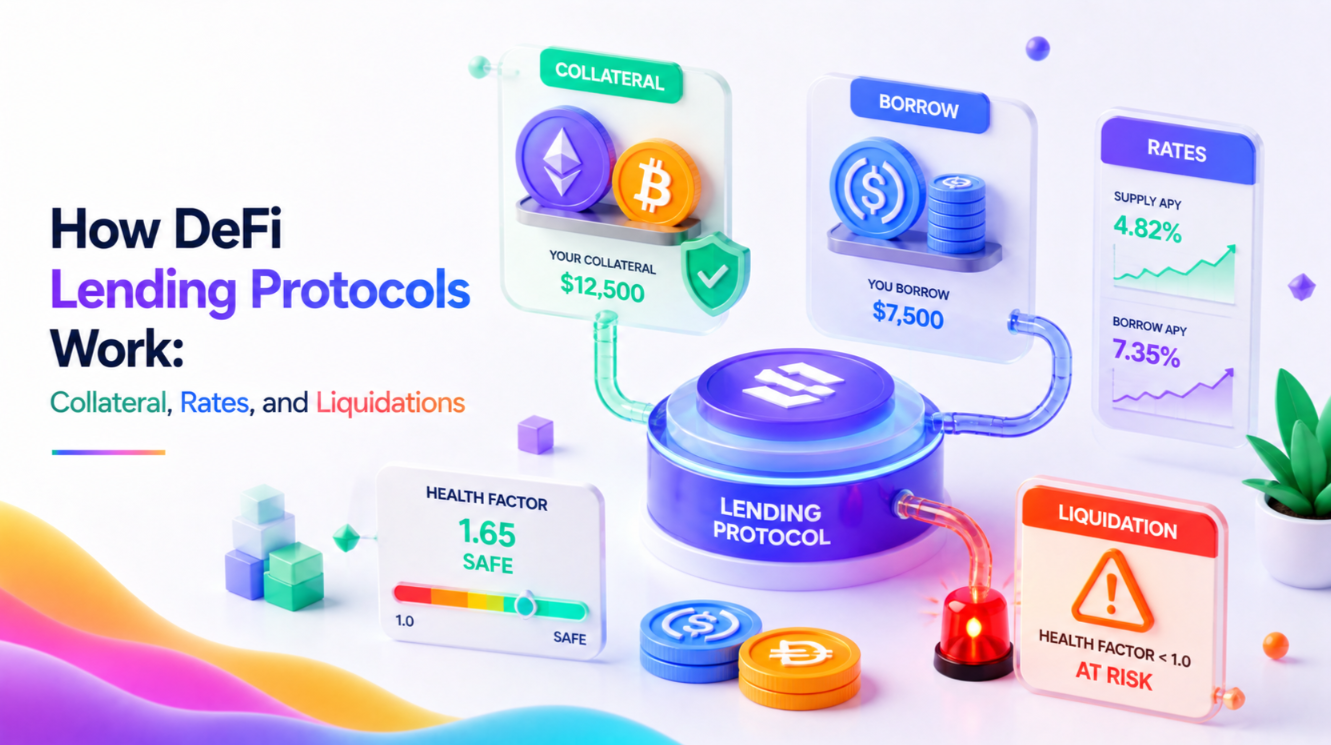
DeFi lending replaces the credit check with over-collateralisation: you post more value than you borrow, and the protocol can sell that collateral if it falls. A health factor tracks how close you are, and at 1 anyone may liquidate the position, repaying part of the debt and taking collateral plus a bonus of typically 5–10%. Rates move with utilisation, and a fully utilised pool can also stop you withdrawing.
DeFi lending protocols have quietly become one of the largest pockets of activity on-chain, routinely holding tens of billions of dollars in deposits across platforms like Aave, Compound and Morpho. The pitch is simple: lock up crypto as collateral, borrow against it, and skip the credit check, the loan officer and the paperwork entirely. The mechanics underneath that pitch, though, are anything but simple, and understanding them is the difference between using these protocols safely and getting liquidated in your sleep.
Why Overcollateralization Replaces the Credit Score
Traditional lending runs on trust built over years: income history, credit scores, legal recourse if you default. DeFi has none of that, so it substitutes trust with excess collateral. Borrow $1,000 in USDC on Aave and you'll typically need to post $1,300–$1,500 or more in ETH or another accepted asset, depending on that asset's loan-to-value (LTV) ratio. The protocol doesn't care who you are; it only cares that the collateral sitting in the smart contract is worth comfortably more than what you've borrowed, at all times, priced by an oracle feed rather than a human underwriter.
Every asset a protocol accepts as collateral gets its own LTV and liquidation threshold, set through governance votes based on the asset's volatility and liquidity. A blue-chip like ETH might get an 80% LTV and an 82.5% liquidation threshold. A smaller-cap token might be capped at 40% LTV, if it's accepted at all, because a thin order book means a large liquidation could crash the price before anyone can sell into it.
Interest Rate Curves and Utilisation
Rates on DeFi lending protocols aren't set by a committee; they float algorithmically based on utilisation, the ratio of borrowed funds to total deposits in a given pool. When a pool is lightly borrowed, rates stay low to attract borrowers. As utilisation climbs toward 80–90%, rates rise sharply to pull in fresh deposits and discourage further borrowing, protecting the pool's ability to let depositors withdraw on demand.
The kink in the curve
Most protocols use a kinked interest rate model: a gentle slope below an optimal utilisation point, then a steep slope above it. Below the kink, borrowing a stablecoin might cost 3–4% annually. Cross 90% utilisation and that rate can spike past 20% within hours, because the model is designed to punish the scenario where withdrawals could get stuck. Watching a pool's utilisation is one of the more underrated habits of an experienced DeFi borrower.
Health Factors: Your Early Warning System
Every borrowing position has a health factor, a single number derived from collateral value, debt value, and the liquidation threshold. A health factor above 1 means the position is safe; at or below 1, it becomes eligible for liquidation. This number moves with the market in real time. A 15% drop in ETH's price while you're borrowing against it can shave your health factor from a comfortable 1.6 down toward 1.0 without you touching a single button.
What Actually Happens During a Liquidation
When a position's health factor drops below 1, it doesn't get frozen or flagged for review, it gets liquidated, usually within the same block. Liquidator bots, running scripts that scan every open position across every major protocol, race to repay a portion of the borrower's debt in exchange for a slice of their collateral at a discount, typically 5–15% below market price. That discount is the liquidator's profit, and it's also the borrower's loss on top of losing the position.
This isn't a gentle process. On protocols like Aave, a liquidator can usually only close up to 50% of a position in one transaction, though some configurations allow full closure for severely undercollateralized debt. Multiple bots often compete for the same liquidation, driving gas wars during volatile periods, which is part of why liquidations cluster around market crashes: the same price move that triggers thousands of unhealthy positions also floods the mempool with liquidation transactions fighting for block space.
Bad Debt, Flash Loans, and Protocol-Level Risk
Liquidations exist to protect the protocol's solvency, but they don't always work fast enough. In a sharp, fast-moving crash, or when an asset's liquidity dries up mid-collapse, the collateral seized can end up worth less than the debt it was meant to cover. That shortfall becomes bad debt, sitting on the protocol's books and, in extreme cases, eating into the funds of depositors who did nothing wrong except supply liquidity to the wrong pool. This is why protocols cap how much of any single volatile asset they'll accept and why governance forums spend so much time debating LTV parameters that sound boringly technical but directly determine solvency.
Flash loans complicate the picture further. Because a flash loan lets anyone borrow an unlimited amount of capital for a single transaction with no collateral, provided it's repaid by the end of that transaction, liquidator bots use them to seize positions without needing their own capital upfront. It's efficient for the market but it also means liquidations happen faster and more mechanically than most retail borrowers expect.
Managing the Risk as a Borrower
The practical takeaway is straightforward even if the mechanics aren't: never borrow up to your maximum LTV, keep a buffer that survives a realistic overnight move in your collateral asset, and set up alerts for your health factor rather than checking it manually. Stablecoin collateral removes price risk but not smart contract or oracle risk. Volatile collateral removes none of the above. DeFi lending protocols reward discipline and punish complacency in roughly equal measure, and the liquidation bots are not going to give you the benefit of the doubt.
FAQ
Why is DeFi borrowing overcollateralised?+
There is no credit score or recourse, so the protocol's only protection is holding collateral worth more than the loan and being able to sell it before it falls below the debt.
What is a health factor?+
Collateral value weighted by each asset's liquidation threshold, divided by total debt. Above 1 the position is safe; at or below 1 anyone can liquidate it.
What happens during a liquidation?+
A liquidator repays part of the debt and takes collateral worth that amount plus a bonus, usually 5–10%. That bonus is your loss and it applies immediately.
How are DeFi interest rates set?+
By utilisation. As more of the supplied liquidity is borrowed, rates rise along a curve, which draws in suppliers and discourages further borrowing.
 Dario FennDeFi & Markets Lead · DeFi protocols, yield, market structure and on-chain data