How Crypto Oracles Work: Bringing Real-World Data On-Chain
Smart contracts can't see the outside world on their own. Oracles are the systems that feed them prices, events, and data — and getting that design wrong has cost DeFi protocols hundreds of millions.
Dario FennDeFi & Markets Lead · DeFi protocols, yield, market structure and on-chain dataUpdated 14 July 2026
The short answer
A blockchain can only agree on what it can verify itself, so contracts cannot see external prices or events. Oracles supply that data, and because contracts act on whatever the oracle reports, a manipulated or stale feed can drain a protocol without any bug in its own code. Robust designs aggregate many independent sources and node operators, use time-weighted rather than spot prices, and apply deviation thresholds and heartbeats.
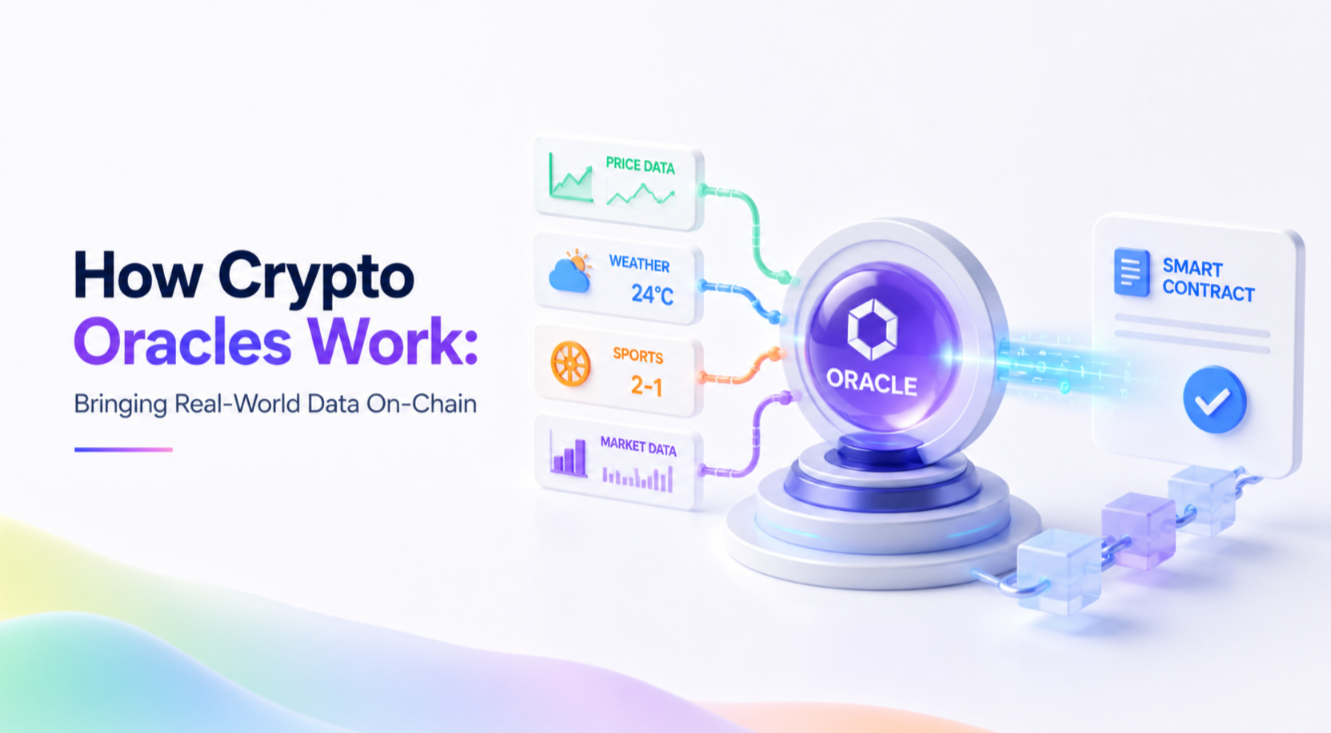
A blockchain is, by design, a closed box. Every node has to independently verify every piece of state, which means the network can only agree on things it can check for itself — the classic example being that a smart contract has no innate way of knowing the price of ETH, the outcome of a football match, or the temperature in London. That's a deliberate feature, not an oversight: if nodes had to trust some external input to reach consensus, the whole point of decentralised verification would collapse. But an enormous amount of what crypto is actually used for — lending, derivatives, insurance, prediction markets — depends on exactly that kind of outside information. Understanding how crypto oracles work is understanding the workaround: a layer of infrastructure built specifically to get trustworthy outside information onto a chain that otherwise has no way of seeing it, and how well that layer is designed is one of the more consequential and least visible questions in the industry.
What an oracle actually is
Strip away the jargon and an oracle is simply a bridge between off-chain data and on-chain logic — a service that fetches information from the outside world, formats it, and delivers it to a smart contract in a way the contract can act on. The tricky part was never the fetching. APIs for asset prices, sports results, and weather data have existed for decades. The tricky part is delivering that data in a way a decentralised system can trust without simply reintroducing a single point of failure — because if your entire DeFi protocol's solvency depends on one server telling the truth, you haven't really built something decentralised, you've built something with an unusually elaborate wrapper around a centralised weak point.
Why oracle design is a security problem, not a plumbing problem
The failure mode here has a name: oracle manipulation, and it's been behind some of DeFi's more expensive lessons. If a lending protocol determines whether your collateral is sufficient by checking the spot price on a single, thinly traded exchange, an attacker with enough capital can move that price on that one venue, trigger a liquidation or borrow against inflated collateral, and walk away before the price reverts. Mango Markets lost around $114 million in October 2022 to exactly this pattern — an attacker used a large position to distort the oracle price of MNGO, then borrowed against the inflated paper value. bZx suffered similar flash-loan-driven oracle attacks years earlier, for smaller amounts, that should have been a warning to the rest of the industry. The lesson every protocol eventually learns the same way is that an oracle isn't a data feed you plug in and forget — it's part of your attack surface, and its design choices are security choices.
The main oracle architectures
Push oracles, the model Chainlink popularised, work by having a decentralised network of independent node operators each fetch a price from multiple sources, aggregate it off-chain, and push an updated value on-chain at set intervals or when the price moves beyond a threshold. The contract consuming the data simply reads the latest value already sitting in storage, which is cheap and fast for the consumer, at the cost of the price being slightly stale between updates. Pull oracles, which Pyth Network built its reputation on, flip this: prices are continuously published off-chain by first-party data providers — exchanges and trading firms — and a contract pulls the latest signed price on demand, paying the gas cost of that update itself. This suits protocols that need very fresh prices, such as perpetuals exchanges, at the cost of a marginally more complex integration.
A third category, request-response oracles, is built for one-off, arbitrary queries rather than continuously updated feeds — a contract asks a specific question (did this flight land on time? what was the outcome of this election?) and an oracle network answers it once. This is the model behind most prediction markets and parametric insurance products, where the data being requested isn't a repeating price feed but a discrete fact that only needs to be resolved once.
How decentralisation actually gets built into an oracle
The mechanics that make an oracle trustworthy rather than merely convenient come down to a few overlapping techniques. Sourcing from multiple independent venues rather than one exchange makes it much harder for an attacker to distort the composite price without moving the entire market, which is a far more expensive proposition than manipulating a single thin order book. Running the aggregation across many independent node operators, rather than one server, means no single operator going offline or acting maliciously can corrupt the feed — Chainlink's approach requires a threshold of nodes to agree before a price update is accepted. Requiring node operators to stake collateral that can be slashed for reporting bad data, an approach oracle networks have increasingly adopted, gives operators a direct financial reason to report honestly rather than merely a reputational one. And using time-weighted or volume-weighted averages instead of instantaneous spot prices smooths out the kind of brief, thin-liquidity spikes that flash-loan attacks are specifically engineered to exploit.
What to check before trusting a protocol's oracle setup
For anyone evaluating a DeFi protocol rather than building one, a few questions do most of the work. Which oracle provider does the protocol actually use, and is it a name with a track record — Chainlink and Pyth dominate for good reason, and a protocol rolling its own custom oracle is taking on meaningfully more risk than one plugging into established infrastructure. How many independent sources feed into the price the protocol relies on, since a feed drawing from one exchange is fragile in exactly the way Mango Markets discovered. Does the protocol use time-weighted pricing for anything liquidation-sensitive, or does it react to instantaneous spot prices that a well-funded attacker could distort for the length of a single transaction. And has the protocol had any oracle-related incidents before, even near-misses that didn't result in a full exploit — a team that has patched oracle issues quietly is not automatically less trustworthy than one that hasn't, but it's worth knowing what happened and how they responded.
Oracles beyond price feeds
It's easy to think of oracles purely as a price-feed problem because that's where the biggest exploits have landed, but the same infrastructure increasingly does much more. Proof-of-reserve feeds let a stablecoin or wrapped-asset issuer publish, on-chain and continuously, evidence that the reserves backing their token actually exist — a direct response to the trust issues that have dogged custodial stablecoins. Randomness oracles, such as Chainlink VRF, solve a different problem entirely: blockchains are deterministic by design, which means they cannot generate genuinely unpredictable randomness on their own, yet games, NFT mints, and lotteries all need exactly that. Cross-chain messaging protocols, which increasingly overlap with oracle networks, use the same verify-and-relay pattern to move not just data but instructions between chains. The common thread across all of these is the same problem restated in different clothes — how does a system that can only trust its own consensus come to trust something it cannot independently verify — which is why the strongest oracle networks tend to be the ones built as general-purpose trust infrastructure rather than as a single-purpose price feed bolted onto one protocol.
The trade-off that never fully goes away
There is no version of an oracle that's simultaneously instant, free, and fully trustless — every design is a trade-off between latency, cost, and the number of independent parties required to agree before data is accepted as true. Push oracles favour efficiency for the consuming contract at the cost of freshness; pull oracles favour freshness at the cost of update gas; request-response oracles handle bespoke queries that neither model was built for. None of that is a flaw to be engineered away so much as a structural reality of connecting a system that can only trust its own consensus to a world that operates by entirely different rules. The protocols that have avoided nine-figure oracle exploits aren't the ones that found some clever shortcut around that trade-off — they're the ones that took it seriously enough to design around its weakest points before an attacker found them first.
FAQ
What is a blockchain oracle?+
A system that brings external data on-chain so contracts can act on it. Contracts cannot read anything outside their own chain by themselves.
Why are oracles a security risk?+
Because whatever the oracle reports is treated as true. A manipulated or stale price can trigger liquidations or drain a protocol without any bug in the protocol's own code.
How do oracles resist manipulation?+
By aggregating many independent sources and node operators, using time-weighted averages rather than a spot price, and applying deviation thresholds and heartbeats.
What should I check about a protocol's oracle?+
Which oracle prices each asset, how often it updates, whether the collateral is liquid enough that manipulating it would be expensive, and what happens if the feed stalls.
 Dario FennDeFi & Markets Lead · DeFi protocols, yield, market structure and on-chain data