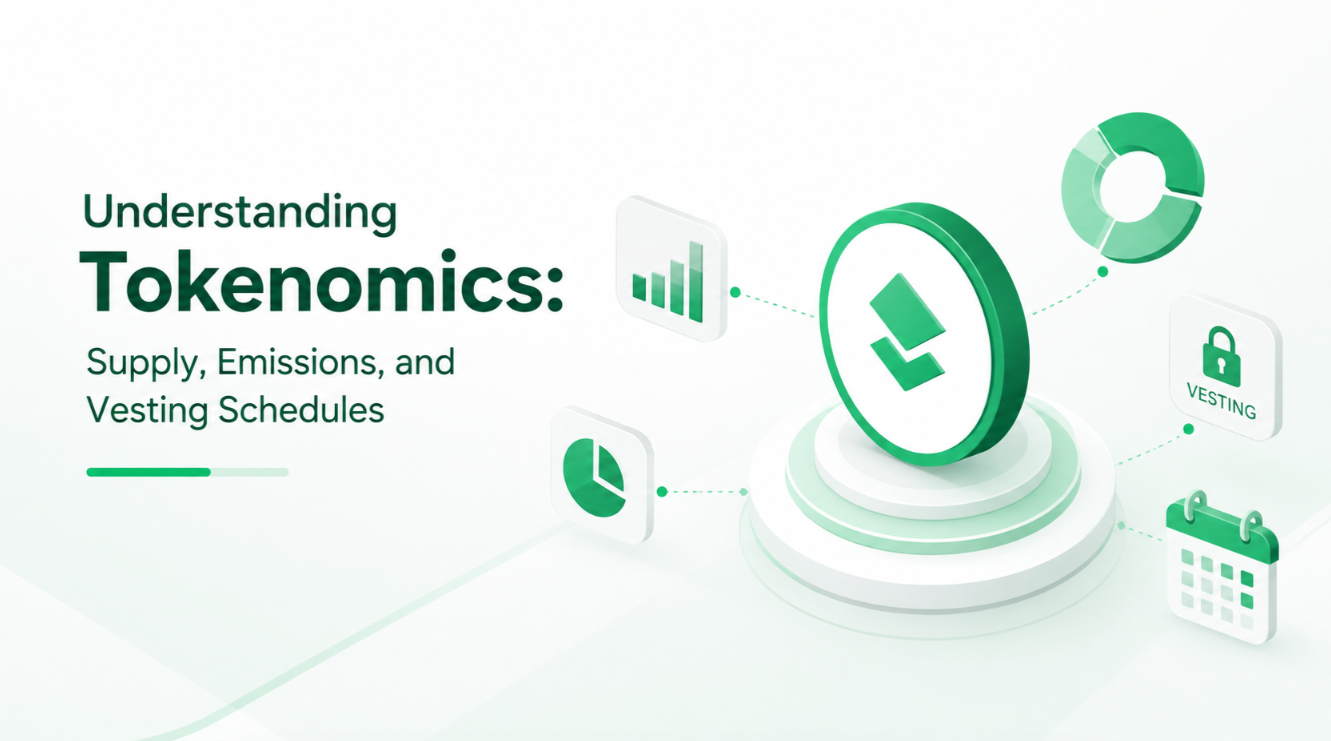
Understanding Tokenomics: Supply, Emissions, and Vesting Schedules
A token's price chart tells you nothing about the supply mechanics working against it. Here's a framework for reading tokenomics properly before you decide what a token is actually worth holding.
Dario FennDeFi & Markets Lead · DeFi protocols, yield, market structure and on-chain dataUpdated 27 May 2026
The short answer
Three numbers carry most of a token's supply story: circulating supply, total supply and fully diluted valuation. The gap between circulating and total is dilution still ahead of you, and it closes as tokens unlock whether or not demand has grown. Read the vesting schedule for cliff dates and monthly unlock size against daily volume, and the allocation table for who holds supply at what cost basis.
Ask most people why a token is worth what it's worth and you'll get an answer about the project's narrative, its team, or its recent price momentum. Ask fewer people about the token's supply schedule and you'll get blank looks — which is strange, because understanding tokenomics is arguably the single most mechanical, most knowable input into where a token's price is headed, and it's sitting in public documentation the whole time. Supply design doesn't predict adoption, but it does predict sell pressure, and sell pressure is the thing that quietly overwhelms good fundamentals more often than bad fundamentals ever do.
The three numbers that actually matter
Every serious tokenomics analysis starts with three figures, and conflating them is the single most common mistake retail investors make. Circulating supply is the number of tokens actually in the market right now, tradeable and liquid. Total supply is everything that has been created so far, including tokens locked, vested, or otherwise not yet liquid. Maximum supply, where one exists, is the hard cap the protocol will never mint beyond. The gap between circulating supply and total or maximum supply is where the danger lives: a token trading at a modest market capitalisation but a wildly larger fully diluted valuation is one where today's price reflects only a fraction of the tokens that will eventually exist, and that gap doesn't close by magic — it closes as those tokens unlock and hit the market, whether or not demand has grown to absorb them.
Fixed supply versus inflationary emissions
Bitcoin's fixed 21 million cap is the reference point everyone knows, but it's actually the exception rather than the rule — most tokens are designed with ongoing emissions, and the design of those emissions matters enormously. Proof-of-work and proof-of-stake networks typically emit new tokens as block rewards to pay for security, which is a real cost worth paying but one that dilutes existing holders unless demand growth outpaces the emission rate. The relevant question isn't "does this token inflate" — most do — but "does the emission schedule taper over time, and is it transparent about how much." Ethereum's post-Merge issuance, which can turn net-deflationary when network fee burn exceeds new issuance, is a genuinely different economic proposition to a token with a fixed high annual emission rate regardless of usage, and the two get lumped together under "inflationary" far too often.
Reading a vesting schedule properly
Vesting schedules govern when tokens allocated to the team, investors, and early backers actually become liquid, and they are, without exaggeration, one of the most predictable sources of sell pressure in the entire industry — because unlike demand, which is uncertain, a vesting date is fixed and known in advance. The standard structure includes a cliff, a period during which no tokens vest at all, followed by linear or stepped vesting over months or years afterward. A one-year cliff followed by two years of linear vesting is a common, relatively conservative structure; short cliffs followed by rapid unlocks are a red flag, because they suggest early backers can exit close to when retail is first getting access to the token. The detail worth checking specifically is what happens the moment the cliff ends — a large single-block unlock landing all at once creates a much sharper supply shock than the same total amount unlocking gradually over subsequent months, even though the total quantity released is identical.
Why allocation breakdown changes the whole picture
Two tokens with identical total supply and identical vesting timelines can have completely different risk profiles depending on who holds the unvesting tokens. A token where investors and the team collectively hold a large share relative to the community and ecosystem allocation is one where a disproportionate amount of future supply sits with parties whose primary incentive, eventually, is to realise a return — which isn't a moral failing, it's simply the arrangement, and it's worth pricing in rather than ignoring. Ecosystem and community allocations, by contrast, tend to be released against usage — liquidity mining, grants, airdrops — which links new supply more directly to actual network activity rather than releasing it on a fixed calendar regardless of what's happening on-chain. The allocation breakdown is usually published at launch in a project's tokenomics documentation; the mistake is reading it once at launch and never checking it again as unlocks actually land.
Deflationary mechanisms and their limits
Token burns, buybacks, and fee-burning mechanisms get marketed as straightforwardly bullish, and sometimes they are, but the mechanism matters more than the headline. A burn funded by genuine protocol revenue — a share of trading fees permanently removed from supply, the way several DEX and derivatives protocols now operate — reduces supply in proportion to actual usage, which is a real economic effect. A burn that's simply a one-off marketing event, or funded from treasury reserves rather than organic revenue, removes tokens from supply without telling you anything about whether the underlying network is actually being used. The distinction is worth making because "deflationary" has become one of the most overused words in token marketing, applied to mechanisms with wildly different substance behind them.
Building a simple framework before you evaluate anything else
Before assessing a token on narrative, team, or roadmap, it's worth running through supply mechanics first, because a poor supply design can undermine an otherwise sound project, while good supply design won't rescue a project with no real usage. Check the gap between circulating and fully diluted valuation, and be honest about what today's price actually reflects. Check the emission schedule and whether it's tied to security spending, usage, or simply a fixed calendar. Map the vesting schedule against the current date, specifically noting any cliffs ending within the next few months, since those are the moments sell pressure tends to spike regardless of sentiment. And look at who holds the unvested supply, because a token dominated by investor and team allocations carries a different risk profile to one weighted toward community and ecosystem distribution.
Comparing tokenomics across categories fairly
One trap worth naming explicitly is comparing supply mechanics across tokens that aren't actually playing the same game. A layer-1 gas token, a governance token for a lending protocol, and a fixed-supply asset positioned as a store of value all have different jobs, and "good tokenomics" looks different for each. A gas token benefits from emissions that fund security, provided usage grows to offset dilution. A governance token's value is tied to the protocol's revenue and the rights that token actually confers, so a large treasury allocation might be entirely appropriate if it funds genuine ecosystem growth rather than sitting idle. Judging every token against a single fixed-supply, zero-inflation ideal misreads projects that were never designed to fit that mould, and it's worth asking what job a given token is meant to do before deciding whether its supply design serves that job well.
The bottom line
None of this tells you whether a project will succeed — that still depends on adoption, execution, and demand that no spreadsheet can fully forecast. What supply analysis gives you instead is a read on the headwind a token is working against, independent of how good the underlying product turns out to be. A brilliant protocol with a poorly designed unlock schedule can spend years fighting its own supply curve; a mediocre protocol with a disciplined, usage-linked supply design can outperform expectations simply by not working against itself. Reading tokenomics properly won't make the call for you, but it will tell you which direction the mechanical pressure is pointing — and that's worth knowing before you decide how much conviction the rest of the story deserves.
FAQ
What are the key tokenomics numbers?+
Circulating supply, total supply and fully diluted valuation. The gap between circulating and total is the dilution still ahead of you.
What is fully diluted valuation?+
The price multiplied by total eventual supply. It is the honest comparison figure, because tokens still vesting will be sold into the same market you are buying in.
How do I read a vesting schedule?+
Look for cliff dates and the monthly unlock rate afterwards, then compare the size of each unlock against typical daily volume. Large unlocks into thin liquidity move price.
Why does the allocation breakdown matter?+
It shows who receives supply and at what cost basis. A large insider allocation acquired far below market is persistent sell pressure regardless of how the project performs.
 Dario FennDeFi & Markets Lead · DeFi protocols, yield, market structure and on-chain data