Real-World Asset Tokenization Explained: Bringing Bonds and Real Estate On-Chain
Tokenization takes a claim on a bond, a building, or a bar of gold and represents it as a transferable token on a public blockchain. Here's how the mechanics actually work, and why the technology is the easy part.
Dario FennDeFi & Markets Lead · DeFi protocols, yield, market structure and on-chain dataUpdated 19 June 2026
The short answer
Tokenization represents a claim on an off-chain asset — a Treasury bill, a building, a bar of gold — as a transferable token, with a legal structure connecting the two. Tokenized Treasuries and private credit have gained real traction because the yield is straightforward and the underlying is standardised. The token is almost never direct ownership: it is a claim against an issuing entity that holds the asset.
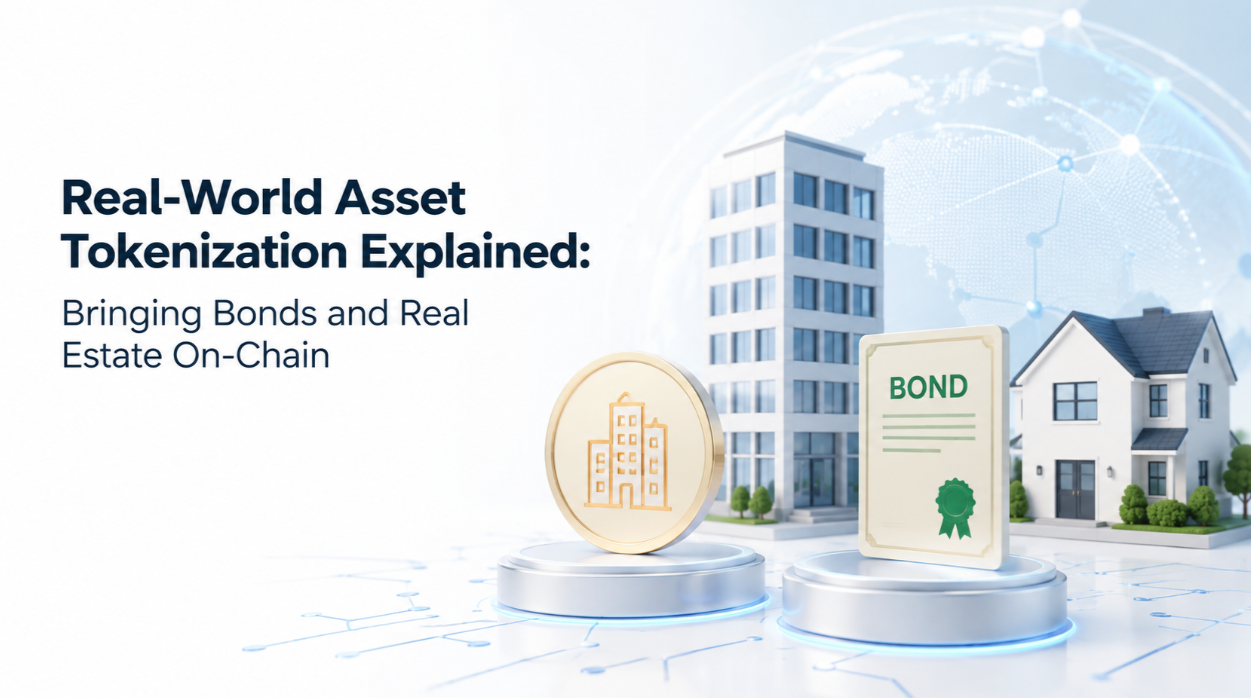
Real-world asset tokenization is, at its core, a fairly unglamorous idea dressed up in newer infrastructure: take an asset that already exists off-chain — a Treasury bill, a slice of a commercial building, an ounce of gold sitting in a vault — and issue a token on a public blockchain that represents a legal claim to it. The token can then be transferred, traded, and used as collateral with the speed and programmability of any other on-chain asset, while the underlying asset itself stays exactly where it always was, doing whatever it normally does. This isn't a new concept dressed in crypto language for its own sake; asset-backed certificates and depositary receipts have existed in traditional finance for decades. What's changed is the settlement layer underneath the claim, and that change turns out to matter more than it sounds like it should.
What tokenization actually does, mechanically
A tokenized asset typically works through a structure where a legal entity — often a special purpose vehicle set up specifically for this purpose — holds the underlying asset and issues tokens that represent a proportional claim against it. The blockchain doesn't hold the Treasury bill or the building; it holds a record of who owns what share of the SPV's claim to that asset, updated by a smart contract instead of a spreadsheet or a transfer agent's ledger. The value of this shift is almost entirely about settlement, not about the asset itself changing in any fundamental way. Traditional securities settle in days, through a chain of custodians, clearing houses, and transfer agents that each take a cut and add a delay. A tokenized version of the same claim settles as fast as the underlying blockchain does, transfers 24 hours a day rather than during exchange hours, and can be split into far smaller denominations than traditional issuance processes typically bother supporting.
Tokenized Treasuries: the category that actually took off
Tokenized US Treasuries became the first RWA category to reach meaningful scale, and the reason is instructive: Treasuries are simple, highly liquid, and their value doesn't depend on judgement calls about condition, occupancy, or appraisal the way real estate does. Products from issuers like BlackRock's BUIDL and Franklin Templeton's BENJI let holders earn a yield tied to short-term government debt while holding a token that settles instantly and can, depending on the platform, be used as collateral within DeFi. The appeal for crypto-native capital is straightforward: instead of sitting in a stablecoin earning nothing, capital can sit in a Treasury-backed token earning a yield anchored to the risk-free rate, without leaving the on-chain environment to do it. This use case exploded specifically because government debt is about as close to a solved valuation problem as an asset gets — which is precisely what makes it a poor guide to how easily other RWA categories will scale the same way.
Tokenized real estate: same idea, much harder problem
Real estate tokenization applies the identical structural idea — an SPV holds a property, tokens represent fractional claims against it — but runs into problems Treasuries never have to deal with. A building needs a property manager, incurs maintenance costs, has to be insured, and its value depends on an appraisal that's inherently more contestable than a bond's price, which the market sets continuously and transparently. Fractional ownership through tokens also doesn't resolve the governance questions that have always dogged shared property ownership: who decides on a renovation, who chooses the property manager, what happens when a majority of token holders want to sell but a minority doesn't. Tokenization makes the ownership claim more liquid and easier to transfer; it does nothing to make the underlying asset itself easier to manage, value, or exit, which is why real estate tokenization has produced plenty of pilot projects and comparatively few examples of genuine, deep secondary-market liquidity.
Private credit and the yield that actually drove adoption
Beyond Treasuries, tokenized private credit — loans originated off-chain and represented on-chain, often through platforms like Figure or Maple — has become one of the fastest-growing RWA categories, precisely because private credit yields have historically been higher than public bond yields and inaccessible to most on-chain capital without going through a fund structure with high minimums and long lock-ups. Tokenization lowers the practical barrier to accessing that yield, but it's worth being clear that it does nothing to change the underlying credit risk of the loans themselves — a tokenized pool of loans to small businesses carries exactly the default risk it would carry off-chain, and the token wrapper doesn't add a layer of protection against borrowers failing to pay. What it changes is the accessibility and transferability of the claim, not the creditworthiness of what's behind it.
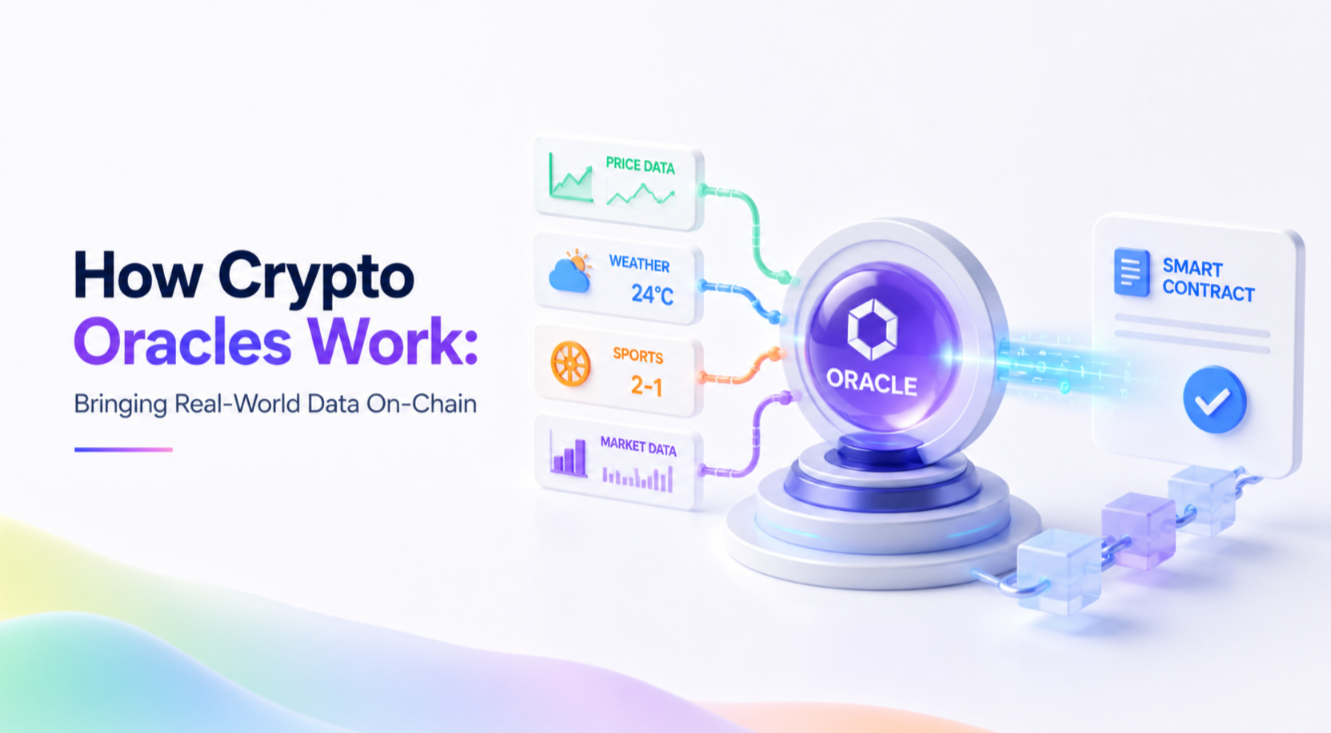
Every category of tokenized RWA runs into a version of the same dependency crypto infrastructure keeps running into elsewhere: the blockchain needs to know something about the off-chain world it cannot verify on its own. For a tokenized Treasury, that's confirmation the underlying bonds are actually held and haven't been double-pledged elsewhere. For tokenized real estate, it's an up-to-date appraisal reflecting current market conditions rather than a stale valuation from the token's issuance date. For tokenized private credit, it's confirmation that reported loan performance — repayment rates, delinquencies — matches what's actually happening off-chain rather than what an issuer would prefer investors to believe. None of this is solved by the blockchain itself; it's solved, to whatever degree it is solved, by the same oracle and attestation infrastructure that prices DeFi collateral, applied here to assets where getting it wrong has considerably higher stakes than a mispriced token swap. It's a dependency worth naming plainly, because the clean, real-time appearance of a token's price on-chain can quietly launder a much messier, slower, and more judgement-laden process happening off-chain underneath it.
Why institutions are actually interested
It's worth taking seriously why large, conservative financial institutions — not just crypto-native firms — have moved into tokenization rather than dismissing it, because the interest isn't really about believing in blockchains as a technology so much as recognising a genuine operational cost problem. Settlement inefficiency in traditional securities markets is expensive: it ties up capital for days during settlement windows, requires reconciliation between multiple record-keeping systems that don't always agree, and adds counterparty risk during the gap between a trade executing and it actually settling. A tokenized bond that settles in seconds rather than days, with a single shared ledger that all parties reference instead of each maintaining their own, removes a real cost center regardless of whether anyone involved cares about crypto as an ideology. That's a more durable reason for institutional interest than speculative upside, and it's why the tokenized Treasury market has kept growing steadily rather than tracking crypto's broader price cycles.
The gap between the token and the claim it represents
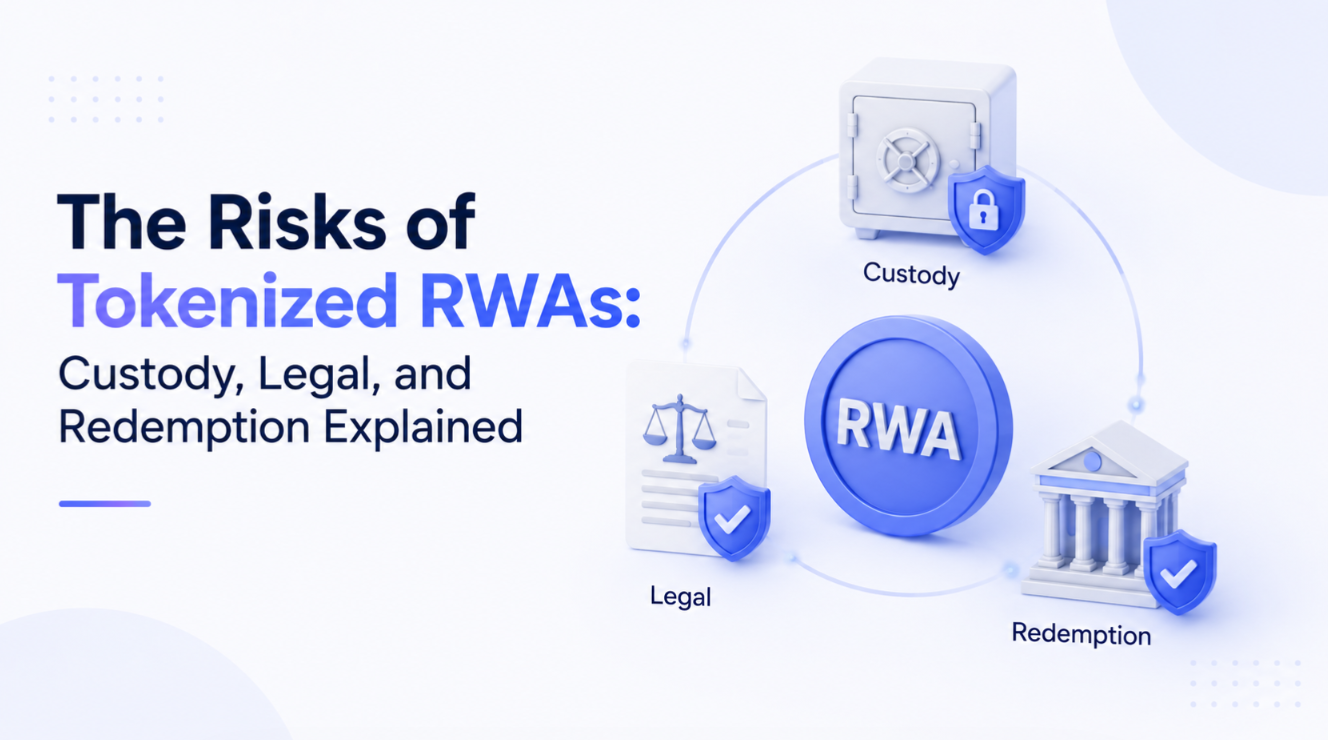
The single most important thing to understand about any tokenized RWA is that the token is not the asset — it's a representation of a legal claim to the asset, and the strength of that claim depends entirely on the legal structure behind it, not on anything the blockchain itself can enforce. A smart contract can guarantee that a token transfers correctly and that the ledger of who holds what is accurate and tamper-resistant. It cannot guarantee that the SPV holding the underlying asset is properly capitalised, that the custodian holding the Treasuries hasn't rehypothecated them, or that a court in the relevant jurisdiction will actually honour a token holder's claim if the issuer becomes insolvent. That gap between on-chain certainty and off-chain enforceability is the central design challenge of the entire category, and it's the subject worth understanding in detail before treating any tokenized asset as equivalent in risk to the thing it represents.
FAQ
What is real-world asset tokenization?+
Representing a claim on an off-chain asset — a bond, a building, a commodity — as a transferable token, with a legal structure connecting the token to the underlying.
Which tokenized assets have actually gained traction?+
Tokenized Treasuries and private credit, because the yield is straightforward and the underlying is standardised. Real estate has proved much harder.
Does holding the token mean owning the asset?+
Rarely directly. Usually the token is a claim against an issuing entity that holds the asset, so the legal structure and the custodian decide what you actually own.
Why are institutions interested in tokenization?+
Faster settlement, continuous transferability and programmable distribution. The appeal is operational rather than a change in the underlying asset.
 Dario FennDeFi & Markets Lead · DeFi protocols, yield, market structure and on-chain data