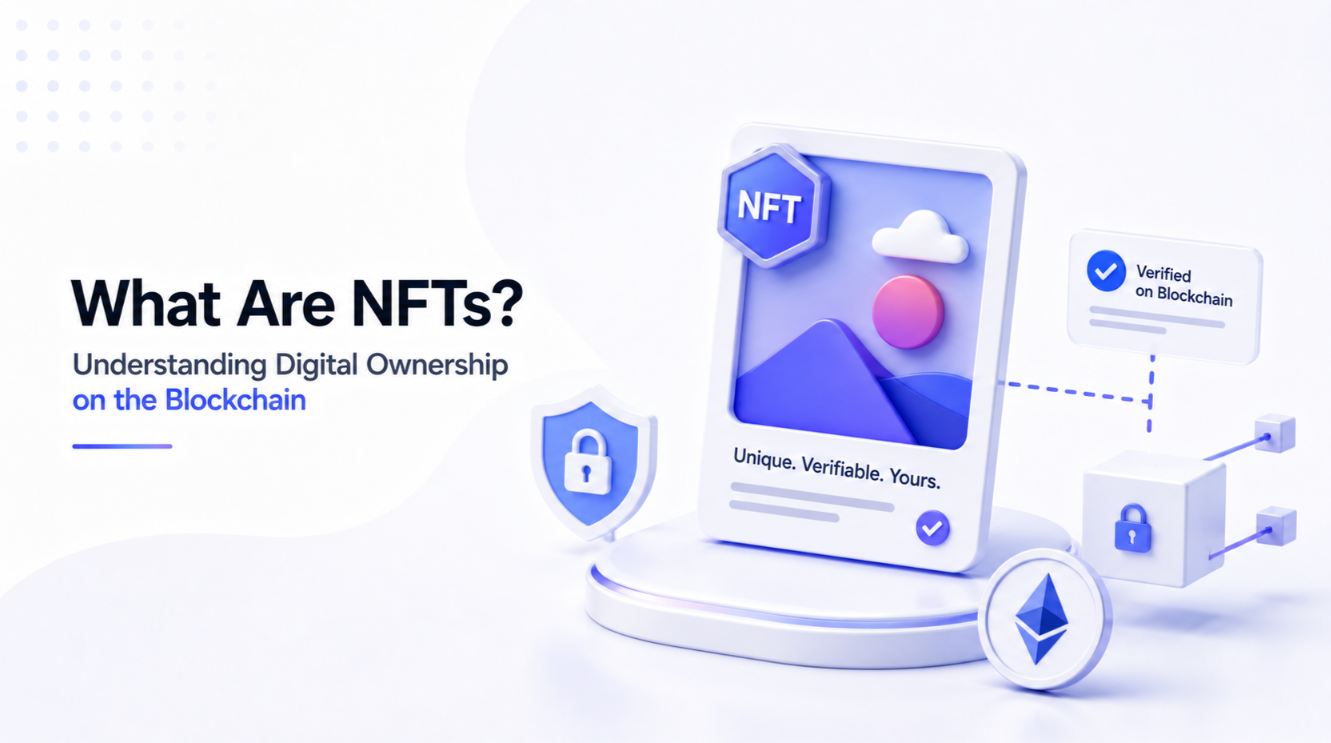
What Are NFTs? Understanding Digital Ownership on the Blockchain
NFTs explained from first principles — what the token actually proves, where the technology is genuinely useful, and where the hype outran the substance.
Dario FennDeFi & Markets Lead · DeFi protocols, yield, market structure and on-chain dataUpdated 22 May 2026
The short answer
An NFT is a unique entry on a blockchain recording that an address holds a particular token. It proves the token, not copyright, and usually not the file either — the artwork typically lives on external storage the token points at. The durable uses are provenance and transferable rights: ticketing, credentials, in-game items and on-chain identity.
An NFT — non-fungible token — is a unique entry on a blockchain that represents ownership of a specific thing, distinguishing it from a fungible token like ETH or a dollar, where every unit is interchangeable with every other. Strip away the jargon and the speculative mania that defined 2021, and what's left is a genuinely useful piece of technology: a way to prove, publicly and without a central registry, that a specific wallet controls a specific asset. Understanding what that proof actually covers — and what it doesn't — is the difference between seeing NFTs clearly and either dismissing them entirely or overpaying for a JPEG.
What a Token Actually Proves
When you own an NFT, the blockchain records that your wallet address holds a token with a unique ID, minted from a specific smart contract. That's it — that's the whole claim. The token itself is typically just a few lines of data: a contract address, a token ID, and a pointer (a URI) to some metadata describing what the token represents. Everything else — whether that token confers any rights, whether it's linked to a physical object, whether the creator promises anything at all — is a matter of the surrounding legal and social agreement, not something the blockchain enforces. This is the single most misunderstood part of NFTs, and it explains a lot of the disputes that followed the 2021 boom.
Standards matter here too. The vast majority of NFTs on Ethereum follow the ERC-721 standard, which defines each token as strictly unique, while a related standard, ERC-1155, allows a single contract to manage both unique and interchangeable items efficiently — useful for games that need thousands of identical swords alongside a handful of one-of-a-kind items. Knowing which standard a collection uses tells you a fair amount about how it's likely to behave technically, long before you get into questions of art or community.
NFTs Aren't the Same as the File
Buying an NFT of a digital artwork doesn't transfer copyright, and it doesn't mean you own the only copy of the image — anyone can right-click and save the same file you paid for. What you own is the token, and the token's value comes from the fact that the blockchain can verify you, specifically, hold the 'original' minted instance, the way owning a signed print differs from owning a photocopy even though the image is identical. Whether that distinction matters to a buyer is entirely subjective, which is precisely why NFT valuations have swung so wildly — the same object can be worth thousands to one person and nothing to another, because the value sits in provenance and status rather than in the pixels.
Where the 'art' actually lives
Here's a detail that trips up a lot of newcomers: most NFT metadata and images aren't actually stored on the blockchain itself, because doing so would be prohibitively expensive at scale. Instead, the token points to a file hosted elsewhere — sometimes on a centralized server that can go offline, sometimes on a decentralized storage network like IPFS or Arweave, which is far more resilient. Before buying, it's worth checking where the underlying file actually lives, because a token pointing to a dead link is a real and recurring failure mode, not a hypothetical one.
Fully on-chain projects exist too, where the artwork itself is generated and stored directly in the smart contract's code — Art Blocks and a handful of generative collections took this approach specifically to guarantee permanence, at the cost of higher minting fees, since storing data directly on a blockchain is one of the more expensive things you can do with it. It's a useful benchmark: a project willing to pay that premium for permanence is making a different statement about longevity than one that points to a free file host.
Beyond Profile Pictures
The profile-picture collections that dominated headlines are one application among many, and arguably not the most durable one. Event ticketing is a natural fit — an NFT ticket can't be counterfeited the way a paper one can, and smart contracts can enforce resale rules like royalty splits automatically. Gaming is another: in-game items minted as NFTs can, in principle, be traded or used across different games rather than trapped inside one publisher's database. Real-world asset tokenization — representing a share of property, a bond, or a piece of physical art as an on-chain token — is a slower-moving but arguably more consequential use case, since it opens fractional ownership and faster settlement to assets that have historically been illiquid. None of these are settled successes yet, but they're a more grounded bet on the technology's long-term use than speculative collectibles ever were.
Membership and access tokens are another quietly growing category — an NFT that functions less like a collectible and more like a keycard, unlocking a community, a piece of software, or a physical event without requiring a centralized login system to verify who holds it. This use case tends to attract less attention than art drops, but it's arguably closer to what made the technology interesting in the first place: a portable, verifiable credential that works across platforms without asking permission from any single company.
Why the 2021 Boom Went Wrong
The mania phase conflated two very different things: genuine interest in a new ownership primitive, and a straightforward speculative bubble where people bought JPEGs expecting to flip them for a profit within days. When that music stopped, trading volumes on most marketplaces fell by well over 90% from their peak, and the vast majority of collections minted during the boom now trade for a fraction of their mint price, if they trade at all. That collapse wasn't a verdict on the underlying technology so much as on the incentive structure of the boom itself — low barriers to minting, aggressive marketing, and a market where reflexive price momentum substituted for anything resembling fundamental value.
It's also worth noting how quickly the marketplace landscape itself shifted once the mania faded. Platforms that competed largely on trading volume and zero-royalty enforcement during the boom found that stripped-down incentive doing lasting damage to creator relationships, and several of the larger marketplaces have since walked back royalty-optional models in response to pushback — a reminder that the rules of these markets are still being actively negotiated between platforms, creators and traders, not fixed in stone.
Royalties, Provenance and What Actually Holds Value
The NFTs that have retained value tend to share a few traits: a genuinely engaged community, a creator or brand with staying power, and — increasingly rare, since most marketplaces made them optional — enforceable creator royalties on secondary sales, which aligned the creator's incentives with the collection's long-term health rather than a single cash-out at mint. Provenance matters too; a token's full ownership history is permanently visible on-chain, which is part of why buyers scrutinise the wallet history of a piece before purchasing, in much the same way an art collector checks a painting's chain of custody.
What to Check Before You Buy
Verify the contract address against the official source rather than trusting a link in a message or comment — fake collections cloning a popular project's branding are a persistent scam vector. Check where the metadata and image are actually hosted, and whether the project has any stated rights beyond simple ownership of the token. Look at the mint distribution and whether the team retained an outsized share for themselves. And be honest with yourself about the difference between buying something because you like it and buying something because you expect someone else to pay more for it later — those are different decisions with very different risk profiles, even though the transaction looks identical on-chain.
If you're experimenting for the first time, treat it the same way you would treat learning DeFi: small amounts, a wallet you understand, and enough patience to read the contract details before you commit anything meaningful.
NFTs aren't inherently a scam and they aren't inherently the future of the internet either — they're a piece of infrastructure that solves a specific problem, verifiable and transferable digital ownership, reasonably well. What gets built on top of that infrastructure, and whether it outlasts the speculative excess of any given cycle, is still being decided. Judge individual projects on what they actually deliver, not on the category's reputation in either direction.
FAQ
What does owning an NFT actually prove?+
That an address holds a token pointing at a particular item. It is a record of the token, not automatic copyright or ownership of the underlying file.
Is the artwork stored on the blockchain?+
Usually not. The token holds a link to the file, often on decentralised storage. If that storage disappears, the token remains and the image may not.
What are NFTs actually useful for?+
Provenance and transferable rights — ticketing, credentials, in-game items and on-chain identity — where a verifiable record of which address holds what has real value.
What should I check before buying an NFT?+
The contract address from an independent source, where the file is stored, the collection's real liquidity rather than its floor price, and how concentrated ownership is.
 Dario FennDeFi & Markets Lead · DeFi protocols, yield, market structure and on-chain data