How Protocols Are Fighting MEV: PBS, Encrypted Mempools, and More
Sandwich bots have extracted billions from ordinary swaps since the Merge. Here's what the actual technical countermeasures — PBS, encrypted mempools, and private order flow — do and don't fix.
Selin AydinSecurity Editor · Crypto security, custody, exploits and smart-contract riskUpdated 1 July 2026
The short answer
MEV mitigation attacks the problem from several directions: proposer-builder separation splits block construction from validation, encrypted mempools hide transactions until ordering is fixed, and private order flow skips the public mempool entirely. None removes MEV, because ordering carries value wherever prices move. They redistribute it — to builders, to solvers, or back to users as price improvement.
MEV mitigation has become one of the busier corners of Ethereum research precisely because maximal extractable value — the profit a block producer or a sophisticated bot can extract by reordering, inserting, or censoring transactions within a block — turned out to be structural rather than incidental. It isn't a bug that occasionally gets exploited; it's an economic force present in every block that includes a DEX trade, a liquidation, or an arbitrage opportunity, currently redistributing an estimated hundreds of millions of dollars a year from ordinary users to searchers, builders, and validators. The industry's response over the past three years has been a genuine engineering effort, not just PR, and it's worth understanding what each piece of that effort actually does.
What MEV mitigation is actually trying to fix
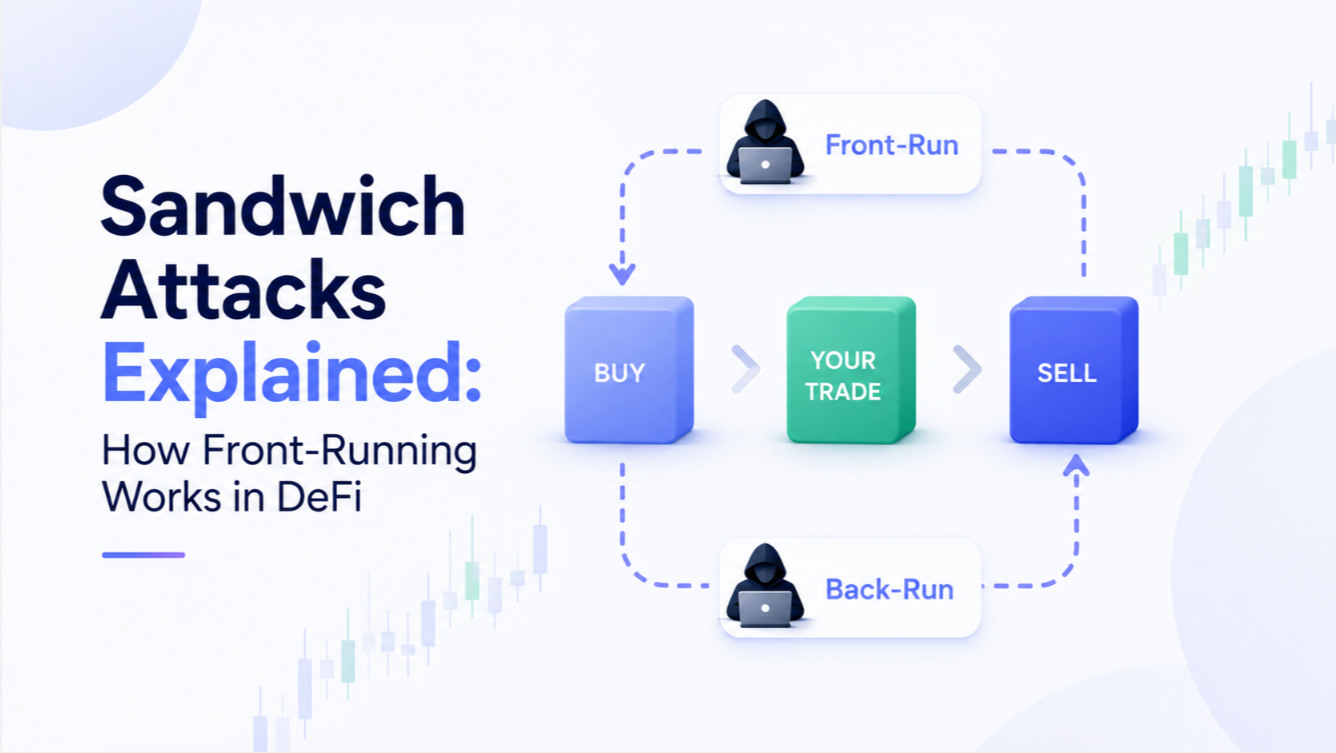
The most visible form of MEV is the sandwich attack: a bot spots a pending swap in the public mempool, buys the same asset just ahead of it to push the price up, lets the victim's trade execute at the worse price, then immediately sells into the resulting liquidity for a guaranteed profit. Frontrunning liquidations and backrunning arbitrage work on the same underlying principle — visibility into pending transactions, plus the ability to pay for priority ordering, equals extractable profit. Every mitigation strategy that exists targets one of two levers: hide the transaction from opportunistic eyes before it's included, or change who gets to decide transaction ordering and how they're compensated for it.
Proposer-builder separation: splitting the job in two
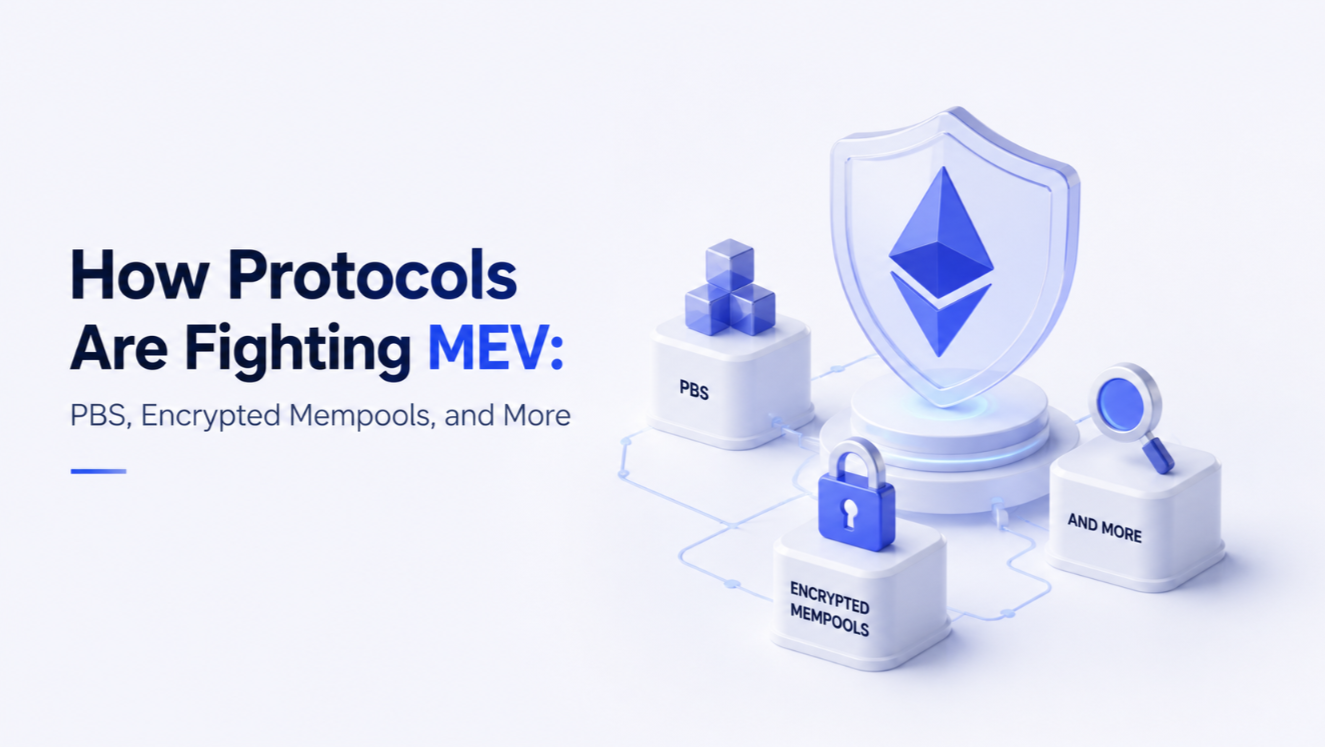
Ethereum's primary structural fix since the Merge is proposer-builder separation, or PBS, implemented in practice through MEV-Boost. Instead of the validator proposing a block also deciding its transaction order, that job is outsourced to specialised builders who compete to construct the most profitable block possible, bundling in searcher transactions and MEV-extraction opportunities, then submit sealed bids through relays to the validator, who simply picks the highest-paying bid without seeing its contents until after committing. The logic is that MEV extraction still happens, but the value it generates flows back to validators as revenue rather than being captured entirely by whoever has the fastest bot and the best mempool visibility — which is a redistribution of MEV's proceeds, not an elimination of MEV itself, and worth being clear-eyed about.
The centralization PBS quietly introduced
PBS solved one problem and created another: block building is now dominated by a small number of sophisticated builders, and for a period in 2023 a single builder was regularly constructing more than half of all Ethereum blocks, largely because scale and proprietary order flow deals compound — the biggest builder sees the most transactions, which lets it construct the most competitive blocks, which wins it more market share. Relays, the trusted intermediaries that pass sealed bids from builders to validators, introduced their own centralization and censorship concerns, most visibly when several major relays began filtering out OFAC-sanctioned addresses following the Tornado Cash sanctions, meaning a meaningful share of Ethereum blocks were, for a time, excluding certain transactions entirely at the relay layer. Enshrined PBS — building the separation directly into the protocol rather than relying on the MEV-Boost side-market — remains an active research goal specifically to remove relays as a trusted, centralizing chokepoint.
Encrypted mempools: hiding the target until it's too late to attack
A more direct fix targets the sandwich attack's actual prerequisite: visibility. Encrypted mempool designs, such as Shutter Network's threshold-encryption approach, have users submit transactions encrypted, so their contents — the swap direction, size, and slippage tolerance a sandwicher needs — are invisible to searchers and builders until after ordering is already locked in, at which point a distributed committee releases the decryption key. Only then does the transaction's content become public, by which time it's too late for anyone to insert a front-running trade ahead of it. SUAVE, a project spun out of Flashbots, takes a related but more ambitious approach, proposing a decentralised block-building network with encrypted transaction inputs and its own MEV-aware execution environment, aiming to make private, fair ordering a shared public good rather than something each application has to bolt on separately.
Private order flow: skipping the public mempool entirely
The pragmatic, already-widely-adopted fix is simpler than encryption: don't broadcast the transaction to the public mempool at all. Services like Flashbots Protect and MEV Blocker let users route transactions directly to a builder or a curated set of builders, bypassing the public mempool where searcher bots are watching, and in MEV Blocker's case, actively auctioning off any residual backrunning opportunity and rebating the proceeds to the user rather than letting a sandwicher keep them. This is now the default RPC endpoint for a meaningful share of retail wallet traffic, and it's the single most effective sandwich-attack countermeasure currently deployed at scale, precisely because it removes the information asymmetry the attack depends on rather than trying to out-encrypt or out-compete it.
Application-level defences: batch auctions and fair ordering
Some of the most effective mitigation happens above the base layer entirely. CoW Swap settles trades through periodic batch auctions rather than continuous first-come-first-served ordering, matching coincidences of wants peer-to-peer where possible and routing the remainder through the best available on-chain liquidity, with all trades in a batch clearing at a uniform price — a structure that makes classic sandwiching mathematically pointless because there's no single transaction to front-run within the batch. Other protocols lean on tighter default slippage tolerances, TWAP-based execution that spreads a large order over time to reduce the size of any single exploitable transaction, and commit-reveal schemes for sensitive actions, all of which shrink the attack surface without needing base-layer changes.
Solvers, aggregators, and the rise of intents
A related shift, running roughly in parallel with PBS, is the move towards intent-based trading: instead of a user specifying an exact transaction, they specify a desired outcome — swap this asset for at least this much of that one — and a competitive network of solvers races to fill it via whatever route, including private liquidity, produces the best price. UniswapX and CoW Swap's solver competition both work this way, and the effect on MEV is meaningful because the solver bears the execution risk and competes on price improvement rather than the user broadcasting a raw, exploitable transaction to a public mempool at all. It also quietly outsources a genuinely hard problem — finding optimal execution across fragmented liquidity — to specialists who are incentivised to compete that value back to the user rather than extract it, which is a meaningfully different economic structure from the searcher-versus-victim dynamic that defined MEV's first few years.
What this means for an ordinary DEX user today
None of this architecture matters if a trader is still connecting a wallet with a default public RPC endpoint and accepting whatever slippage tolerance the interface pre-fills. The practical checklist is short: use a wallet or RPC provider that routes through private order flow by default, treat any slippage setting above roughly 0.5% on a liquid pair as an open invitation to a sandwich bot, and prefer aggregators and DEXs that have adopted batch auctions or intent-based solving for anything above a trivial trade size. None of this requires understanding relay architecture or gamma-adjusted builder incentives — it just requires knowing that the mitigation layer exists and is worth actively opting into, because the default configuration on plenty of wallets still broadcasts to the public mempool exactly as it did in 2021.
Why MEV gets redistributed, not eliminated
It's worth being honest about the ceiling here. As long as there is public, verifiable state and value in reordering transactions relative to each other — which is inherent to any transparent blockchain, not a design flaw specific to Ethereum — some form of MEV will exist. What PBS, encrypted mempools, and private order flow actually accomplish is moving that value away from opportunistic sandwich bots preying on retail swaps and towards validators, builders, and increasingly the users themselves via rebates, while trimming the ugliest and most user-hostile extraction methods. That's a genuinely better equilibrium than 2021's open mempool free-for-all, but anyone describing current MEV mitigation as having 'solved' the problem is overselling engineering that has, so far, mostly succeeded at making extraction fairer and less visible rather than making it disappear.
FAQ
What is proposer-builder separation?+
Splitting block production so specialised builders assemble blocks and validators simply choose the most valuable one. It stops validators needing MEV expertise to compete.
What is an encrypted mempool?+
A design where pending transactions are hidden until ordering is fixed, so a bot cannot see what to front-run. The trade-off is added latency and complexity in decryption.
Does private order flow protect ordinary users?+
Yes, largely. Sending a transaction directly to builders rather than the public mempool removes the sandwich exposure, and most major wallets now offer it as a setting.
Can MEV be eliminated?+
Not entirely. Ordering will always carry value where prices move. These designs mostly redistribute it — to builders, solvers or back to users as price improvement — rather than remove it.
 Selin AydinSecurity Editor · Crypto security, custody, exploits and smart-contract risk