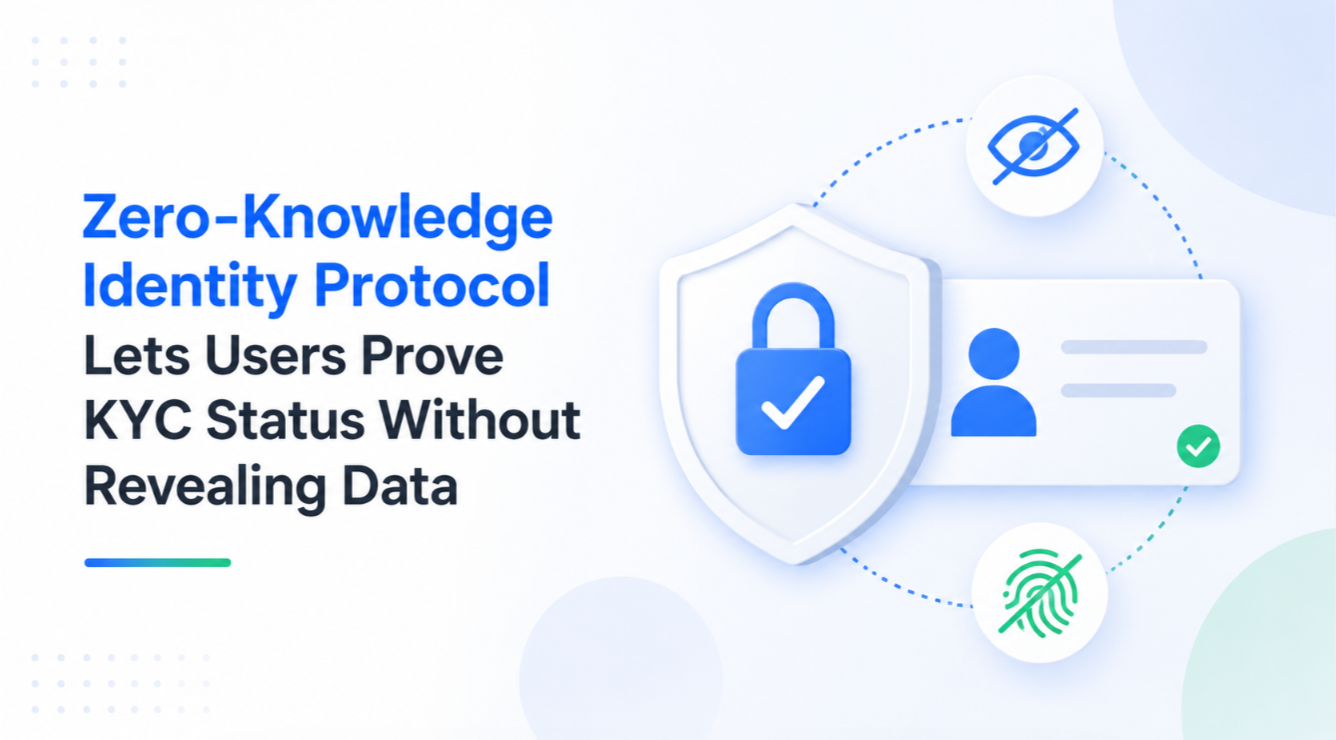
Zero-Knowledge Identity Protocol Lets Users Prove KYC Status Without Revealing Data
A new zero-knowledge identity protocol allows wallets to prove they've passed KYC checks with a licensed provider without exposing any of the underlying personal data on-chain, offering a possible middle path between compliance and privacy.

The tension between regulatory compliance and on-chain privacy has generally been treated as a zero-sum trade-off: either a protocol collects identifying data and hands it to regulators on request, or it stays private and gets treated as suspect by exactly the institutions crypto needs to work with. A newly launched zero-knowledge identity protocol is betting that framing is wrong.
How the proof actually works
The mechanism is simpler than the cryptography behind it suggests. A user completes identity verification once with a licensed KYC provider, off-chain, the same way they would for any regulated exchange. The provider then issues a cryptographic credential attesting to specific facts — verified identity, resident of a particular jurisdiction, not on a sanctions list — without those facts themselves ever touching a blockchain. When a dApp or protocol needs proof of KYC status, the user generates a zero-knowledge proof from that credential, demonstrating the underlying claim is true without revealing the name, address, or documents that back it up.
The dApp on the receiving end gets a cryptographically verifiable yes-or-no answer to "is this wallet KYC'd by an approved provider" and nothing else. It can't see who the person is, can't build a profile from repeated proofs, and can't correlate the credential across different applications unless the user chooses to reuse the same proof — and even then, well-designed implementations use nullifiers to prevent linking separate proofs back to the same underlying identity.
Why this matters for DeFi specifically
Regulated DeFi access has mostly meant one of two unappealing options: fully permissioned pools that require handing custody-style KYC data directly to a smart contract front-end, or geo-blocking based on IP address, which is trivially circumvented and satisfies almost nobody. A protocol that can cryptographically prove compliance status without a central database of user identities changes the calculus for both sides. Regulators get an auditable, standards-based signal that a given pool of users has passed verification. Users avoid having their personal documents sitting in yet another database that becomes a breach target.
The parts that still need work
The obvious weak point is trust in the credential issuer. Zero-knowledge proofs guarantee that a statement is true relative to the data the issuer signed off on — they don't guarantee the issuer itself is honest, well-run, or free from being compelled to revoke or misuse credentials. If the identity provider gets compromised or coerced, the privacy guarantee for individual proofs holds, but the integrity of the whole system depends on the issuer layer in a way pure cryptography can't fix.
There's also the practical adoption question that has slowed every privacy-preserving identity effort before this one: it only works if enough dApps actually integrate the verification standard, and enough KYC providers actually issue the credentials, for the proof to be widely accepted rather than a niche feature supported by one or two protocols.
Still, this is a meaningfully different approach from the compliance-versus-privacy standoff that has defined the space for years. Whether it becomes infrastructure or stays a promising experiment will come down to adoption by the credential issuers and the regulated venues that would actually rely on it, not the underlying cryptography, which appears to be sound.