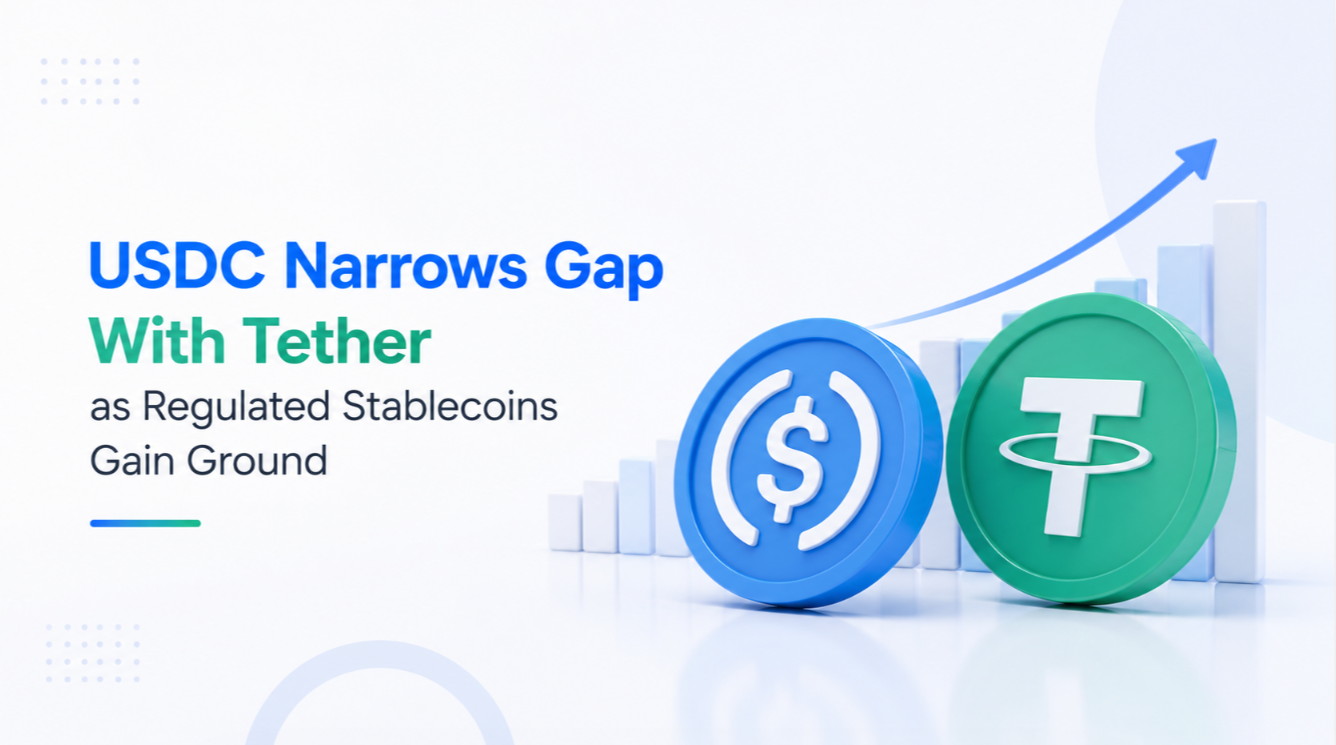
USDC Narrows Gap With Tether as Regulated Stablecoins Gain Ground
USDC is closing the market-share gap with Tether as exchanges and institutions lean toward licensed, audited stablecoins under the new regulatory regime.

USDC's slice of the stablecoin market has been quietly growing for months, and the gap to Tether's long-held dominance is narrower now than at any point since USDT effectively won the liquidity war back in 2021. This isn't a dramatic flip. It's a slow reallocation, driven less by any single catalyst and more by a regulatory environment that increasingly rewards being the transparent, audited option rather than the largest one.
Tether remains comfortably the bigger token by circulating supply, and its liquidity depth on most exchanges still dwarfs USDC's in absolute terms. But market share isn't just about total supply — it's about where new flow is going, and a growing share of new institutional and exchange-driven volume is choosing USDC specifically because Circle's reserve reporting and licensing posture line up more cleanly with what regulators now expect issuers to demonstrate.
Why exchanges are tilting toward regulated tokens
Exchange listings tell the clearest version of this story. Several major venues have expanded USDC trading pairs and, in some jurisdictions, scaled back USDT pairs specifically to stay inside the lines of local stablecoin licensing regimes that treat Circle's disclosure standard as the baseline for compliant operation. That's a structural tailwind Tether can't simply out-market its way around, because the constraint isn't about brand trust — it's about which token an exchange is legally comfortable listing in a given jurisdiction.
Institutional treasury desks are behaving similarly. Firms that need to justify stablecoin holdings to auditors, boards, or regulators increasingly default to USDC precisely because Circle's monthly attestations and public reserve breakdowns make that conversation shorter. Tether has improved its own disclosure practices considerably over the past two years, but it's still playing catch-up on the perception front, and perception is doing real work in procurement decisions right now.
What Tether still has going for it
None of this means Tether is losing the war. USDT's dominance in emerging markets, particularly across parts of Asia, Africa, and Latin America where it functions as de facto dollar access, is largely untouched by regulatory shifts happening in the US and EU. That usage is sticky, denominated in real economic need rather than compliance preference, and it's the part of Tether's business least exposed to the trend favoring USDC elsewhere.
Tether's profitability also remains vastly higher than Circle's, since it carries lower distribution costs and a larger reserve base generating Treasury yield. A shrinking share of a growing pie can still mean growing absolute revenue, and Tether's balance sheet gives it room to weather a slow share erosion in regulated markets without it threatening the core business.
The more interesting question is what happens if the trend compounds. If USDC keeps taking incremental share on every exchange listing decision and every institutional mandate for the next two years, the stablecoin market could look genuinely bifurcated by 2028 — USDC as the default for regulated, institutional flow, and USDT as the dominant rail for retail and emerging-market dollar access. That's not Tether losing. It's the market splitting into two distinct use cases that happen to share the same asset class.