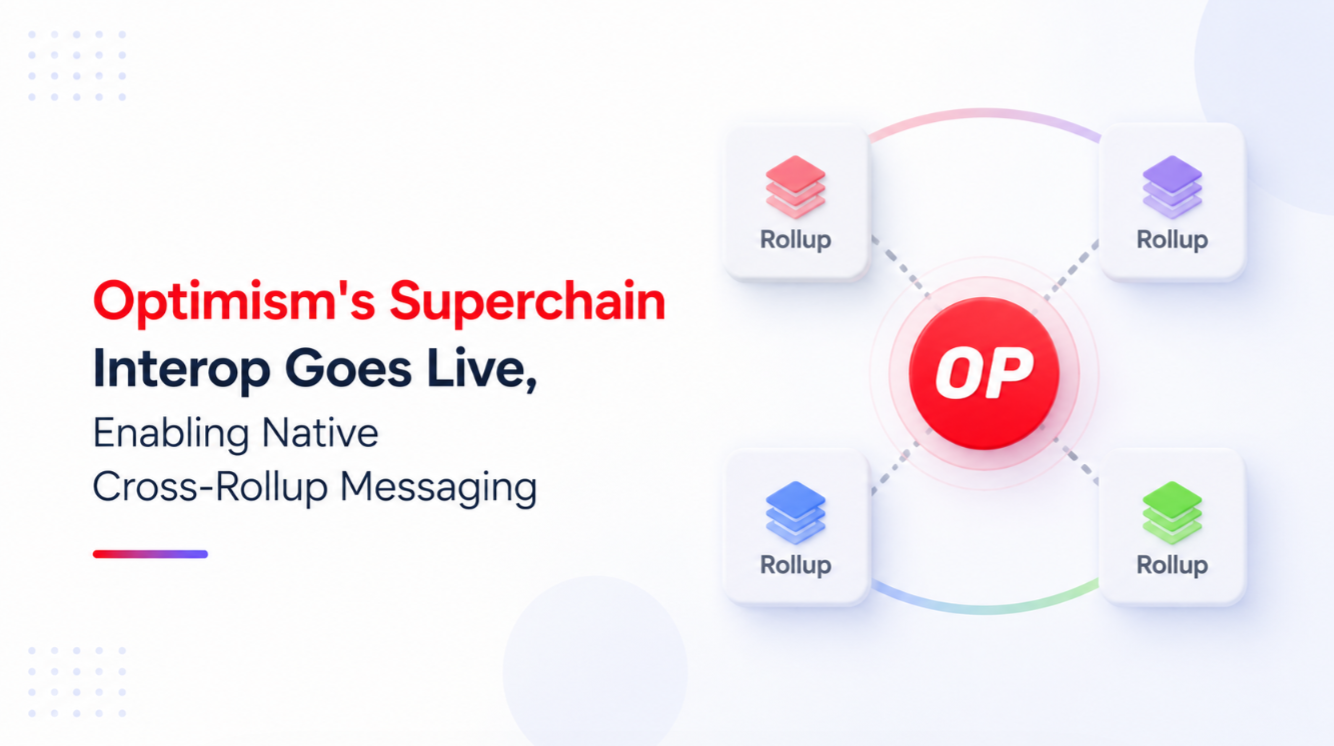
Optimism's Superchain Interop Goes Live, Enabling Native Cross-Rollup Messaging
Optimism's Superchain interoperability protocol is now live on mainnet, letting assets and messages move natively between OP-chains like Base and OP Mainnet without relying on third-party bridges.

Optimism's Superchain interoperability protocol has gone live on mainnet, and it addresses what has quietly been the ugliest problem in the rollup-centric roadmap: moving assets between two chains that both trust Ethereum has, until now, required routing through a third-party bridge that neither chain actually trusts. That gap has been the source of more stolen user funds than almost any other category of DeFi exploit, and closing it natively is a bigger deal than the relatively quiet launch suggests.
The bridge problem, briefly
When a rollup like Base wants to send value to another rollup like OP Mainnet or Zora, the cleanest security path would be to prove the transaction against Ethereum itself, since both chains ultimately settle there. In practice, almost nobody did that, because it was slow and awkward. Instead, users relied on third-party bridge protocols that lock assets on one side and mint a representative token on the other, trusting a separate set of validators, multisigs or oracles to do that honestly. Those bridges have been catastrophic honeypots — Ronin, Wormhole and Nomad between them account for well over a billion dollars in losses, and nearly every major bridge hack follows the same pattern of a trust assumption quietly weaker than the chains it connects.
What native interop actually does differently
The Superchain interop protocol lets OP Stack chains that share a common set of rules — the same fault-proof system, the same governance framework — pass messages and assets directly, verified against the shared security model rather than against an external bridge's own validator set. Practically, that means a transfer from Base to OP Mainnet can be verified using the same trust assumptions that already secure each chain individually, rather than adding a new, weaker link in between. Cross-chain arbitrary messaging follows the same channel, so a smart contract on one OP chain can call a function on another in roughly one block's worth of latency, not the minutes-to-hours delay typical of bridge-and-wrap flows.
Why this only works within the Superchain, for now
The catch, and it's an important one, is that this native interop currently only works between chains that are part of the OP Stack Superchain — Base, OP Mainnet, Zora, Mode and the growing list of chains that adopt the shared standard. A user moving assets from an OP chain to, say, Arbitrum or a non-EVM chain entirely still needs a conventional bridge, with all the trust trade-offs that implies. Optimism's bet is that enough liquidity and application activity concentrates inside the Superchain that this becomes less of a limitation over time, effectively making the boundary of "one trusted network" bigger than any single rollup.
Early signs and remaining risk
In the days since activation, message volume between Base and OP Mainnet has climbed steadily as a handful of DeFi protocols began routing liquidity through the native channel rather than existing third-party bridges, though volumes remain modest relative to total cross-chain flow — this is still early days for a standard that needs application-level integration to matter. It's also worth being clear-eyed that native interop shifts risk rather than eliminating it entirely: a bug in the shared messaging protocol itself, or in the fault-proof system all these chains lean on, now has correspondingly wider blast radius across every connected chain at once. Concentrating trust into one better-designed system is still concentrating trust.
The bigger picture
This is the clearest evidence yet that the rollup ecosystem's near-term future looks less like dozens of fully independent chains competing for liquidity and more like a small number of interoperable superchains, each sharing security assumptions and increasingly behaving like a single logical network with many execution environments. Arbitrum's own Orbit chain ecosystem is pursuing a broadly similar strategy. For users, the payoff, once wallets and front-ends fully abstract the underlying complexity away, should be a DeFi experience that finally stops feeling like managing a dozen separate, mutually suspicious islands.