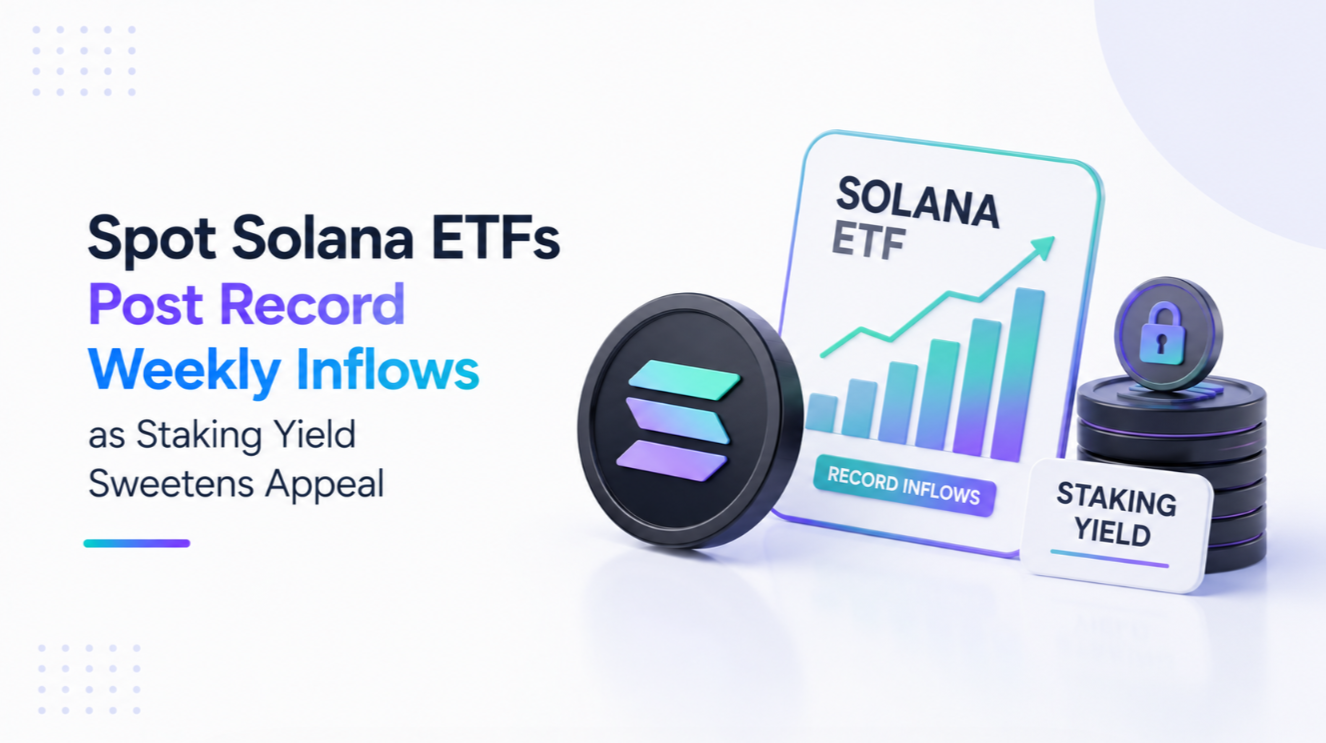
Spot Solana ETFs Post Record Weekly Inflows as Staking Yield Sweetens Appeal
Spot Solana ETFs pulled in their largest weekly haul since launch, with the built-in staking yield giving allocators a return Bitcoin funds simply can't offer.

Spot Solana ETFs pulled in their strongest week of inflows since launch, with issuers collectively absorbing several hundred million dollars in net new capital. That's a notable number for a product category still under a year old, and it's arriving at a moment when Bitcoin ETF flows have gone comparatively flat, suggesting allocators aren't just adding crypto exposure broadly, they're rotating toward products that offer something Bitcoin funds structurally cannot.
The yield the wrapper can pass through
That something is staking yield. Because several of the approved Solana ETF structures allow the underlying fund to stake a portion of its holdings and pass the resulting rewards through to shareholders net of fees, investors get exposure to SOL's price plus a running yield in the mid-single digits, something a spot Bitcoin ETF has no equivalent mechanism for, since Bitcoin's proof-of-work design doesn't generate a native yield at all. For an allocator comparing two large-cap crypto ETF options side by side, one of which pays you to hold it and one of which doesn't, the yield differential is doing real work in flow decisions right now.
Why this matters more than it might at first glance
It's worth being precise about what's driving this rather than reaching for the obvious 'crypto is back' framing. This isn't broad risk-on sentiment lifting all boats, since Bitcoin and Ethereum funds haven't seen comparable acceleration over the same stretch. It's a specific product feature attracting specific capital, largely from allocators running yield-plus-growth mandates who were previously sitting out spot crypto ETFs entirely because a zero-yield wrapper didn't fit their allocation framework. Staking-enabled ETFs solve that fit problem directly.
The mechanics behind the number
Solana's proof-of-stake design means validators earn rewards for securing the network, and ETF issuers structuring around that have had to navigate custody and delegation arrangements carefully to keep the yield flowing through without triggering unwanted tax or regulatory complications for the fund. Not every approved Solana ETF stakes its full holdings, some cap the staked percentage to preserve liquidity for daily creation and redemption activity, and the actual yield passed through to shareholders varies by issuer once management fees and validator commissions are netted out. Investors comparing products should be checking the actual net yield disclosed in fund documentation rather than assuming a headline network staking rate applies uniformly.
What could slow this down
The obvious risk sitting underneath the enthusiasm is slashing exposure and validator concentration. If a fund's staking activity is concentrated with a small number of large validators and one of them gets slashed for downtime or misbehaviour, that loss flows through to fund holders in a way a plain spot Bitcoin ETF investor never has to think about. Issuers have generally addressed this by diversifying validator delegation across dozens of operators, but it's a real structural risk that didn't exist in the Bitcoin ETF category, and it's the kind of tail risk that tends to get ignored right up until it isn't.
Reading the flow data going forward
If this week's inflow pace holds even at half its current rate, Solana ETF assets under management would meaningfully close the gap with Ethereum's ETF complex within a couple of quarters, a gap that had looked fairly entrenched given Ethereum's earlier ETF approval and larger existing institutional footprint. Whether that holds depends less on Solana's price action and more on whether the yield differential keeps looking attractive relative to Treasury yields and other income-generating allocations competing for the same institutional dollars. For now, the flow data says the staking wrapper is winning that argument.