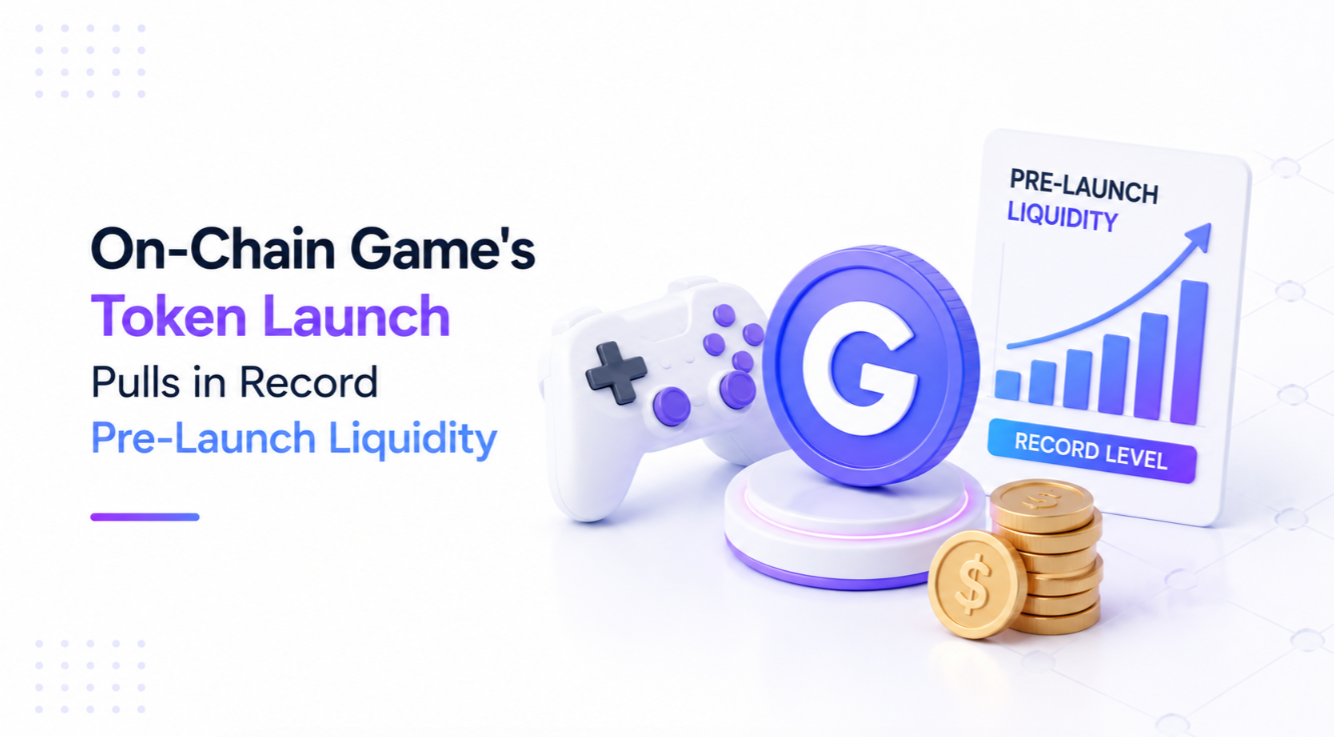
On-Chain Game's Token Launch Pulls in Record Pre-Launch Liquidity
A fully on-chain strategy game's token generation event has drawn the largest pre-launch liquidity commitment the sector has seen, reopening the question of whether gaming can pull retail back toward NFTs.

On-chain gaming has spent the past two cycles being the sector everyone name-checks and almost nobody plays. That reputation took a dent this week when a fully on-chain strategy title's token generation event pulled in more pre-launch liquidity than any comparable launch on record, with committed capital arriving well ahead of the token actually going live and trading.
The numbers behind the headline
The mechanics matter more than the headline figure. Rather than a conventional IDO or a single-block mint, the studio ran a staged liquidity bootstrapping process that let players and liquidity providers commit assets over several days, with pricing adjusting dynamically as demand came in. That structure tends to produce larger cumulative totals than a flash sale simply because it doesn't force everyone through the same narrow window, but it also means the headline liquidity figure reflects commitment, not necessarily conviction that survives first contact with a floating market. The distinction is one this sector has learned the hard way before.
What's genuinely different this time is the source of the capital. On-chain trackers show a meaningfully higher share of wallets with prior gameplay history — actual on-chain transaction records tied to matches played, not just governance-token farming addresses that show up for every launch and vanish within a week. That's the metric worth watching more than total value locked, because the sector's last boom was undone almost entirely by mercenary liquidity that had no relationship to the underlying game and left the moment incentives dried up.
Why gaming keeps getting a second look
The bull case for on-chain gaming has always been coherent even when the execution wasn't: composable, player-owned assets that persist across a game's lifecycle solve a real problem in traditional gaming, where studios can delete years of player investment with a single shutdown decision. The bear case has been equally consistent — most on-chain games have been thin gameplay wrapped around a token mechanic, built by teams optimising for the TGE rather than for anyone wanting to play the thing twice. This title's pitch is that the strategy layer is deep enough to hold attention independent of the token, an argument that will only be tested once the game is live and the incentives to log in are no longer purely financial.
The retail question
Whether this translates into a broader NFT recovery is a separate question from whether the launch itself succeeds. Blue-chip NFT collections have spent roughly two years grinding sideways to lower, and gaming has repeatedly been floated as the catalyst that brings non-speculative users back into the NFT ecosystem — buying an asset because they want to use it, not because they expect to flip it. That thesis has failed to materialise at scale several times already, and one strong pre-launch liquidity number doesn't settle it. What it does confirm is that there is still meaningful capital willing to commit early to on-chain gaming when the product signals more effort than a rebranded yield farm, which after two quiet years is itself a data point worth taking seriously.
The real test starts after the token lists. Pre-launch liquidity is a measure of anticipation; retention through the first few weeks of live trading, when early liquidity providers are free to exit and the token has to stand on actual usage, is the measure that has sunk every over-hyped gaming launch before this one. That's the number to watch next, not this week's.