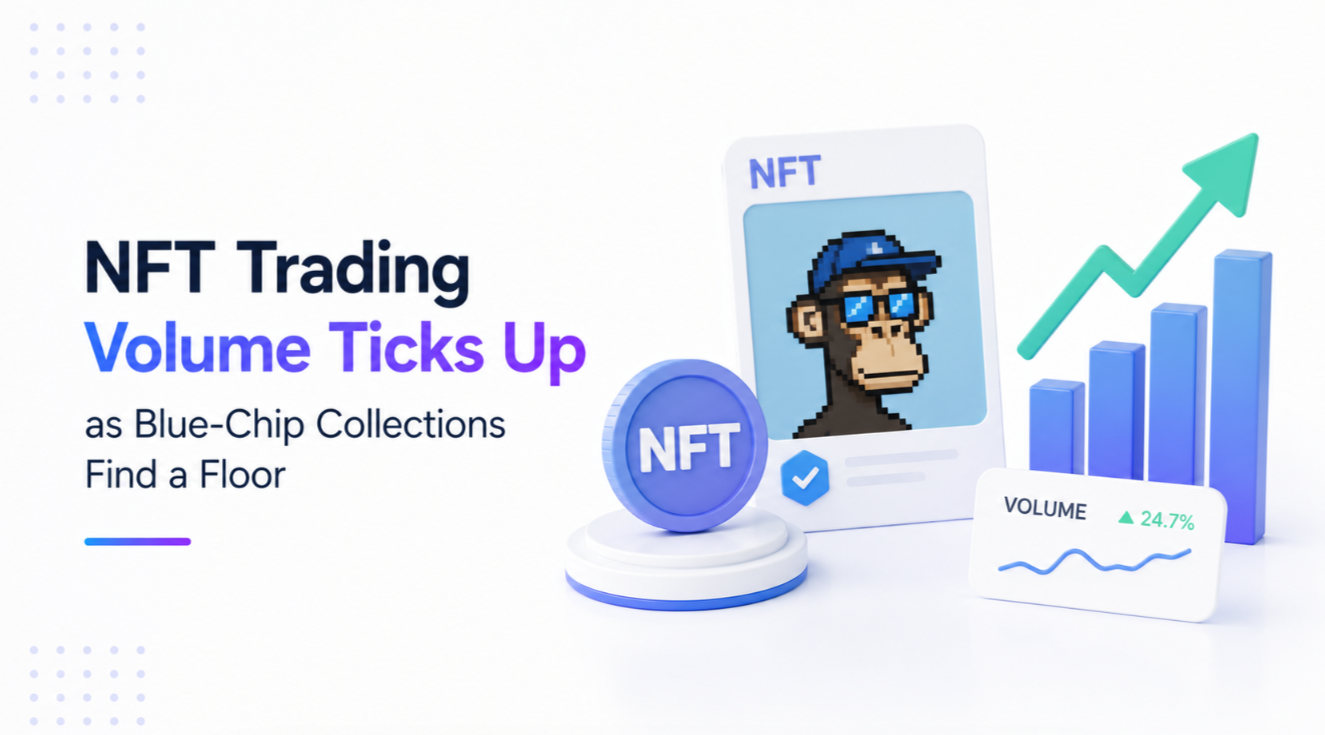
NFT Trading Volume Ticks Up as Blue-Chip Collections Find a Floor
After roughly two years of steady decline, marquee NFT collections are showing early, tentative signs of stabilising demand and pricing rather than another leg down.

NFT trading volume has been a one-way conversation for the better part of two years: down, then down again, punctuated by dead-cat bounces that reversed within weeks. The last few weeks look different, not dramatically so, but enough that marketplace data and floor prices across a handful of blue-chip collections are pointing the same direction for the first time in a while — up, or at least flat where flat used to be a good outcome.
What the data actually shows
Aggregate NFT volume across major marketplaces has ticked higher over the past month, driven disproportionately by a small set of established collections rather than a broad-based rally. Floor prices on several of the most-watched blue-chip names have held or edged up against a backdrop where Ethereum itself has been range-bound, which matters because it strips out the simplest explanation — that NFT prices denominated in ETH are only rising because ETH is. When floor prices hold steady in ETH terms while ETH itself isn't moving much, that's demand for the asset specifically, not just currency drift.
Unique buyer counts and the ratio of new wallets to repeat traders are the more telling numbers, and here the picture is mixed but not discouraging. A meaningful share of recent buying activity is coming from wallets with prior collection history rather than fresh capital, which reads less like a speculative wave and more like existing holders and long-time collectors accumulating at levels they consider cheap. That's a slower, less exciting recovery than a retail-driven volume spike, but it's arguably a healthier one — it doesn't carry the same air-pocket risk that hit the market every time mercenary capital rotated out after the last several false starts.
Why blue chips specifically
The concentration in established collections rather than newer projects tells its own story. Two years of drawdown culled most of the speculative middle tier of the NFT market — collections without a genuine community, a distinct aesthetic, or a reason to exist beyond the mint. What's left standing is disproportionately the names that had staying power through the entire decline: the collections with the deepest holder bases, the most established secondary-market liquidity, and in several cases ongoing utility or brand tie-ins that gave holders a reason to keep the asset rather than dump it into a falling market. Scarcity value concentrates in survivors during a shakeout, and that appears to be exactly what's happening here.
The case for caution
None of this amounts to a confirmed trend reversal, and anyone who lived through the 2023 and 2024 head-fakes in this market should be instinctively wary of calling one now. A month or two of firmer volume and holding floors has looked like the start of a recovery before and turned out to be liquidity providers testing the market before pulling back. The more durable signal will be whether trading volume broadens beyond the handful of blue-chip names currently carrying the data, and whether new capital — not just existing holders repositioning — starts showing up in the buyer mix.
What can be said with more confidence is that the floor genuinely does look like a floor for now, in the specific sense that the steady grind lower that defined the last two years has stopped. Whether that's the first stage of a real recovery or simply a pause before the next leg down is not a question the data can answer yet. It's a question the next few months of buyer composition and volume breadth will.