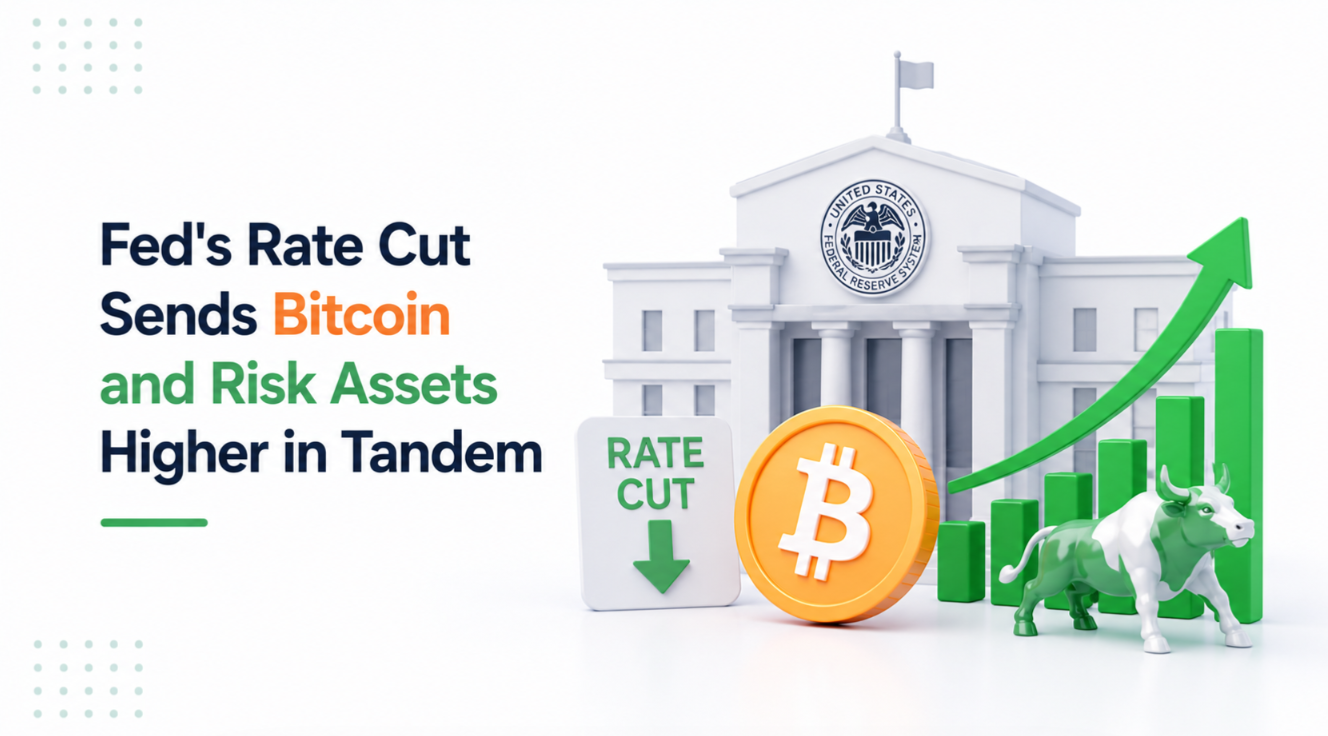
Fed's Rate Cut Sends Bitcoin and Risk Assets Higher in Tandem
The Federal Reserve's latest rate cut lifted bitcoin alongside equities and other risk assets, underscoring how tightly crypto's price action still tracks the broader liquidity cycle rather than trading on its own logic.

Bitcoin moved higher within minutes of the Federal Reserve's rate decision this week, and it did not move alone. Equity futures, high-yield credit spreads, gold and a broad basket of risk currencies all leaned the same direction, which is precisely the pattern that keeps undermining the argument that crypto has decoupled from traditional macro drivers. It hasn't. If anything, the correlation has been the dominant story of the past year, and this cut reinforced it rather than breaking it.
Why a rate cut moves bitcoin at all
The transmission mechanism isn't mysterious, even if it's occasionally treated as one in crypto-native commentary. Lower policy rates reduce the return available on cash and short-duration Treasuries, which pushes capital further out the risk curve in search of yield or growth exposure. Bitcoin, for all the store-of-value framing that gets attached to it, still trades in practice like a high-beta risk asset — it tends to rally harder than equities when liquidity conditions ease and fall further when they tighten. That behaviour has held across most of the rate-hiking and rate-cutting cycles of the past several years, and this week didn't deviate from the pattern.
A weaker dollar is doing some of the work too. Rate cuts typically pressure the currency, and a softer dollar has historically been supportive for dollar-denominated commodities and for bitcoin specifically, which a growing share of macro allocators now treat as a liquidity-sensitive asset alongside gold rather than as an uncorrelated hedge. The two assets have actually been moving together more often than not this year, which cuts against the older narrative of bitcoin as "digital gold" trading on its own independent logic.
The decoupling narrative keeps not happening
Every cycle produces a fresh round of arguments that crypto is finally maturing into an asset class that trades on its own fundamentals — network usage, on-chain activity, adoption metrics — rather than on the Fed's balance sheet. The data keeps not cooperating. Correlation between bitcoin and the Nasdaq has spent extended stretches this year at levels comparable to, or higher than, bitcoin's correlation to gold, which is not what a genuinely decoupled asset would look like. That doesn't mean bitcoin has no idiosyncratic drivers — ETF flows, halving-cycle dynamics and exchange-supply metrics all move price at the margin — but the dominant macro regime still sets the tide that those idiosyncratic factors operate within.
What this cut signals going forward
The more interesting question than "did bitcoin rally" is what the Fed's broader path implies for the rest of the year. A single cut is a data point, not a trend, and the market's reaction will depend heavily on the accompanying guidance about the pace of further easing. If this cut is read as the start of a sustained easing cycle, the liquidity tailwind for risk assets — crypto included — has further to run. If it's read as a one-off adjustment with the Fed prepared to hold or reverse depending on inflation data, the rally in bitcoin and equities alike is more fragile than the initial price action suggests.
Forecasting the exact path from here is inherently uncertain, and nothing in this piece should be read as investment advice or a prediction of where prices go next. What the data does support is a narrower, more testable claim: crypto's price behaviour continues to track the global liquidity cycle closely enough that macro positioning — not on-chain fundamentals alone — remains the dominant lens for understanding short-term moves in bitcoin and the broader digital-asset market.