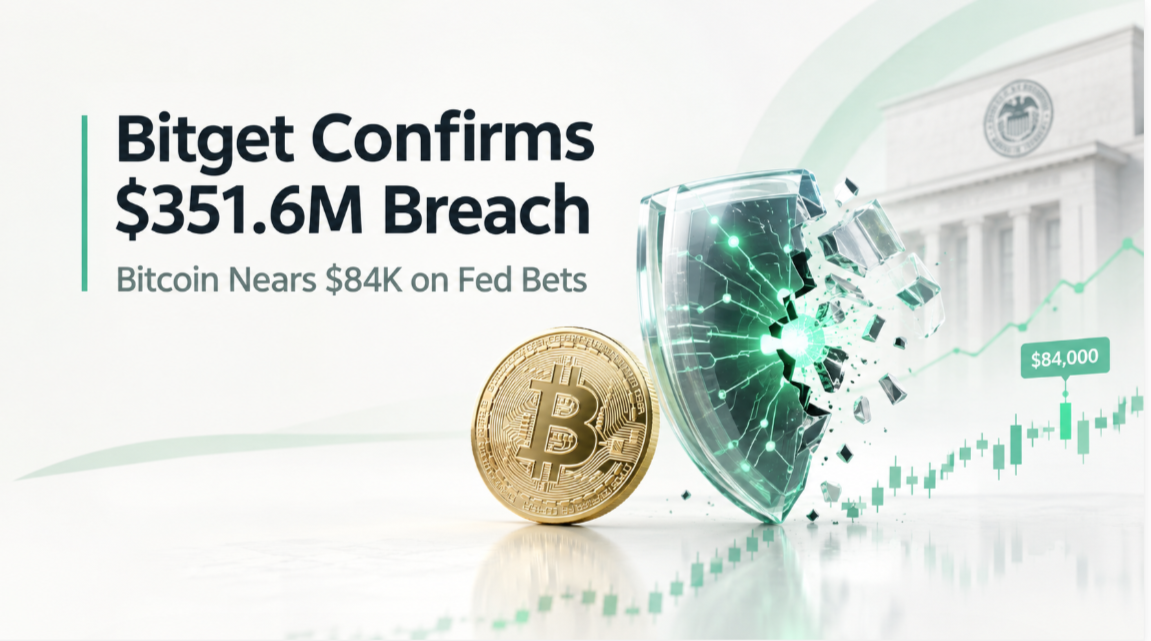
Bitget Confirms $351.6 Million Breach as Bitcoin Steadies Near $84,000 on Fed Rate Bets
Bitget confirms a $351.6 million hack linked to North Korea, while Bitcoin holds near $84,000 after hot US PMI data lifts Fed rate-hike bets.

Two major storylines dominated US crypto markets this week: a $351.6 million security breach at global exchange Bitget, and Bitcoin's attempt to stabilize near $84,000 after stronger-than-expected US economic data reignited fears of further Federal Reserve tightening.
Bitget Confirms $351.6 Million Hack, Points to North Korea
Bitget disclosed that its security systems detected unauthorized transfers from a portion of its hot and warm wallets at 18:31 UTC on September 24. CEO Gracy Chen said attackers did not steal private keys directly; instead, they compromised a backend system within the exchange's wallet infrastructure, used it to spoof transaction data, and tricked the platform's own authorization process into releasing funds. Bitget's cold wallets, which hold the bulk of user assets offline, were unaffected.
The exchange said the roughly $351.6 million shortfall will be fully covered by its User Protection Fund, which holds more than $464 million. Deposits and trading have continued without interruption, though withdrawals remain paused while Bitget completes a security review; Chen said a full incident report was expected within 24 hours.
Preliminary evidence, including IP addresses tied to VPN infrastructure previously linked to state-sponsored hacking groups, has led Bitget to suspect North Korean actors were behind the intrusion. Blockchain researchers tracking the stolen funds report the attacker has already begun converting assets, including XRP and stablecoins, into ETH and routing portions through the privacy mixer Tornado Cash.
The incident adds to a string of high-profile breaches this year, including a $320 million exploit tied to the Liquid Network earlier in September, and is likely to renew scrutiny of exchange custody practices among US regulators and institutional traders.
Bitcoin Holds Near $84K as Hot PMI Data Boosts Fed Hike Bets
Bitcoin's price action told a parallel story of macro-driven volatility. The preliminary US September Purchasing Managers' Index came in at 58.4, the fastest pace of business activity expansion since 2021, while input prices climbed to their highest level since October 2022. The stronger-than-expected reading pushed Treasury yields higher and lifted the market-implied odds of a 25-basis-point Fed rate increase in October to roughly 70%, according to CME data.
Bitcoin, which had touched $87,000 earlier in the week — its highest level since January — retreated on the news, briefly dipping below $84,000 before finding support in the $83,600–$83,800 range and recovering toward $84,400. The pullback reflected broader pressure on risk assets and non-yielding investments as rate-hike expectations firmed.
Despite the short-term wobble, some technical indicators point to underlying resilience. Bitcoin's monthly Supertrend indicator has flipped bullish again near the $84,000 level — a signal that preceded a major rally in 2023 — and the asset has reclaimed several key moving averages. Traders are now watching remarks from Cleveland Fed President and FOMC voter Beth Hammack for further clues on the central bank's next move.
What It Means for US Investors
Taken together, this week's developments underline two persistent themes for the American crypto market heading into the fourth quarter: exchange security remains a live risk even for major, well-capitalized platforms, and Bitcoin's price continues to trade in lockstep with US monetary policy expectations. With the Fed's October decision now firmly in focus and Bitget's investigation still unfolding, both stories are likely to keep shaping sentiment in the days ahead.