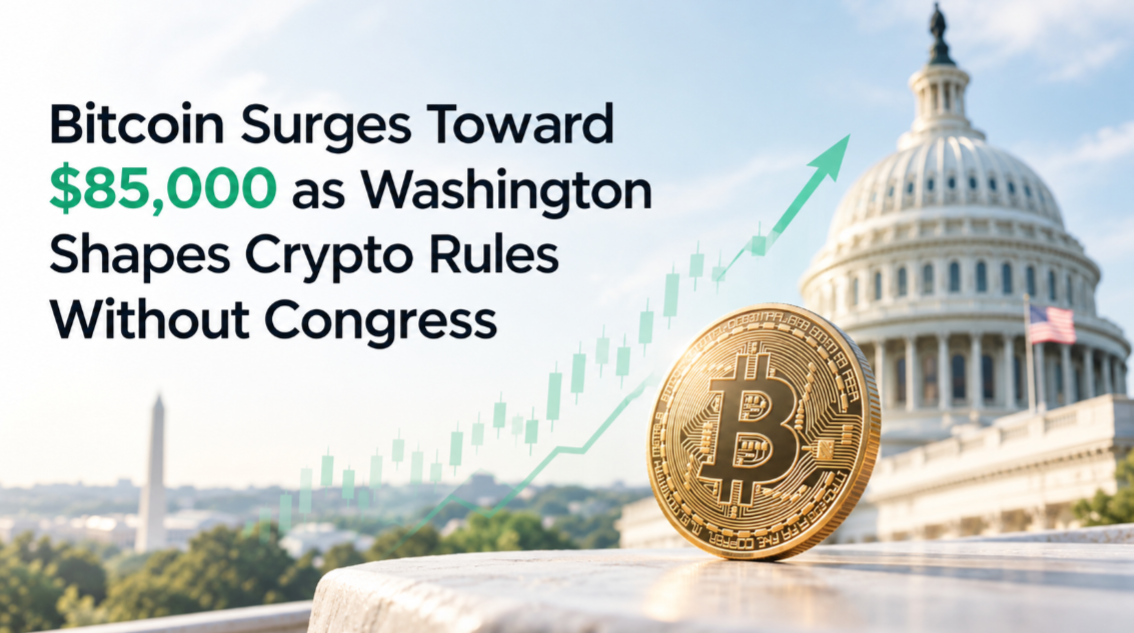
Bitcoin Surges Toward $85,000 as Washington Shapes Crypto Rules Without Congress
Bitcoin jumped toward $85,000 on Monday as a $648 million short squeeze hit the market, while the SEC and CFTC moved ahead with crypto rules after the Senate blocked the CLARITY Act.

Bitcoin started the week with a sharp move higher, pushing toward the $85,000 level on Monday, September 21. The rally comes just days after the U.S. Senate failed to advance the CLARITY Act, and as federal regulators begin building crypto rules without waiting for Congress. Together, the two stories show a market driven by leverage in the short term, while the long-term rulebook for digital assets is increasingly written by agencies rather than lawmakers.
Bitcoin Jumps as a Short Squeeze Hits the Market
Bitcoin traded near $84,984 during European morning hours, a gain of more than 5% over 24 hours, and moved well above the September high of $82,284 set on September 4, according to CoinDesk. Data from CoinGlass showed about $746 million in liquidations across the crypto market over the same period, with roughly $648 million coming from short positions.
A short squeeze works like a chain reaction. When traders betting on lower prices run out of collateral, exchanges close their positions by buying the asset, which adds upward pressure and can force out even more short sellers. CoinDesk noted that the advance was powered mainly by forced covering rather than new buying interest. Even so, traders did not step aside: futures open interest rose about 7.6% to $156 billion, and 24-hour volume increased 39% to $224 billion. The move was broad, with 95 of the 100 assets in the CoinDesk 100 index trading higher.
Fed Hike and Cooling Oil Set the Macro Tone
The rebound follows a volatile stretch. Bitcoin dipped to about $74,900 on September 15, and the Federal Reserve raised interest rates the following day. Since then, crypto has recovered as energy markets calmed. Brent crude traded near $102 on Monday after touching $108 in mid-September, and traders often read lower oil prices as a sign that inflation pressure may ease.
The macro test is far from over. PCE inflation data is due on September 30, the jobs report on October 2 and CPI on October 14. James Butterfill, head of research at CoinShares, has warned that another rate increase this year now looks increasingly plausible, which could limit how far risk assets can run.
Senate Blocks the CLARITY Act
On September 15, the Senate rejected a procedural motion to advance the CLARITY Act in a 49-50 cloture vote. The bill was meant to create a federal market structure framework for digital assets, including a clearer split of oversight between the Securities and Exchange Commission and the Commodity Futures Trading Commission.
The debate also exposed a fight over whether stablecoin platforms should be allowed to offer rewards that compete with bank deposits. Anton Golub of Forte said banks won this round because they increasingly see stablecoins as competition for deposits. Legal experts add that overseas hubs such as the United Arab Emirates, which already have licensing regimes in place, may benefit the longer the U.S. debate drags on.
SEC and CFTC Move Ahead on Their Own
Two days after the vote, on September 17, the SEC issued a temporary Innovation Exemption that allows eligible Tokenized Securities Venues to trade certain tokenized U.S. stocks on public blockchains through permissioned liquidity pools. The relief lasts five years and comes with strict conditions. Tokens must carry the same rights as the underlying shares, including dividends and voting, purely synthetic products are excluded, issuers must be notified and can opt out, and trading must pause whenever the primary exchange halts the stock. SEC Chair Paul Atkins described the order as intentionally limited, saying the agency does not want to lock in today's technology as the standard for the future.
On September 18, the CFTC sent its own crypto proposal to the White House for review. Details have not been made public, so it remains unclear which assets and licensing rules it will cover.
What It Means for U.S. Investors
Monday's rally looks more like a leverage-driven squeeze than a shift in long-term conviction, so sharp reversals remain possible if bitcoin fails to hold its new range. On the policy side, regulation by agency can move faster than legislation, but exemptions are temporary and can be revised. Watch upcoming inflation data, the response to the SEC's request for public comment, and whether Congress returns to market structure legislation.