Base Overtakes Arbitrum as Largest Layer-2 by Total Value Locked
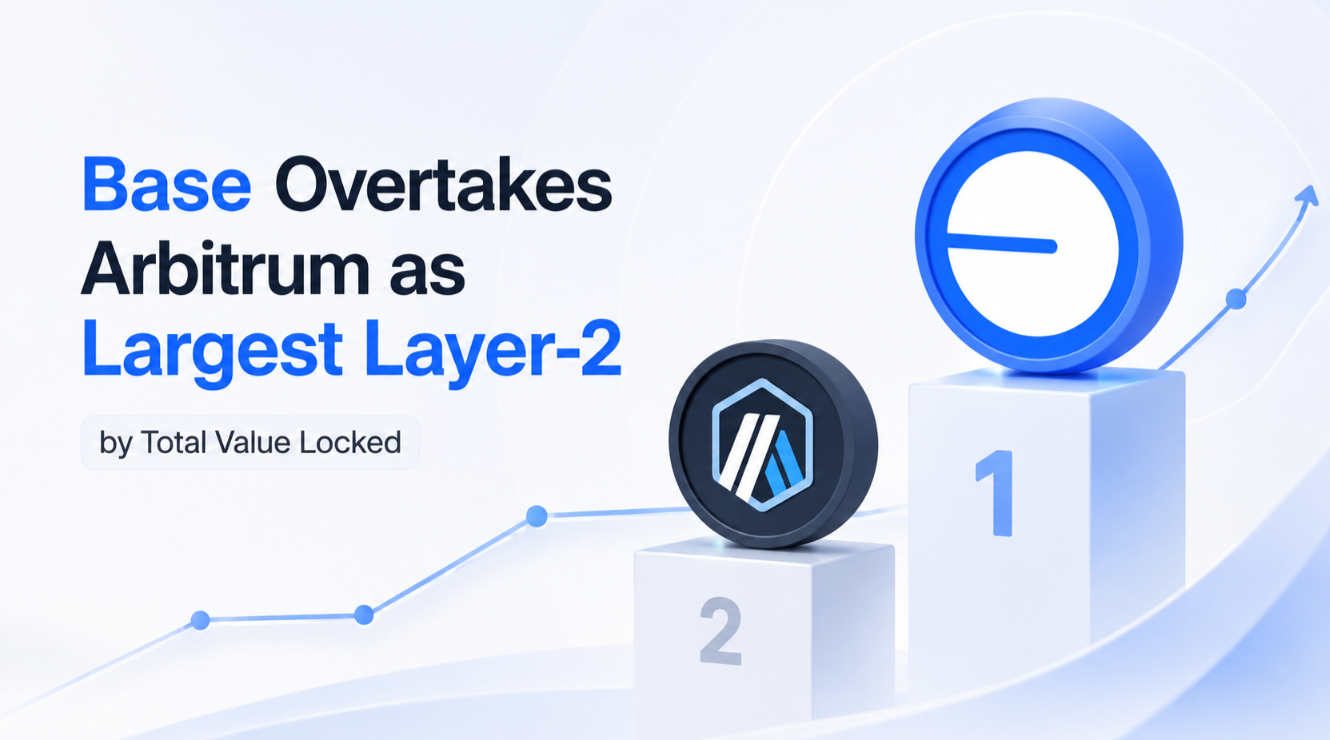
Coinbase's Base has pulled ahead of Arbitrum in total value locked, a shift driven less by yield farming than by a steady pipeline of consumer apps with a built-in distribution channel.

Base has overtaken Arbitrum as the largest Ethereum layer-2 by total value locked, a changing of the guard that would have seemed unlikely eighteen months ago when Arbitrum still held a commanding, multi-year head start built on being first to serious DeFi liquidity. The lead isn't enormous, and TVL rankings flip on capital flows that can reverse in a bad week, but the trend line and the reasons behind it are worth taking seriously.
Two very different growth strategies
Arbitrum built its position the old-fashioned rollup way: incentive programmes, a deep bench of DeFi-native protocols like GMX and various Uniswap deployments, and a token distribution that rewarded early liquidity providers handsomely. It worked, and for a long stretch Arbitrum was simply the default place serious on-chain capital went when it wanted lower fees than mainnet without giving up meaningful security guarantees.
Base took a different route. Rather than leading with incentives, Coinbase leaned on the one advantage no other rollup has: a direct pipe into a regulated exchange with tens of millions of users, and an internal mandate to ship consumer-facing apps — social, payments, gaming — directly onto the chain. Coinbase Wallet integration and the onchain-social experiments that followed weren't subtle plays for DeFi liquidity, but they built the habit of on-chain activity among a much wider user base than crypto-native yield farmers.
Where the TVL is actually coming from
The composition matters as much as the total. A meaningful share of Base's growth has come from stablecoin balances tied to consumer apps and from liquidity following the launch of large, well-marketed protocols choosing Base as a home chain over Arbitrum or Optimism specifically because of the Coinbase distribution advantage. That's a different kind of capital to the mercenary, incentive-chasing liquidity that inflated many L2 TVL charts during 2023's airdrop farming season, and it's arguably stickier, because it's attached to actual product usage rather than a points programme with an expiry date.
Arbitrum, for its part, hasn't stood still — its DAO treasury and ongoing incentive rounds remain some of the largest in the L2 landscape, and its DeFi ecosystem is still deeper and more battle-tested in derivatives and lending specifically. This isn't a story of Arbitrum failing; it's a story of Base catching up faster than most models expected, on the back of an advantage that's structurally very hard for any other rollup to replicate.
The centralization question nobody can avoid
It would be dishonest to write this up without flagging the obvious tension: Base is operated by Coinbase, a single, regulated, publicly listed company, running a sequencer that remains centralized even as the roadmap points toward eventual decentralization. Arbitrum has its own centralization critiques, particularly around its security council's emergency powers, but its sequencer decentralization roadmap and governance structure are, on paper, further along. Capital has voted for convenience and distribution over decentralization purity, at least for now, and that's an uncomfortable data point for anyone who thought DeFi users would systematically reward the more trustless option.
What to watch from here
The rankings will likely keep shuffling as both chains ship. Arbitrum's Stylus upgrade, letting developers write contracts in Rust and other languages beyond Solidity, could open a fresh wave of application development that plays to its technical strengths. Base's trajectory depends heavily on whether Coinbase keeps shipping consumer hits at the pace it has, and whether regulatory scrutiny of exchange-operated infrastructure intensifies. Either way, the layer-2 competition has clearly moved past the incentive-farming phase into something that looks more like a genuine product fight, and that's a healthier state for the ecosystem than the airdrop mercenaries who dominated the last cycle.