AI Agents Start Paying Each Other On-Chain Using the x402 Protocol
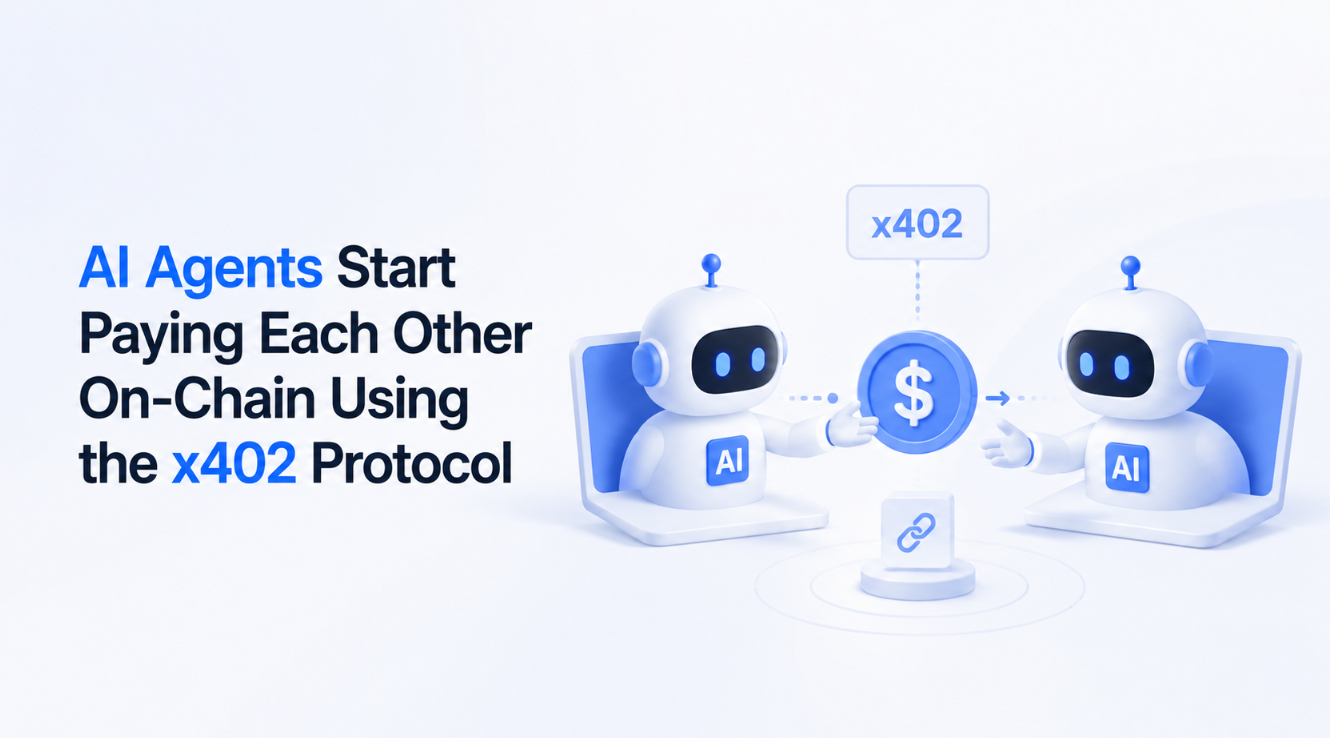
Autonomous software agents are now settling machine-to-machine payments in stablecoins through the x402 protocol, moving the idea from demo day into live commercial traffic.

For two years, "agents paying agents" has been one of crypto's most-promised, least-delivered narratives. That is starting to change. A growing number of API providers, data marketplaces and inference platforms have quietly switched on support for x402, a payment protocol built around HTTP's long-dormant 402 status code, and the result is autonomous software settling real invoices in stablecoins without a human clicking "approve" anywhere in the loop.
What x402 actually does
The protocol itself is unglamorous, which is probably why it is working. When a client hits a paywalled endpoint, the server returns the standard HTTP 402 "Payment Required" response along with machine-readable terms: amount, token, chain, recipient address. The client — in this case an AI agent with its own wallet and spending policy — signs a payment and retries the request with proof attached. No subscription, no invoice, no card on file. Settlement happens on-chain, typically in USDC on a low-fee network, and the whole exchange finishes in under a second.
That simplicity matters because the previous attempts at machine-to-machine payment rails tried to bolt blockchain settlement onto existing billing infrastructure and mostly collapsed under their own complexity. x402 instead treats payment as a native part of the request-response cycle, which is exactly the layer where autonomous agents already operate. An agent calling a weather API, a scraping service or another agent's compute doesn't need a merchant account; it needs a wallet and a rule for how much it's willing to spend per call.
From pilot to production traffic
What has changed recently isn't the concept but the volume. Several inference marketplaces and data-labelling platforms have reported meaningful transaction counts running through x402-compatible endpoints, driven mostly by agent frameworks that now ship wallet integration as a default rather than an add-on. Coinbase's involvement in popularising the spec gave it distribution; the fact that stablecoin rails on networks like Base settle cheaply and near-instantly gave it a reason to stick.
The commercial logic is straightforward once you sit with it. Traditional API monetisation assumes a human decision-maker who signs up, enters payment details and tolerates a billing cycle. Agents don't tolerate anything — they either have the funds and authorisation to complete a task or they fail and try an alternative provider. Pay-per-call pricing, settled instantly on-chain, removes the friction that made micropayments uneconomical under card-network rails, where a fee of a few cents per transaction could exceed the value of the transaction itself.
The risks nobody's pricing in yet
None of this is riskless. Giving an autonomous agent a funded wallet and a standing instruction to pay for services it deems necessary is a genuinely new attack surface. Prompt injection that tricks an agent into overpaying, or into paying a malicious endpoint masquerading as a legitimate one, is not a hypothetical — it is the obvious next exploit class once real money starts flowing through agent decision loops. Spending caps, allow-lists and circuit breakers are being bolted on by the more careful implementations, but plenty of agent frameworks are shipping wallet functionality faster than they're shipping the guardrails around it.
There's also a settlement-finality question that crypto-native builders understand better than the AI crowd building on top of them. Instant, irreversible payment is a feature until an agent makes a mistake, at which point it's also the absence of any dispute mechanism. Card networks built chargebacks for a reason; x402 has none, by design.
Even so, the direction of travel is clear. Machine-to-machine commerce has been a slide-deck promise since the first machine-learning-meets-blockchain pitch decks circulated around 2017. What's different now is that the agents doing the paying are competent enough to be worth paying for, and the rails settling those payments are finally cheap and fast enough not to be the bottleneck. That combination is why x402 traffic is growing while most of the last cycle's agent-economy experiments have quietly gone dark.