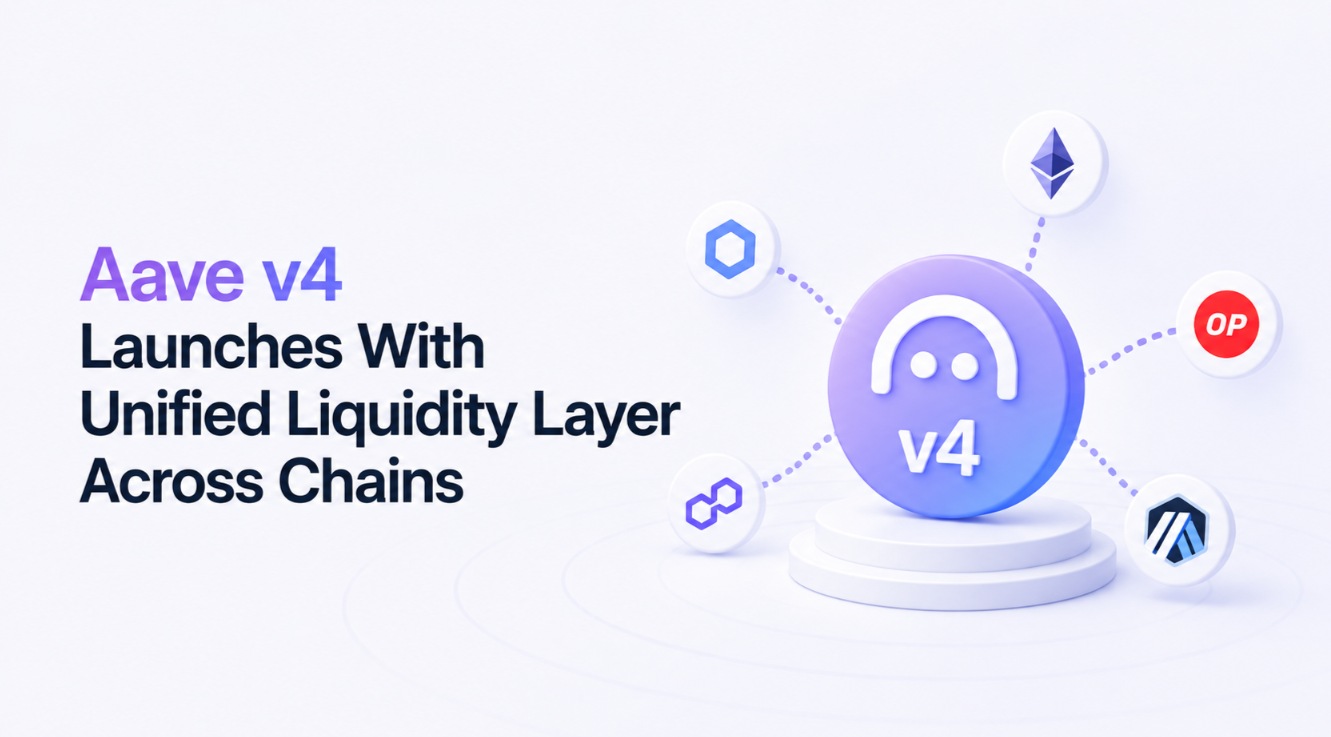
Aave v4 Launches With Unified Liquidity Layer Across Chains
Aave v4 replaces the protocol's patchwork of isolated markets with a single cross-chain liquidity hub, betting that consolidation beats the multi-chain land grab that has splintered DeFi lending for two years.

Aave v4 is live, and the headline feature isn't a shiny new asset listing or a temporary yield bump — it's plumbing. The protocol's unified liquidity layer, in development since the DAO first floated the idea back in 2023, sets out to fix a problem Aave itself did plenty to create: liquidity scattered across a dozen semi-isolated markets on a dozen chains, each one competing for the same depositors while quietly bleeding depth to whichever venue offers a marginally better rate that week.
The old model, inherited from v3's Portals and isolated pools, worked well enough when Aave had one or two serious deployments to manage. It stopped working once every L2 with an incentives budget wanted its own Aave instance. Borrowers ended up choosing chains based on where the liquidity happened to sit rather than where they actually wanted to transact, and liquidators had to run infrastructure across a sprawling and uneven set of markets just to keep the system solvent.
How the unified liquidity layer works
V4 collapses that sprawl into a hub-and-spoke design. A central liquidity layer holds the bulk of deposited capital, while chain-specific "spoke" markets plug into it and draw on shared depth rather than maintaining their own isolated reserves. In practice that means a lender depositing USDC on Base is now contributing to the same pool that a borrower draws against on Arbitrum, with GHO — Aave's native stablecoin — acting as the settlement layer that moves value between spokes without requiring a separate bridge hop for every transaction.
Interest rates become dynamic across the whole system rather than fragmented per-market, which should, in theory, tighten spreads and cut the dead capital that sits idle in thin markets nobody is borrowing against. Risk parameters are still set per spoke, so a shock on one chain doesn't automatically cascade everywhere — that's the pitch, at least, and it's the part worth watching closely once real stress hits rather than a testnet simulation.
Why the timing matters
This isn't happening in a vacuum. Morpho and Euler have both been quietly taking share from Aave over the past eighteen months by offering more capital-efficient, purpose-built vaults, and neither has Aave's legacy overhead. A unified liquidity layer is Aave's answer: use scale and brand trust as the moat, since it can't easily out-innovate smaller, more nimble competitors on efficiency alone. Whether depositors care about that distinction as much as the protocol hopes is an open question.
The obvious risk is concentration. Pooling liquidity that used to sit in separate, walled-off markets means a bug or an oracle failure in the shared layer has a bigger blast radius than a bug confined to one isolated pool. Aave's engineering team has leaned hard on the security review process for this release — multiple audits, a public bug bounty extension — but unified liquidity is, structurally, a bet that centralizing risk management beats distributing it, and that bet hasn't been tested at scale yet.
There's also a governance question lurking underneath the technical one. Aave DAO has a mixed record on shipping complex upgrades on schedule, and v4's rollout will require migrating meaningful TVL out of v3 markets that still work fine and that plenty of depositors have no urgent reason to leave. The protocol is offering migration incentives to smooth that over, which tells you the team expects inertia to be the biggest obstacle, not the code.
Watch the migration numbers over the next two quarters rather than the launch headlines. A unified liquidity layer only proves its worth if capital actually consolidates into it; if v3 markets keep humming along at meaningful TVL a year from now, v4 will have shipped a better architecture that the market simply didn't bother to use.